Saturday, April 18, 2020

Backyard Visitors

One of the advantages of working from home is that my office window looks over the backyard and I see the birds that come to visit. Mostly it's the usual suspects, sparrows, chickadees, magpies, and crows. Last summer a white pigeon perched in a tree in our backyard most days. The other day it was the neighborhood Merlin with breakfast (looked like a sparrow).

Yesterday was a pair of Blue Jays. Usually I hear them before I see them, but this pair was being quiet for a change. They hung around for a while so I got my camera and opened my window (thankfully the weather has warmed up!) However, they weren't very cooperative subjects. They'd perch in a perfect position, I'd line up for a shot, and they'd move. Patience is the name of the game, but theoretically I was working, so how long do I wait for the stars to align? I compromised, alternating watching and working. Finally I got a few shots. They really are quite beautiful birds. And they seem to be getting more common these days.

Blue Jay

Blue Jay

Blue Jay

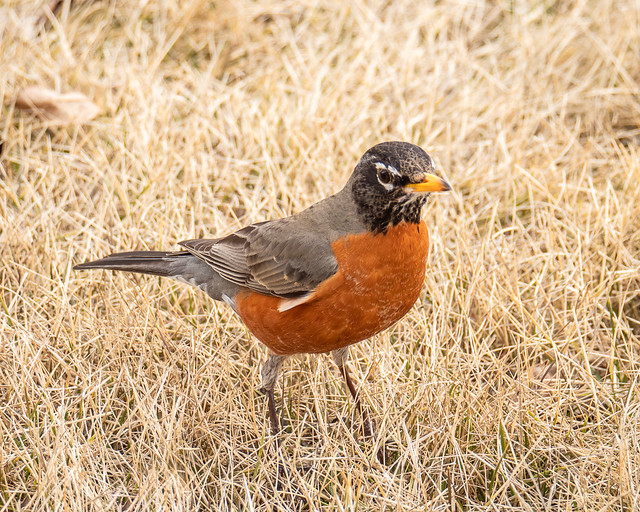
Of course, since I was watching, I noticed other birds, like this bright red robin. I realize the one I photographed the other day must have been a juvenile with its lighter mottled breast.

Robin

There were also some House Sparrows around. They may be common and non-native (introduced from Europe in the 1800's), but I still like them.

House Sparrow (male)

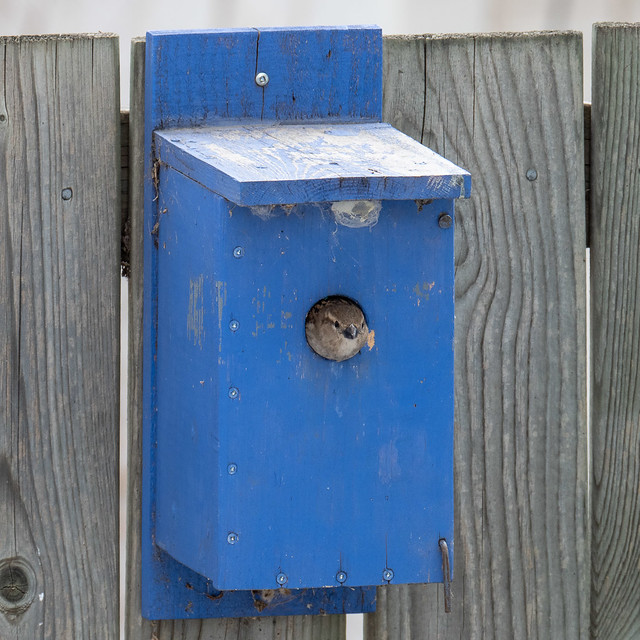
Of course, spring is the time for raising a family. And this pair of sparrows appeared to be moving into one of our birdhouses. Do you think she's impressed by his singing?

House Sparrow pair

House Sparrow (female)

House Sparrow (female)

House Sparrow (female)

House Sparrow (female)

See all 14 photos in this album

Sunday, April 12, 2020

Riverside

It's was a beautiful sunny warm day (rare lately), so I headed out for another walk along the riverbank with my camera.

I was going out through our backyard to get to the alley when I saw movement out of the corner of my eye. I turned and it was one of our neighborhood jackrabbits. We see their tracks in our yard all the time, but seldom see them in person. I wasn't really ready to start taking photos, but luckily it stayed frozen in place long enough for me to get a few shots before it dashed out the back gate and down the alley at high speed. It was a bit unusual to see one in the middle of the day, usually it's morning or evening when I see them.
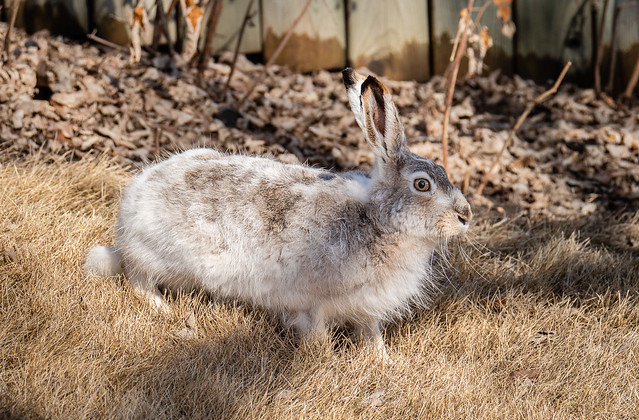
jackrabbit

I continued on down to the river. Just as I got there I slipped on some ice and sat down in the snow. I've been running in these icy conditions for the last two months and haven't fallen yet. Of course, then I'm paying attention to my footing, whereas here I was paying more attention to looking for birds. It was a soft landing and I was fine, but my camera also landed in the snow! It's theoretically weather-proof but I would prefer not to test that. I wiped off the snow and cleaned the lens as best I could with a handkerchief that wasn't the cleanest. Not the most auspicious start to a photography session!

I heard my first subject before I saw it. A crow was caw'ing loudly in a tree above my head.
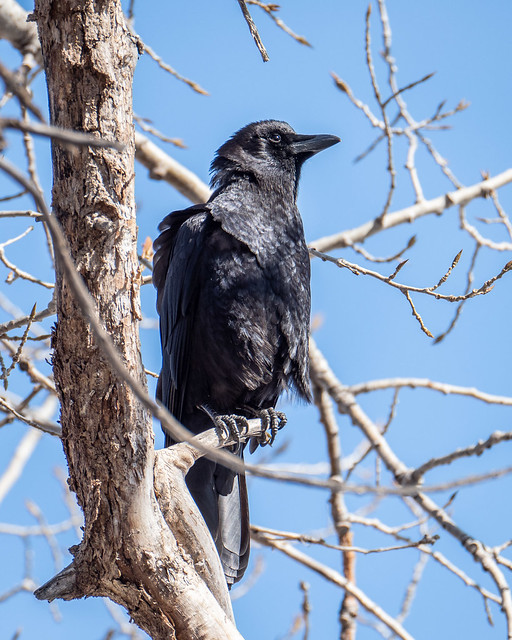
crow

There were some of the winter Goldeneyes still on the river but they were too far away even for my telephoto lens. But it didn't take long to find some closer Mallards and Canada Geese. The problem was that I was headed south, almost straight into the sun. So I couldn't see the birds very well with them silhouetted, whereas they could easily see me coming. I needed to turn the tables so I headed back to the path, walked up river a ways and then worked my way north with the sun at my back.

I found one pair of Mallards sleeping next to shore. I gradually worked my way closer to them, stopping every few feet to take more shots and let them get accustomed to me. A couple of times they got a little nervous, but they must have decided I wasn't a threat. They did open their eyes to look at me each time I moved. But then they'd slowly close again. Curiously, it looked like they had a white eyelid.

let sleeping ducks lie

Sometimes I felt it was a stare down. But they can't have very good vision straight ahead since it's looking out the edge of each eye. On the other hand, it's the only way they'd get stereo vision which might help judge how close I was.
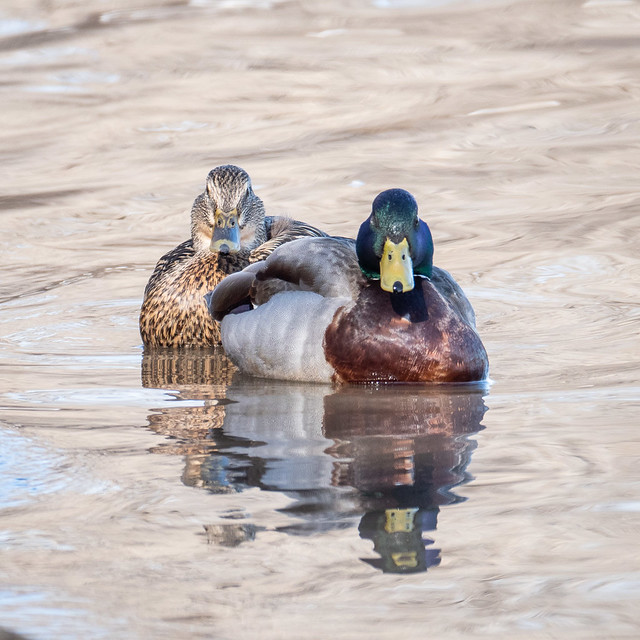
stare down

They seemed like a close couple, never getting very far apart.
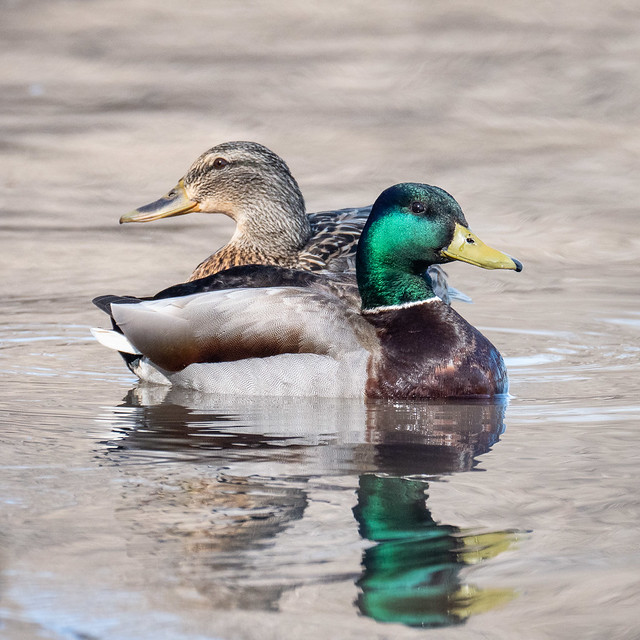
Mallard pair

Although the males have the flashy iridescent green heads, the females are almost prettier. (I'm sure the males agree.) If you saw them separately there wouldn't be many clues (to me, at least) that they were the same species.

Mallard pair

female Mallard

Of course, there were also Canada Geese around. I hate to admit it, but I've taken so many photographs of them that it's hard to get excited about taking more. They are a bit challenging with the mix of white and black on their heads. It's hard to get a good exposure of both.

Canada Geese


Canada Goose

The smooth water and partial clouds made good background reflections.

It was also good to see the buds developing on some of the trees. The sap must be starting to flow since you could see tiny drops oozing around the buds.

buds on the trees

I could hear the chickadees but they were hard to spot, even with the bare tree. And even when you did spot them, they seldom sat still long enough to photograph, and they were often obscured in the bushes. I caught this one just as it was flying away, with his beak open, probably making its distinctive "chick a dee dee dee" call.
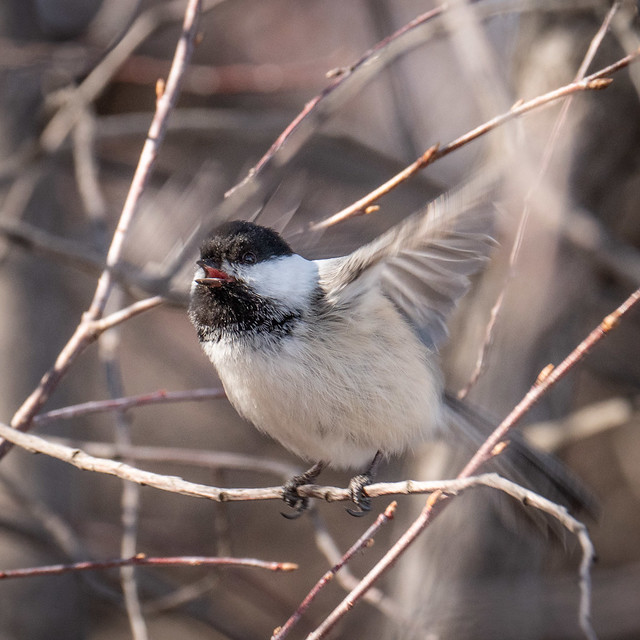
Chickadee

I was back on the paved trail and putting my camera away when I saw movement in the tree beside me. It was a robin, the first I'd seen this spring. And it even cooperatively stayed in one spot while I got my camera back out and took its photo.

Robin

See all 31 photos in this album

Saturday, March 28, 2020

Close to Home

icicles

Thankfully we can still go outside during our isolation. Photography gives me an excuse to go for a walk. Or alternately, something to do when I go for a walk. (Somehow just going for a walk seems too sedate - something old people do. I'm still in denial about being one of them.)

For a change I headed out with my "old" camera (Nikon 7200) and my "big" lens (Sigma 150-600). (I'd really like to get the big lens for my new Olympus E-M1 but I can't really justify the high cost.)

I was thinking I'd take pictures of sparrows and chickadees since we've had lots at the bird feeder. But I didn't see a single one. I've also been hearing woodpeckers pecking and blue jays calling but I haven't managed to spot them. The only birds I saw were Mallards and Canada Geese.

I love the purple on the female mallards wing. You don't normally see it. Funny how some birds run on the water to take off. If it was me, I'd be focusing on my launch, but it's obviously automatic enough for her that she can keep an eye on me at the same time.

duck takeoff

The big pink tongue seems incongruous in a bird. It was a challenge to hold the long lens steady (even with a monopod) and catch the goose squawking. This was the only shot that worked out. I assume this is a couple (they mate for life) but I'm not sure if it's the male or the female being vocal.

Canada Geese

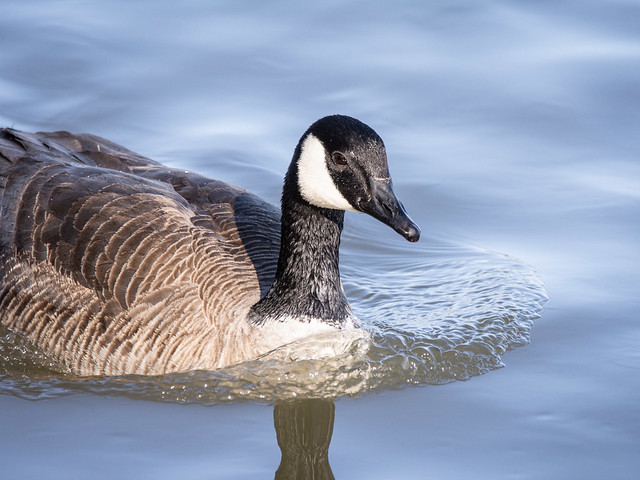
A nice portrait. I like how the water is pushed in front.

Canada Goose

I ended up taking more photos of icicles than birds. A long telephoto doesn't seem like the right lens, but sometimes it's tricky to get close to the icicles so it actually worked quite well. There are lots of icicles but the trick is to find them in a good setting with a decent background.

icicles

I love the shapes formed by the waves and water level changes.

icicles

icicles

I like a blue tint on ice photographs. Often that comes naturally. But if the ice is dirty converting to black and white helps. So then I'll add some split toning to restore the blue. Even when the blue isn't really obvious (as above), it makes quite a difference compared to the straight black and white that looks too "warm" for the subject.

A few days later I went out again, this time with the Olympus and the 12-200 lens (24-400 equivalent). Definitely a lot smaller and lighter than the Nikon with the big lens! (It's a bit frustrating to switch cameras - my fingers automatically go to controls for the wrong camera.) Again, I ended up taking mostly ice photos.

The melting conditions had formed layers in the snow, with icicles between the layers. (I discovered this by suddenly crashing through the knee deep layers.)

icicles

ice

I managed to extract a piece of ice from one of the layers and propped it up to photograph. Interesting patterns from the ice crystals melting and refreezing.

ice

Some of the broken chunks were interesting, but hard to photograph. My black glove helped separate this one from the background.

ice jewels

Water dripping from the ice shelves above formed icicles on the bushes below.

icicles

This was melt water running over dead leaves and for some reason forming bubbles.

bubbles

Walking up the back alley to get home, I noticed interesting patterns in the water flowing over the asphalt. Small things to amuse small minds, as my father would say. (I see that's attributed to Doris Lessing, an English writer. Amusingly, she's also quoted as saying "There is nothing more boring for an intelligent woman than to spend endless amounts of time with small children.")

water on asphalt

water on asphalt

water on asphalt

Interestingly, I didn't add the blue in these, it's just from being in the shade. Our eyes automatically adjust to this kind of color shift so we normally don't notice it until it's taken out of context in a photograph.

See all 23 photos in this album

Sunday, March 08, 2020

Puerto Vallarta botanical gardens

One of the things we wanted to do when we were in Puerto Vallarta was visit the botanical gardens. But they are about a 30 minute drive south of town and we had already returned our rental vehicle. A taxi was expensive but easy, the bus was cheap but not as convenient. We compromised and took a taxi out there, straight from our hotel, and took the bus back. That way we didn't have to go looking for the bus stop on the way there. It was easier to find our way from the bus stop back to the hotel afterwards.

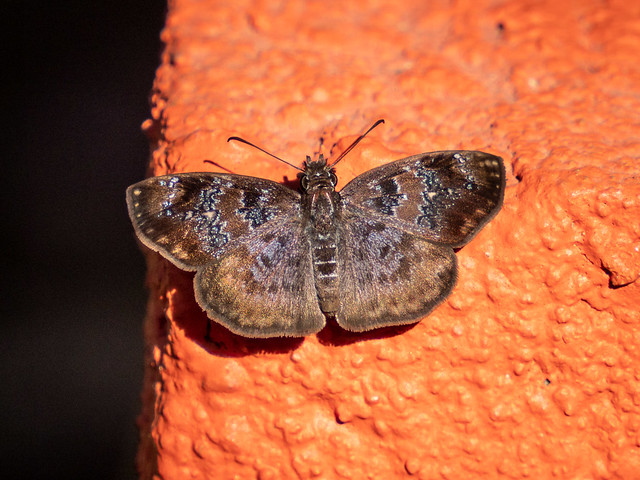
I ended up taking more photos of insects than plants. There were lots of butterflies, although as usual most of them didn't sit still long enough to photograph.

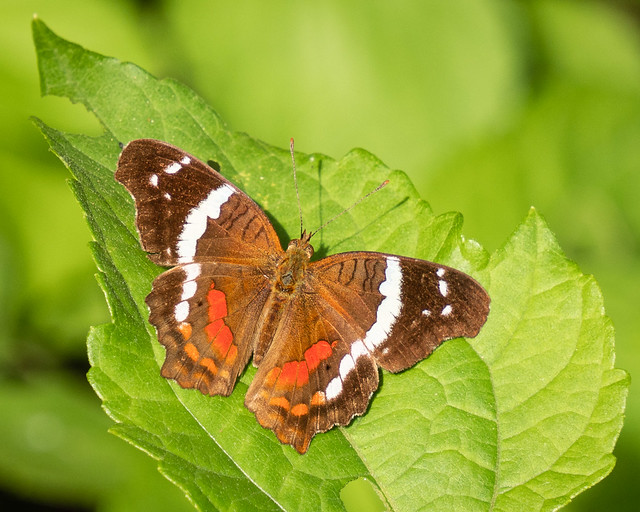
Banded Peacock butterfly

Blue-studded Skipper butterfly

clearwing butterfly

butterfly on flower

Of course, with all the flowers, there were also lots of bees. This one was hovering over this flower so long that I was able to get a shot of him doing it.

bee visiting flower

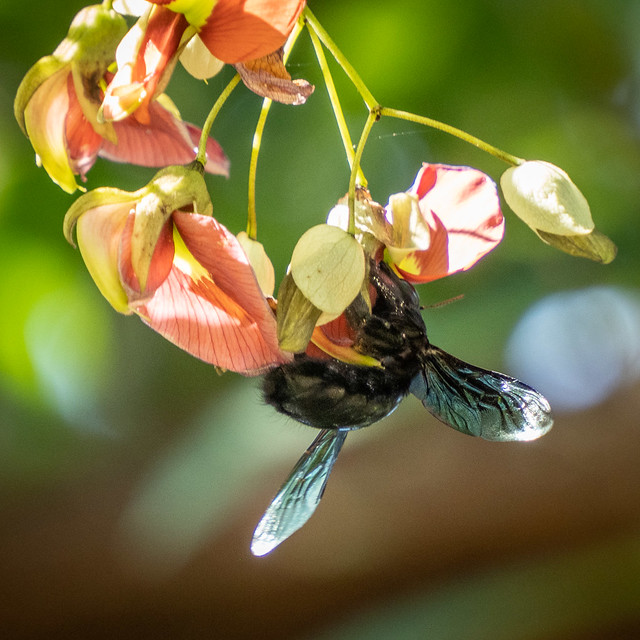
It's not a great photo, but I'm always impressed by huge carpenter bees with their iridescent wings.

Mexican Carpenter Bee

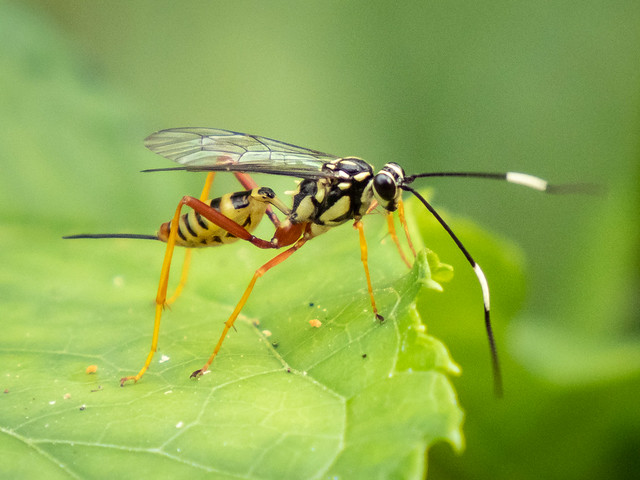
I photographed this wasp as it was walking around on the leaves. The leaves had holes in them, so presumably something like caterpillars were around. That might have been what it was looking for. The large "stinger" is probably its ovipositor, for laying eggs.

wasp

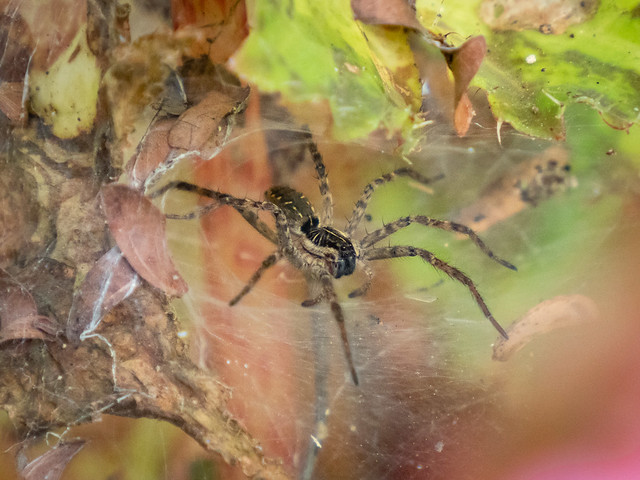
There were lots of spider webs on the plants. These wolf spiders had funnel type webs:

Wolf spider

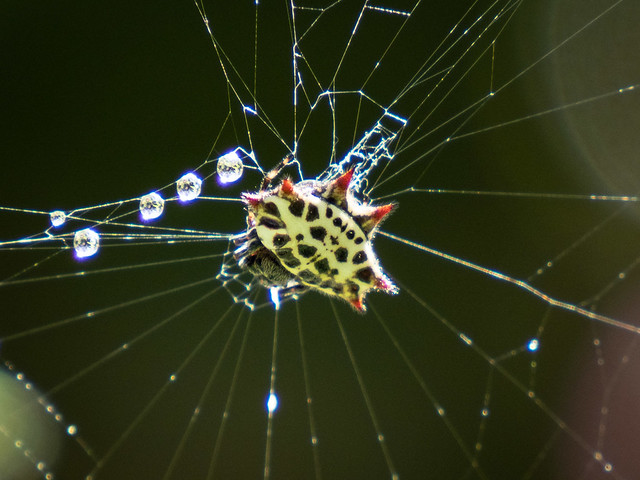
These ones are tiny (the size of a kernel of corn) but quite fancy.

spider

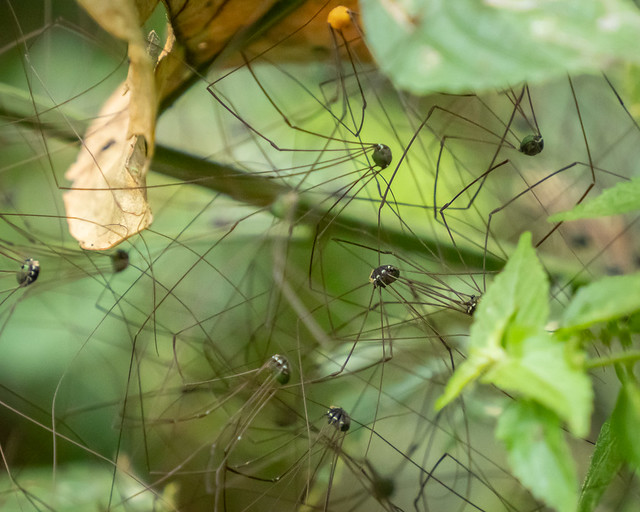
At first I thought it was the wind moving the leaves. It turned out to be a mass of harvestmen (daddy longlegs). If something disturbed them (like waving your hand near them) they would all start moving. A few of them were bright yellow-orange. I'm not sure if that was one of the sexes or if it was a different kind.

mass of Harvestmen

The gardens are a mixture of fairly wild areas with narrow dirt trails, along with more developed areas with paved paths and greenhouses. There is quite a large area that is a vanilla "plantation". Vanilla plants are a type of orchid. The natural pollinators are rare or nonexistent so they are hand pollinated. Most of our vanilla comes from species that originated in Mexico, although it's now grown other places. There were also cacao trees. The pods, roughly pineapple sized, contain the cocoa beans used to make chocolate.

cocao pods

I always like the bright colors and interesting shapes of the heliconias.

Heliconia

Heliconia

An interesting flower. Are the purple parts the actual flowers?

flower

Not as exotic, but I always like the bright colors of water lilies. They almost look like they are lit from inside.

water lily

There were birds (and bird watchers) around, but I didn't have much success photographing them. We heard this bird but couldn't see it at first. Eventually Shelley spotted it. It's an Elegant Trogon. Not a great photograph, but good enough to get an id.

Elegant Trogon

There were also Great Kiskadees. They're a kind of flycatcher, but "Great Kiskadee" sounds more impressive.

Great Kiskadee

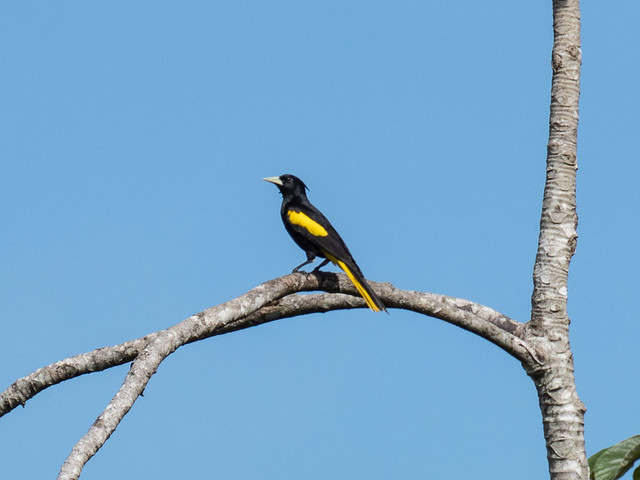
I had a hard time identifying these Yellow-winged caciques because the bird app I normally used (iBird) didn't include them.

Yellow-winged cacique

They were eating the flowers on one kind of tree.

Yellow-winged cacique

There are a pair of resident macaw parrots. We saw them flying overhead, but never got a close look.

There were signs strongly recommending insect repellent. We had brought some but hate using it unless we have to, so we decided to wait and see. I was quite surprised that we didn't encounter any mosquitoes. But when we got back to the hotel we found we had bites of some other kind on our legs (we were wearing shorts) that were quite irritating for several days. I'm not sure what kind of insect it was since we hadn't noticed them biting us at all. I guess we should have paid attention to the signs!

And now we're back in Saskatoon where it's still winter. No flowers or insects here for a while.

See all 47 photos in this batch