Showing posts with label 2020-mexico. Show all posts

Sunday, March 08, 2020

Puerto Vallarta botanical gardens

One of the things we wanted to do when we were in Puerto Vallarta was visit the botanical gardens. But they are about a 30 minute drive south of town and we had already returned our rental vehicle. A taxi was expensive but easy, the bus was cheap but not as convenient. We compromised and took a taxi out there, straight from our hotel, and took the bus back. That way we didn't have to go looking for the bus stop on the way there. It was easier to find our way from the bus stop back to the hotel afterwards.

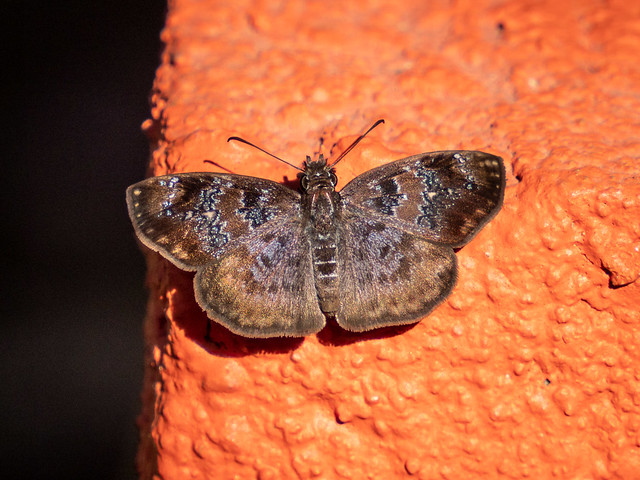
I ended up taking more photos of insects than plants. There were lots of butterflies, although as usual most of them didn't sit still long enough to photograph.
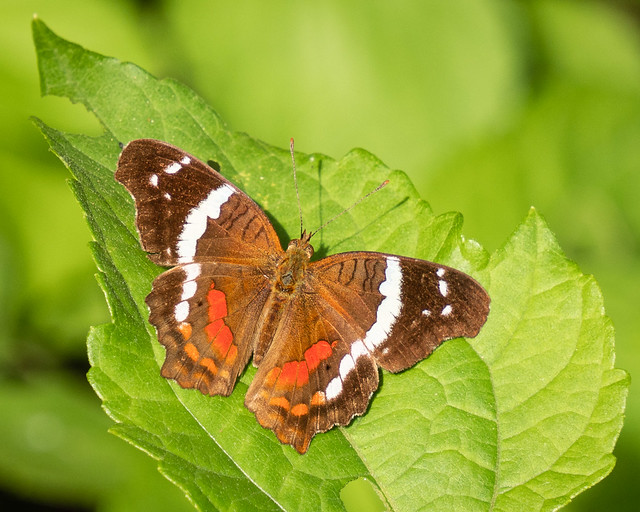
Banded Peacock butterfly

Blue-studded Skipper butterfly

clearwing butterfly

butterfly on flower

Of course, with all the flowers, there were also lots of bees. This one was hovering over this flower so long that I was able to get a shot of him doing it.

bee visiting flower

It's not a great photo, but I'm always impressed by huge carpenter bees with their iridescent wings.
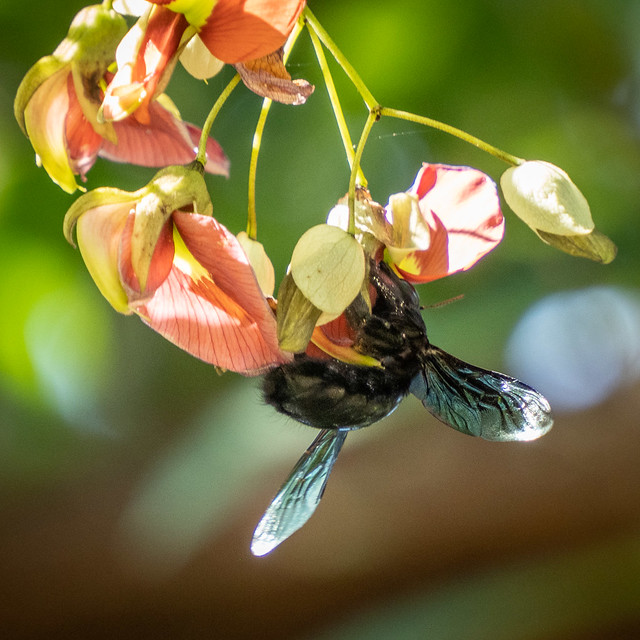
Mexican Carpenter Bee

I photographed this wasp as it was walking around on the leaves. The leaves had holes in them, so presumably something like caterpillars were around. That might have been what it was looking for. The large "stinger" is probably its ovipositor, for laying eggs.
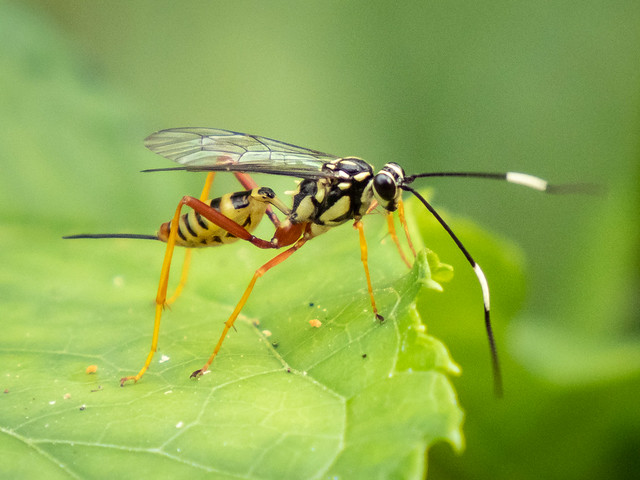
wasp

There were lots of spider webs on the plants. These wolf spiders had funnel type webs:
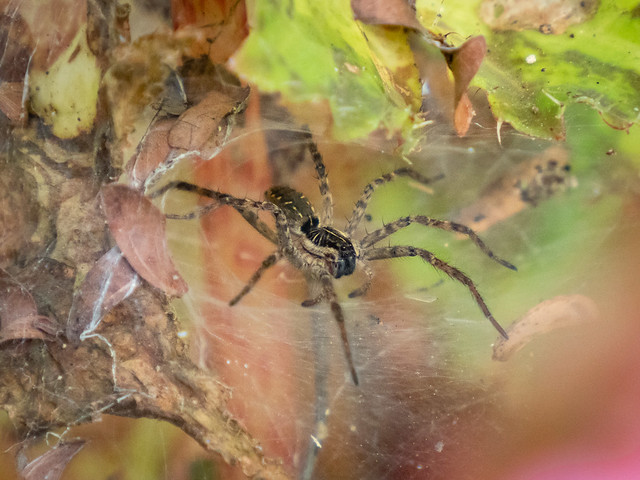
Wolf spider

These ones are tiny (the size of a kernel of corn) but quite fancy.
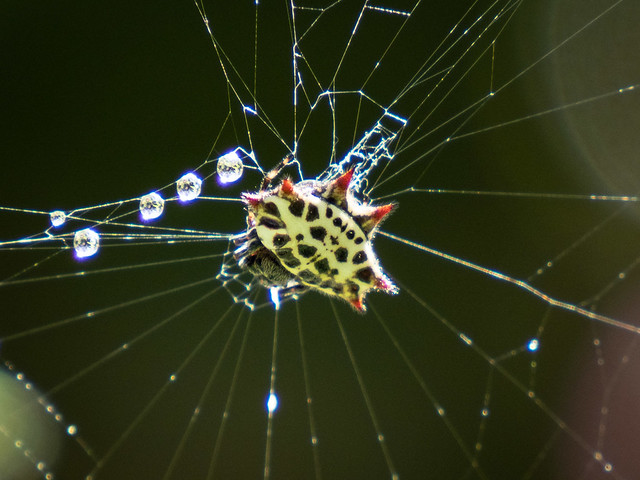
spider

At first I thought it was the wind moving the leaves. It turned out to be a mass of harvestmen (daddy longlegs). If something disturbed them (like waving your hand near them) they would all start moving. A few of them were bright yellow-orange. I'm not sure if that was one of the sexes or if it was a different kind.
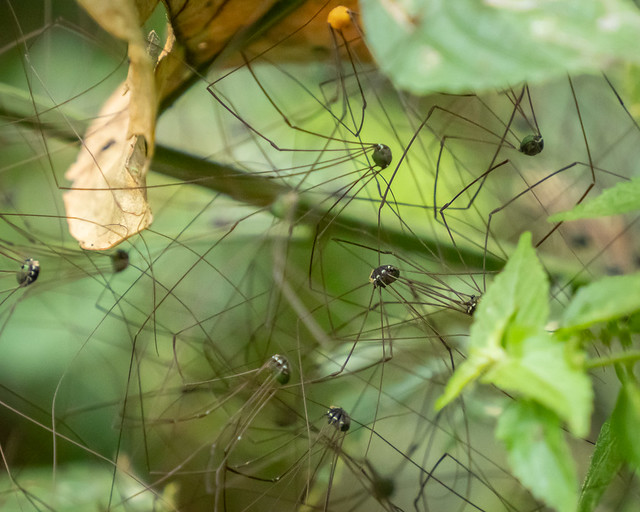
mass of Harvestmen

The gardens are a mixture of fairly wild areas with narrow dirt trails, along with more developed areas with paved paths and greenhouses. There is quite a large area that is a vanilla "plantation". Vanilla plants are a type of orchid. The natural pollinators are rare or nonexistent so they are hand pollinated. Most of our vanilla comes from species that originated in Mexico, although it's now grown other places. There were also cacao trees. The pods, roughly pineapple sized, contain the cocoa beans used to make chocolate.

cocao pods

I always like the bright colors and interesting shapes of the heliconias.

Heliconia

Heliconia

An interesting flower. Are the purple parts the actual flowers?

flower

Not as exotic, but I always like the bright colors of water lilies. They almost look like they are lit from inside.

water lily

There were birds (and bird watchers) around, but I didn't have much success photographing them. We heard this bird but couldn't see it at first. Eventually Shelley spotted it. It's an Elegant Trogon. Not a great photograph, but good enough to get an id.

Elegant Trogon

There were also Great Kiskadees. They're a kind of flycatcher, but "Great Kiskadee" sounds more impressive.

Great Kiskadee

I had a hard time identifying these Yellow-winged caciques because the bird app I normally used (iBird) didn't include them.
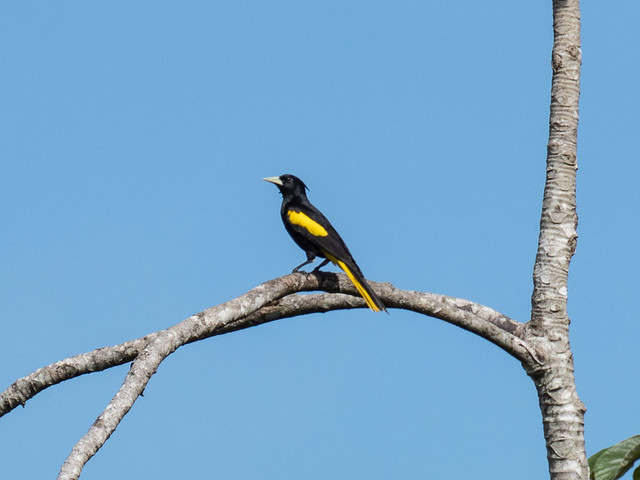
Yellow-winged cacique

They were eating the flowers on one kind of tree.

Yellow-winged cacique

There are a pair of resident macaw parrots. We saw them flying overhead, but never got a close look.

There were signs strongly recommending insect repellent. We had brought some but hate using it unless we have to, so we decided to wait and see. I was quite surprised that we didn't encounter any mosquitoes. But when we got back to the hotel we found we had bites of some other kind on our legs (we were wearing shorts) that were quite irritating for several days. I'm not sure what kind of insect it was since we hadn't noticed them biting us at all. I guess we should have paid attention to the signs!

And now we're back in Saskatoon where it's still winter. No flowers or insects here for a while.

See all 47 photos in this batch

Wednesday, February 26, 2020

Colima Ecopark Zoo

We noticed that there was an Ecopark in Colima. "ecopark" can mean various things, but this one appeared to be a zoo. We stopped there before paragliding one morning. (Morning is cooler and tends to be less crowded.) It turned out to be quite a good zoo.

I have mixed feelings about zoos, obviously captivity is not ideal. But they do exist, and I love to see and photograph the animals. You can only hope they inspire people to help protect nature.

Scarlet Macaw

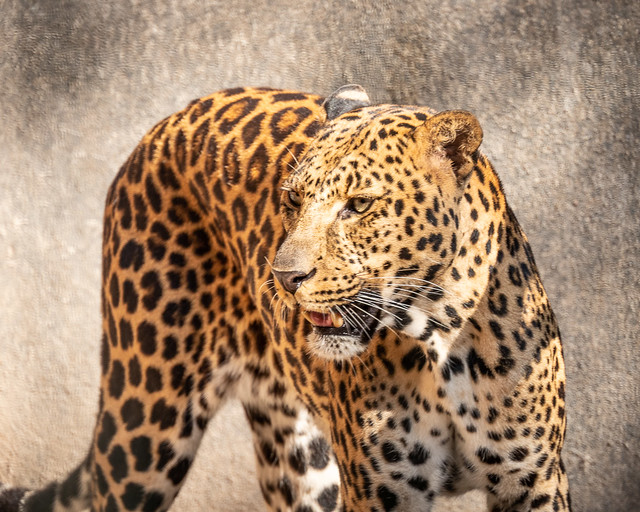
Some of the cages were small and bare, but other enclosures were large with lots of vegetation. Although it is amazing to see them, I feel worst for animals like the big cats.

Black Jaguar

Leopard

Puma (cougar)

Some of the animals, like this capybara, seemed to be roaming the grounds freely.

Capybara

One of the advantages of zoos is that you get to observe animals much more closely than you would in the wild. I love the details like the foot of an ostrich.

ostrich foot

Or a Crowned Crane:

Crowned Crane

Or the patterns of the feathers of a bird:

pattern of feathers

I also like to take "portraits" of animals:

boar

ostrich

turtle

20200218-OMD06429

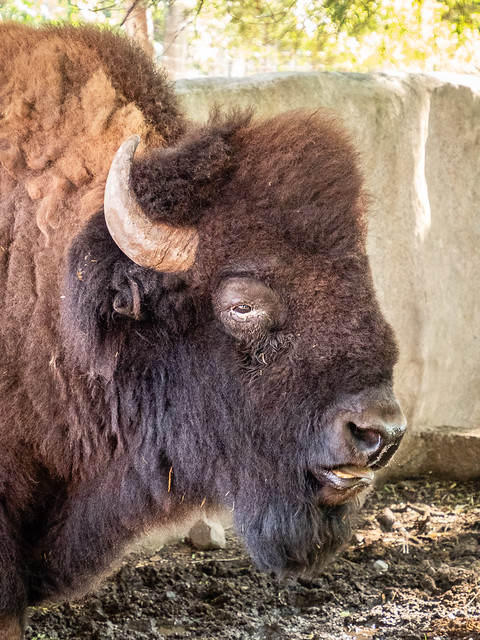
bison

bird

The bird above was inside the walk-in aviary and it took a liking to Shelley. It followed her around, hopping along the railing and flying to land right beside her. It didn't actually touch her, but she was a little nervous to be stalked by a large bird (about the size of a Canada Goose).

The lemurs, iguanas, and monkeys had their own island.

Ring-tailed lemur

iguana

monkey

See all 50 photos in this batch

Friday, February 21, 2020

Paragliding at Colima, Mexico

After diving at Manzanillo we headed inland to Colima where there was another paragliding site. The day we arrived we managed to find the landing zone near Piscila (recognizable by the wind sock). It was a nice big open field next to the road. After Malinche (Tenincingo) I was a little nervous that the landing zone was quite far from launch. But there were some alternate fields where you could land. We tried to drive up to launch, but the road was blocked with traffic cones. We saw some people hiking up though.

It was a bit cloudy the first day I flew. That would slow down the thermals which is usually a bad thing, but I was happy enough to have mellow conditions for my first flight. We arrived early enough that we would have time to hike up but the road was open so we got up to launch quite early. It's an impressive launch - large and covered in artificial turf. You'd almost think you were in Europe.


As expected, the wind was over the back when we first arrived, but around 11am it started swinging around to the right direction. We expected other paraglider pilots to be flying since it's a popular site and it was the weekend. Finally, about 11:30 a truck load of pilots showed up. Several of them made a point of coming to talk to us and giving us an introduction to the site. They obviously had the timing figured out because pretty much as soon as they arrived, they launched.

It was nice to see where they went and where they got lift. Once they were all launched I followed. No one was getting very high, but there were enough light thermals to stay up and get a bit above launch. Often we (paraglider pilots) use clouds to find thermals (the rising moist air often turns into a cloud). But here, because it's dry, the skies are often clear with no clouds to mark the thermals. Instead, the trick is to look for the vultures (turkey and black). They prefer not to exert themselves any more than necessary, so they also look for thermals, and are often better at finding them. At one point I was circling in a thermal along with a vulture. As well as helping me stay in the lift, it also helped me see the turbulence. When I saw it's wings getting rocked from side to side I knew I'd be hitting the same rough air in a few seconds.

I was thermaling with one of the local pilots and when the thermal ran out, he headed out front. I figured he probably knew better than me, so I followed. Unfortunately, we didn't find any lift. The other pilot managed to circle back and presumably stayed up, but I was low enough that I figured I'd better head for the LZ. I could see another pilot packing up in the field before the LZ. Presumably they hadn't quite made it. But I had plenty of height to reach the main field and make a good landing.

I could see people in the shade under a tree in the corner of the field by the road. I kited my wing the rest of the way across the field towards what I assumed were other pilots. It turned out to be a couple of local kids who didn't seem all that impressed with my kiting skills :-)

The next day was even busier with other pilots, and a couple of tandem flights. Although it was clearer, conditions were light and everyone was waiting. Finally, around 1pm everyone got in the air.


There was an alternate landing area that you could reach if you got high enough and that was my goal for the day. From what other pilots had told me, I figured I needed at least 300m (1000ft) of height over launch. I found various thermals, and at one point I got 270m up. I considered going for it, but decided to stick to my cutoff. Shortly after I found a stronger thermal and was 300m up and still rising. At about 400m up I didn't track the thermal quite right and hit the turbulence at the edge of it. Since it was a fairly strong thermal, it bounced me around a bit and I chickened out and left it. (Generally you want to stick with thermals as high as you can get.) With 400m I figured I had lots of height to get to the other LZ. The first part crossed the river and a bunch of forested area where it wouldn't be pleasant to land. There should have been more thermals on the way across, but I didn't find anything. It soon became obvious I wasn't going to make the LZ but there were other fields I could land in. When I got closer, I saw another pilot had landed in one of the fields so I headed there. Another pilot was also approaching the same field. Obviously I wasn't the only one to not find lift. Despite not quite reaching my goal, it was fun to do a tiny bit of cross country.

The next day we decided to hike up to get some exercise. It took about 45 minutes and was a nice hike except that it was already very hot. (Temperatures were over 30c during the day.)

hiking up the cobblestone road with my paraglider
It was Monday so we weren't sure if there would be any local pilots or not. It was windier and I was afraid it might get too windy to fly if I waited too long, so I launched on my own. The thermals weren't as good (probably because it was earlier, and the wind tends to disrupt them). So I ended up with a sled ride to the Piscila LZ. As I was packing up I saw four more paragliders launch. While they didn't have incredible flights, they stayed up a lot longer than I did. Maybe I should have waited a bit longer. Of course, it might have been a question of skill rather than conditions.

checking the wind speed
Tuesday morning we went to the zoo first and then drove up to launch. When I first got out of the car I thought it was less windy but when we got out in the open on launch I realized it was even windier than the day before. Judging wind speed is hard, especially gusts versus lulls so I got out my wind meter. The average was ok but the gusts were hitting 32 km/hr. That's about the speed of my wing so if it picked up much I'd go backwards (not what you want). We hung around for a while to see if any other pilots showed up. No one did. I checked the wind again, thinking maybe it had slowed down. No, the gusts were now 37 km/hr. We headed down.

Photos thanks to Shelley

Tuesday, February 18, 2020

Scuba Diving in Mexico

We wanted to get in some scuba diving while we were in Mexico. We took our own gear with us because rental gear isn't always the best (which is a safety issue). Although the better diving is probably on the Caribbean side, we didn't want to drive that far so we stuck to the Pacific side. One of our favorite dive areas is the Sea of Cortez near Baja Mexico and we hoped there would be some similarities.

The first place we tried was Zihuatenejo. Although the young staff at the Zihuatenejo Dive Center were friendly and helpful, I was a little concerned when the dive master didn't know what a nudibranch was. Maybe it was just a language issue since he was from Germany. I didn't take my underwater camera the first day since I wanted to keep things simpler for the first dives. Unfortunately, that was the day we did shallow dives with little current, which would have been good for photography. Whereas the second day, when I did take my camera, the dives were deep with enough current to make holding still to take photographs almost impossible. Both days the visibility was quite bad, the worst we've encountered for quite a while. On the positive side, there was a lot more hard coral reef than I was expecting. There isn't much around Baja, and most of the reefs are on the Caribbean side. We did see a large seahorse on the first day. We've only ever seen tiny ones before so that was nice. It would have been nice to have my camera, although it wasn't in a very good spot to photograph. It was reddish and 4 or 5 inches long. I assume it was a Giant (or Pacific) Seahorse. We also saw a sea turtle, but with the low visibility it disappeared rapidly. We also saw a nice school of what they called "sardines".

school of sardines

Unfortunately, with the worst possible timing, I caught a cold right when we started diving. The second day of diving I knew I was coming down with something but I thought I could manage. Although I did ok with equalizing on the first dive, the second one gave me a massive sinus headache. After that I gave up on diving till my cold was over. Shelley went out again a third day without me. We had originally planned for four days of diving, but there weren't that many dive sites and the visibility was bad so we decided to move on.

A few days later in Manzanillo we hooked up with Octopus Garden Dive Center. We had chosen a hotel right close to the dive center (Hotelito Escondido - recommended). Although this area wasn't "downtown", it was right on the beach and had a good assortment of restaurants.

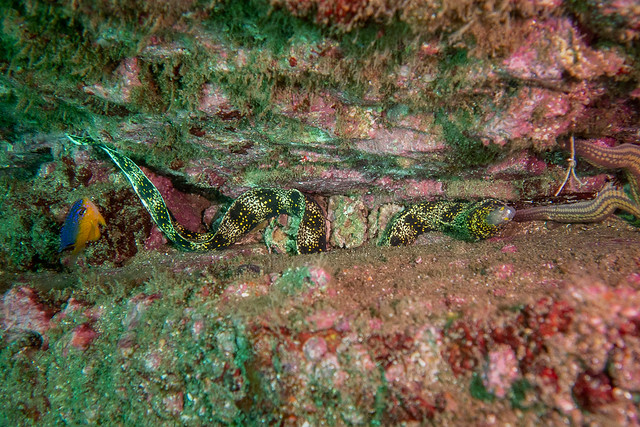
We saw five different kinds of eels, including a couple we hadn't seen before:

Zebra Moray Eel

Snowflake Moray Eel

Tiger Snake Eel

Jewel Moray Eel

We only saw a few nudibranchs which I think were all Red-tipped Sea Goddesses. I only managed a decent photo of one. (It's less colorful than the one I photographed in Belize)

Red-tipped Sea Goddess (nudibranch)

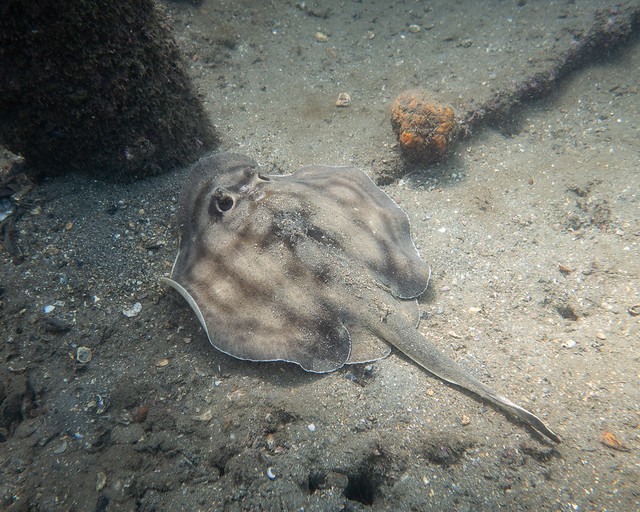
There were lots of stingrays around. I think most of them were Bullseye Round Stingrays like this one.

Bullseye Round Stingray

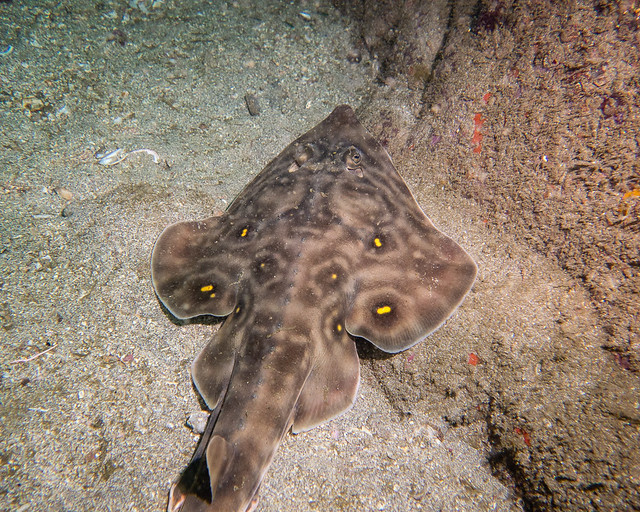
We also saw this Southern Banded Guitarfish. Guitarfish are sort of a cross between a stingray and a shark. I like the bright yellow spots.

Southern Banded Guitarfish

Usually we only see one or two Moorish Idols at a time, so it was interesting to see this larger group. You can get an idea of the visibility from the background. There was a lot of swell at this point so I shot a bunch as I got pushed around and managed to get this one half decent shot.

Moorish Idols

Porcupinefish have such big eyes with interesting flecks in them. This one seemed curious about me.

Longspined Porcupinefish

I thought this was a different kind of boxfish, but it's just the male colors of the Spotted Boxfish. The females are just black with white spots. (And they can change sex and therefore coloring.)

Spotted Boxfish (male)

Guineafowl Puffers also have two distinct colorings, either a similar black with white spots, or a golden phase (not connected to male/female in this case).

Guineafowl Puffer (golden phase)

Scorpionfish are generally well camouflaged, but this one was almost impossible to see. I spotted one fin and figured out what it must be, but it was still almost impossible to actually see the fish.

spot the scorpionfish

We only saw a single fairly small lobster. I'm not sure if they are naturally uncommon here, or whether most of them have been caught.

Blue spiny lobster (Panulirus inflatus)

I didn't see any Christmas Tree Worms, but there were lots of Feather Duster Worms of various colors.

Feather duster worm

Feather duster worm

The "tubes" you can see in the photo above were probably made by feather duster worms.

Given the poor visibility and the limited dive operations, we probably wouldn't bother diving in this area again. But we were still glad to have got out, and despite the conditions we saw quite a bit of stuff.

See also Shelley's post on our diving

See all 33 photos in this batch