Wednesday, November 04, 2015

Loreto Diving

We're scuba diving for six days in Loreto. This is our fifth trip here over the last ten years, obviously we like it! One of the main reasons we come back is Rafael Murillo at Dolphin Dive. He is a Loreto local and is both very knowledgeable about the sea life, and also very friendly and fun. He has been the manager of Dolphin Dive and the main dive master since we have been coming here. We were happy to find out that he and and a partner have taken over ownership. The first time I came here to dive I was newly certified with only about 10 dives. Rafael did a great job of looking after a bumbling newbie and we've been coming back ever since. With about 200 dives now, I hope we're not quite as much trouble!

dive boat

I still struggle with underwater photography. It's a challenge with the visibility, lack of light, shy fish, everything moving, and trying to operate the camera inside a bulky housing with an awkward external flash. I'm happy if I get the subject in the frame and it's half decently exposed, and more or less sharp. Worrying about nice light and backgrounds and artistic composition is still beyond me. Part of the problem, of course, is that we only dive once or twice a year, whereas I take photos above land all the time. I have to learn from Rafael who takes great underwater photographs.

The sea stars are one of the easiest subjects - they are common, colorful, and don't move! They actually have quite interesting details if you get closeup shots.

sea star

sea star

These little boxfish are quite common, but also somewhat shy.

Spotted  Boxfish

The christmas tree worms are also common but they are hard to photograph close up because if you disturb them they contract and disappear. (A pair of "christmas trees" is a single worm.) As I recall, the movie Avatar had some vegetation that was a lot like these.

Untitled

It's hard to capture the feeling of being surrounded by schools of fish. The Sergeant Majors are one of the most common.

Untitled

Here's a closer look at a few of them.

Untitled

Here are some straightforward "id" shots of different fish.

King Angelfish

Surgeonfish

Butterflyfish

Moorish Idol

The scorpionfish are well camouflaged, but you don't want to step on one since they have poisonous spines. The eyes are easiest to spot in this photo.

spot the scorpion fish

I wonder if this boxfish realizes that the scorpionfish is an ambush predator?

scorpion fish and spotted boxfish

These giant damselfish are quite territorial and will chase away other fish, and even attempt to chase away divers (generally unsuccessfully!) They clear a patch of rock (like the one behind this one) to lay their eggs on.

Giant Damselfish

The porcupinefish are funny looking with their big eyes. They are another shy fish and will swim away as soon as you get your camera ready. Presumably their eyes are so big for night vision.

porcupine fish

Now that Shelley is diving with her GoPro, we both get absorbed by our photography and we enjoy the long slow dives (like when Rafael brings his camera) that give us lots of time to look at things.

Shelley

See all 43 photos as a slideshow or overview

Monday, November 02, 2015

Around Loreto

I am accumulating a pile of underwater photos but until I get through them, here are a few shots from above the water.  I always enjoy watching the brown pelicans hanging around the marina. Unlike our white pelicans, these guys dive from the air into the water to catch fish. It's more like they crash into the water, but occasionally they seem to catch something. Of course, it's easier to photograph them sleeping.

sleeping beauty

Despite their ungainly appearance, they are graceful fliers.

brown pelican

There are also blue-footed boobies around. We saw these in Galapogos as well.

blue-footed booby

And osprey.

osprey

And egrets, also catching fish.

breakfast

And, of course, beautiful views of the ocean.

Untitled

See all 21 photos as a slideshow or overview

Sunday, November 01, 2015

Flying to Loreto

From Santa Barbara we headed to Loreto, about halfway down the Baja peninsula. We've driven down Baja, and taken the bus, but this time we took the easy way and flew from Los Angeles. The terrain you fly over is rocky mountainous desert. I had the usual murky porthole, but I still took lots of photos. The color was washed out so I converted the to black and white. None of them are very sharp, but it was the abstract patterns that interested me.

Untitled

Despite being desert, this land is shaped by water. Very few of these "rivers" had any sign of water in them.

Untitled

Untitled

I'm not sure if this is one of them, but there are also some volcanic peaks in Baja.

Untitled

Around Loreto the countryside was quite green due to some recent rain. It's always surprising how the desert can turn green after rain. We flew past the familiar malecón and marina on our way to land.

Loreto, Baja

See all 9 photos as a slideshow or overview

Friday, October 30, 2015

Mission Santa Barbara

On our last morning in Santa Barbara we visited the Old Mission. Founded in 1786 by the Franciscans, this was the 10th of 21 missions built by the Spanish in Alta (upper) California. The mission has been expanded and rebuilt multiple times over the years. Earthquakes have damaged it several times. (The mission at our next stop, Loreto, is even older. Built in 1697, it is considered the "head and mother of all the Spanish missions in Upper and Lower California.")

Mission Santa Barbara

There is a self guided tour through the grounds and a small museum.

Mission Santa Barbara

Of course, most of my photos were of the plants and animals I saw. I suspect most people touring the mission missed this spider :-)

spider

The mission got it's water from damming a small creek that comes down from the mountains.

fountain

Due to the ongoing drought in California the gardens are gradually being changed to use more drought tolerant plants that require less watering.

cactus

Just as we were leaving several acorn woodpeckers came to drink from one of the fountains. The last time I saw one was also in Santa Barbara, but on the zoo grounds.

acorn woodpeckers

See all 18 photos as a slideshow or overview

Wednesday, October 28, 2015

Santa Barbara Zoo

After paragliding nine days straight we decided to take a day off and go to the zoo. The Santa Barbara Zoo is known as one of the best small zoos in America. It is quite spacious, set in nice gardens. The trees provide welcome shade on a hot day. On a weekday morning it was thankfully fairly quiet. The only negative factor was that the glass walls seemed dirtier than normal. I realize not everyone is trying to take photographs, but presumably everyone is trying to see the animals.

One of the animals you won't see too many places are the California condors. Like the smaller turkey vultures, they are not the prettiest birds, but still impressive creatures. We saw condors flying in the wild in the Colca Canyon in Peru - amazing.

condor

Of course, I'm just as happy to see and photograph the unofficial residents.

bird

The snow leopard was busy sleeping. Their paws are huge!

snow leopard

This duck was splashing up a storm having a bath.

bird bath

The leopard was staring intently at something. (This was through especially dirty glass, but came out well.)

leopard

It's always fun to see the flamingoes and the strange positions they sleep in.

flamingo

I like the wrinkled, textured skin of the american alligator.

american alligator

These little birds (wild) were feeding on grass seed. I haven't had time to look them up - anyone know what they are?

bird

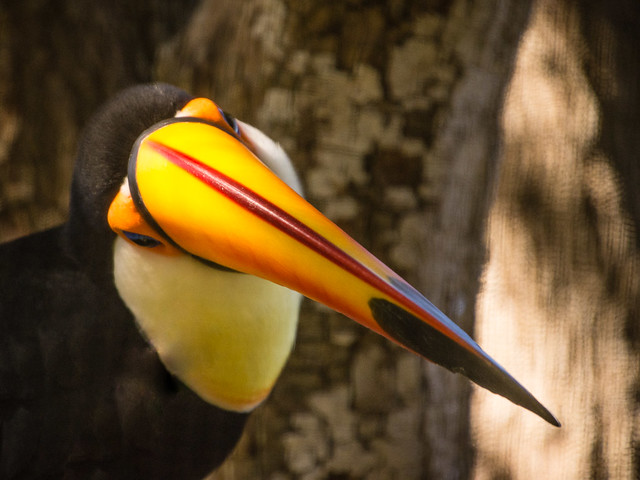
The toucans have such outrageous beaks!

toucan

This snake looks like it's attacking but it was actually just "yawning".

snake

Another of the condors, with a face only a mother could love.

condor

The fennec foxes are much cuter.

fennec fox

See all 48 photos as a slideshow or overview

Tips for photographing at zoos:

  • If your camera allows it, use a larger aperture (i.e. smaller f stop). However, be aware this will make the depth of focus smaller and therefore trickier to get right. (But also puts the background out of focus which is often good.)
  • If your camera allows it, set it to focus on the center spot, rather than automatically picking what to focus on. If what you want to focus on isn't in the center, lock the focus by half pressing the shutter .
  • A decent telephoto lens helps to get closeups when the animals are farther away. (My all purpose travel lens is 18-300mm - effectively 27-450 with 1.5x crop factor)
  • Get the camera close to the glass or fence. Try to aim though the gaps in the fence or through clearer spots in the glass. Watch out for reflections in the glass. A polarizer filter can help cut down reflections but I generally get by without one by being careful about position and angle.
  • A camera with a bigger sensor (e.g. a DSLR) will generally have better low light (high ISO) performance which is a big factor for dim indoor exhibits.
  • Patience helps - waiting for the crowd of school kids to finish smearing greasy palm prints on the glass, or for the animal to move or turn it's head, or come out into the better light.
  • As usual, watch out for the background. Often moving the camera will mean a less distracting background.
  • As usual, shoot lots, especially if the animal is moving. Try different angles and positions.
  • As usual, shooting raw and post-processing with something like Lightroom helps a lot. The new "dehaze" feature of Lightroom is useful for shots through dirty glass. Indoor shots usually need the white balance adjusted, which is harder to do if you just shoot jpegs. Even if you're not shooting raw, post processing can still help.

Monday, October 26, 2015

Santa Barbara 2

A few more photos from an early morning walk around the marina.

marina sunrise

shore bird

brown pelicans

brown pelican

shore bird

See all 12 photos as a slideshow or overview

Thursday, October 22, 2015

Santa Barbara

"The moment one gives close attention to anything, even a blade of grass, it becomes a mysterious, awesome, indescribably magnificent world in itself.”
– Henry Miller

Santa Barbara sunrise

My calves were getting a little sore from the last few mornings running in the New Balance Minimus shoes that I'm traveling with, so I went for a walk with my camera instead. Of course, I couldn't resist a few reflections :-)

mirror image

palm tree reflections

Our neighborhood great blue heron:

neighborhood great blue heron

Untitled

See all 12 photos as a slideshow or overview

Wednesday, October 21, 2015

Backyard Blossoms

The place we're renting in Santa Barbara is just one part of a house, but it has a lovely private courtyard/patio with lots of plants and flowers. There's a fountain where the birds come to drink and wash. And a great blue heron comes and perches in the tall palm trees nearby.

I haven't had a chance to get out and photograph the flowers in the neighborhood, but I did manage a few from around our patio. The passion fruit flower was the first to catch my eye - such showy flowers!

passion fruit

Hibiscus are another favorite, quite common here, in all different colors - orange, yellow, white, red.

hibiscus

And another favorite - bougainvillea.

bougainvillea

I'm not sure what this one is, anyone know?

flowers

See all 8 photos as a slideshow or overview