Showing posts with label baja. Show all posts

Sunday, November 13, 2022

Loreto Diving - Big Stuff

The highlight of our boat trips out to dive sites was encountering two Bryde's whales, a mother and a young one. Bryde's are related to Blue and Humpback whales. Like them, it's a baleen filter feeder. They are "medium" sized, which was still plenty big. Spring is the better whale watching season here, but the water is too cold for pleasant diving. Occasionally we see whales in the fall diving season but it's usually a brief glimpse from a long distance. This time the whales hung around for quite a long time and swam around and under our boat. Even the locals were excited at this extended close encounter.

Bryde's whale

Bryde's whale

Bryde's whale

It's hard to do justice to the encounter with still photographs. Shelley's video gives a better feel.

We were also lucky to see a large group of dolphins on our first day. I didn't have my camera that day, but Shelley got a brief video. We saw individual dolphins other days, but this was the only big group.

Sea lions are a much more reliable sighting. Our first day of diving, Shelley figured we'd be going to the sea lions, a popular dive. But they told us, no, we were going to one of the farther islands. Except the wind turned out to be wrong, so we went to the sea lions after all. Over our eight days of diving we ended up going back to that site several times. It's an interesting area, with intricate rock formations and Blue and Brown footed boobies.

rocks

Brown Booby

Depending on the wind, your first clue that you're approaching the sea lions is often the smell.

sea lions

Sea lions have a curious habit of floating with their fins in the air. This is known as "sailing" and is a way of regulating their temperature.

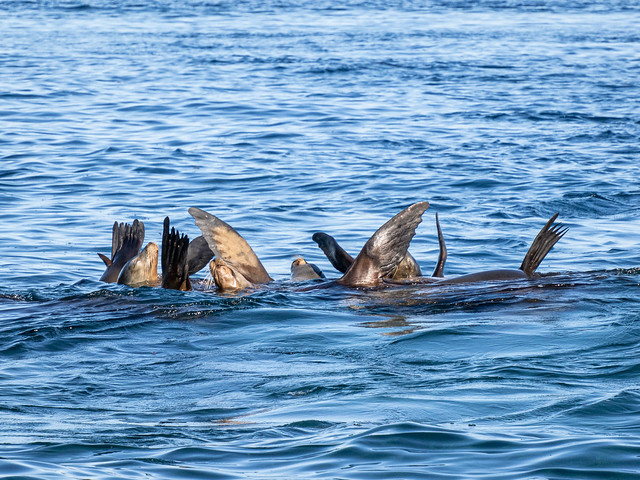
sea lions

sea lions

They don't breed here, so they're quite mellow.
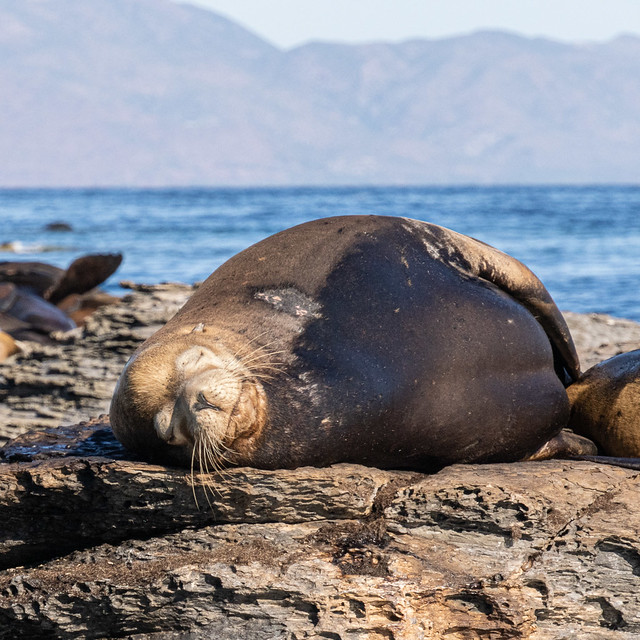
sea lion

It's always fun when they come to check you out underwater. They can be quite curious and inquisitive sometimes. Although having them suddenly zoom by at high speed can be a bit disconcerting.

sea lion

And that wraps up this dive trip. As always we enjoyed Loreto and the underwater world nearby.

Saturday, November 12, 2022

Loreto Diving - Spineless

When I first started diving and people pointed out little stuff like nudibranchs (sea slugs) I was a bit surprised. I was thinking more of fish and sharks and sea turtles. It's like I'd gone to Africa to see the lions and zebras and they'd pointed out a beetle. But it didn't take long before I realized that while a shark might be impressive, there's much more variety in the little stuff, aka the invertebrates. And unlike the big stuff, the little stuff is almost always there. It might not be easy to spot, especially when you're new to it, but once you start looking closely, there's almost always something interesting. A good example of that is when I zoom in on photos on the computer, and I realize that behind the sea anemone I was photographing are a brittle star and a shrimp. Given the variety of these creatures, this is another long post.

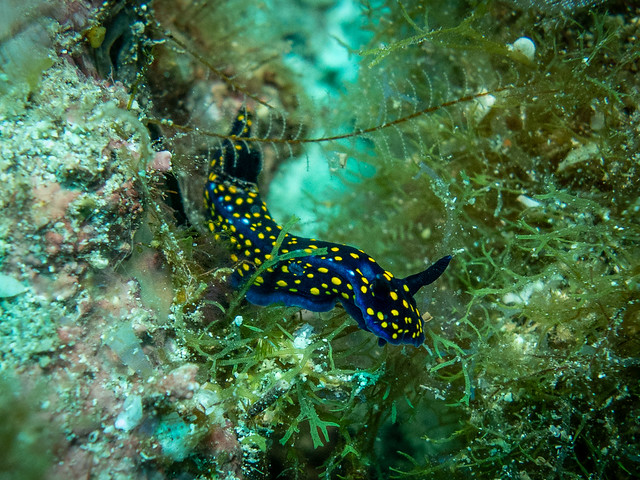
Nudibranchs are a good example. On land, most people have little to no interest in slugs, other than perhaps how to kill them as garden pests. Granted, slugs on land are nowhere near as brightly colored and intricately shaped as slugs underwater. "nudibranch" means "naked lung". Their "lung", the organ they breath through, is external. You can see it on the bottom right of this California Chromodorid.

California Chromodorid

California Chromodorid

Here's a less common Baumann's Chromodorid:

Baumann's Chromodorid

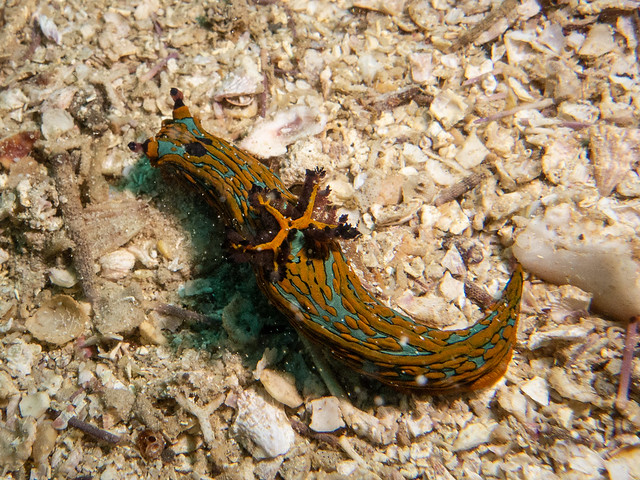
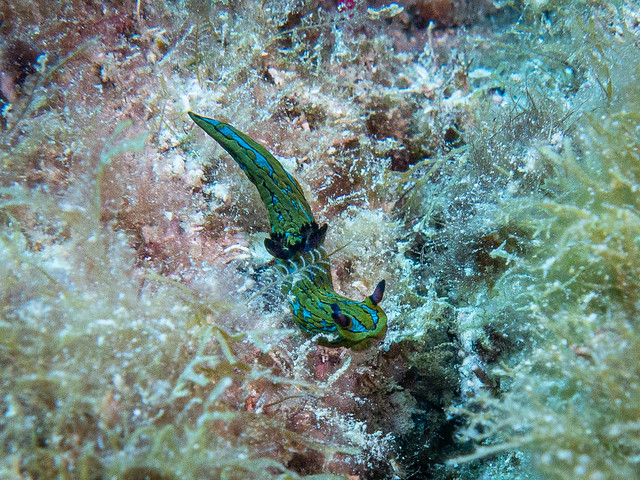
Another relatively common one are the Slimy Slugs. (Their color varies from brown to green.)

Slimy Slug

Slimy Slug

Of course, one of the problems with the little stuff is that it can be quite small. When this one was pointed out I had a hard time seeing what was there since it was only about 1/2 inch long.

Diomedes Sapsucker

Christmas Tree Worms are another colorful form of underwater life. What looks like two creatures is actually one. The "trees" are used to breath and to absorb food. If you disturb them, they instantly withdraw. The bulk of the worm is out of sight. They come in a wide variety of colors, from white to orange to red to blue to yellow. They can be on their own, like this one, or in large numbers covering a rock.

Christmas Tree Worm

Feather Duster Worms are similar but only have a single round "fan".

Feather Duster Worm

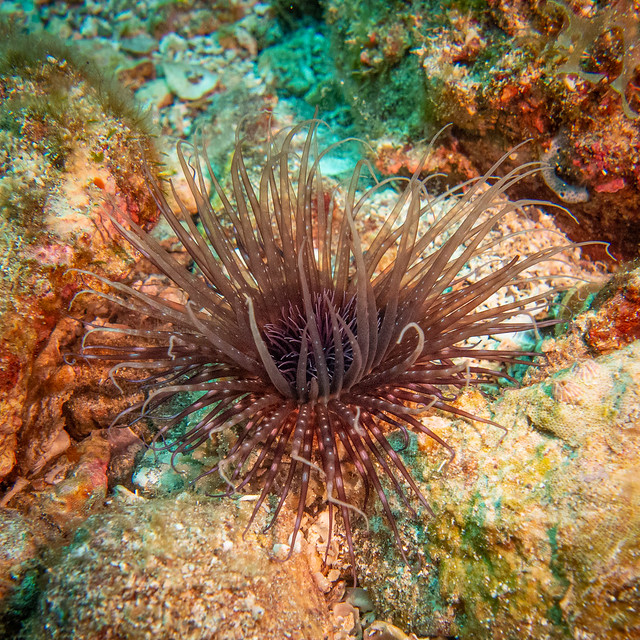
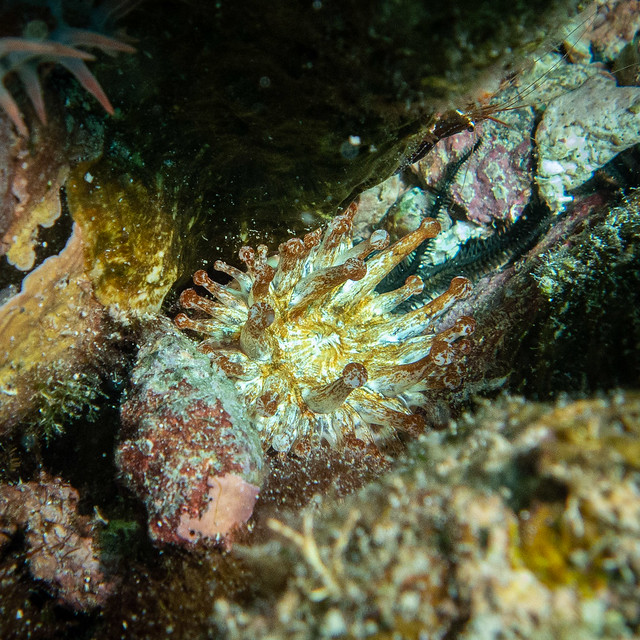
These tube-dwelling anemones come in a variety of colors. I like the ones with the orange centers.

Tube Anemone

Tube Anemone

There are various other unusual anemones around. Although they mostly stay in one place, many anemones can move, although very slowly.

sea anemone

Telmatactis panamensis

Sea anemone

Underwater life can be counterintuitive. What appears plant-like is often an animal, and what appears to be a single thing is often a colony. It's amazing that a colony of creatures like tiny anemones is able to form a structure like a coral. Most of the corals around Loreto are soft corals, although that includes gorgonians which actually produce a hard skeleton. This is a closeup of a California Golden Gorgonian showing the individual polyps.

California Golden Gorgonian

Brown Gorgonian

gorgonians (soft corals)

Orange Cup Coral

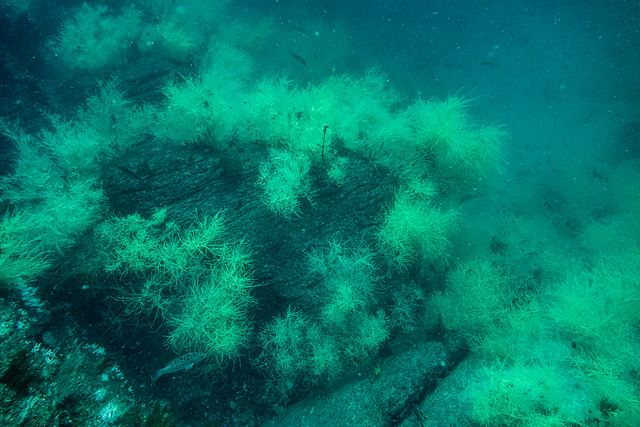
When I first started diving here, people would talk about the black coral. I never saw any coral that was black, but I didn't want to sound stupid so I didn't say anything. Eventually I learned that the black coral was yellow/green and I had been seeing it all along. It's only the dead skeletons that are black. It is quite abundant in certain (usually deeper) areas.

Black Coral

Lion's Paw sea cucumbers (aka Accordion or Sticky Snake sea cucumbers) are normally nocturnal but this one was out during the day for some reason.

Lion's Paw or Accordion Sea Cucumber

Arthropods are creatures with external skeletons and jointed legs. On land we're most familiar with insects and spiders, but they also include lobsters and crabs. The spiny lobsters found here are quite different from the Atlantic lobsters people usually eat. I love how colorful they are.

Blue Spiny Lobster

This was the first time we saw Staghorn Hermit Crabs. Instead of shells, these hermit crabs use a hollowed out piece of coral. It uses its one large claw to seal the entrance when it withdraws inside. The coral is still alive.

Staghorn Hermit Crab

This little coral guard crab was in one of the cauliflower hard corals.

crab in coral

More photos from our diving

Wednesday, November 09, 2022

Loreto Diving - Swimmers

I didn't focus much on fish pictures this trip. It's not that I don't like to get good fish pictures, but they're even more difficult than other underwater photos because they're skittish moving targets. But I still took lots of fish photos when the opportunity presented itself. (Warning: this is a long post)

Shelley and I both thought the fish were more numerous than last time we were here (about 5 years ago). Covid would have meant reduced fishing, but I'm not sure if that explains it. We asked the locals but they didn't seem to think it had changed much. Of course, for them it would change so gradually they might not notice. In any case, it was good to see lots of fish.

Enzl and fish

Scissortail Damselfish

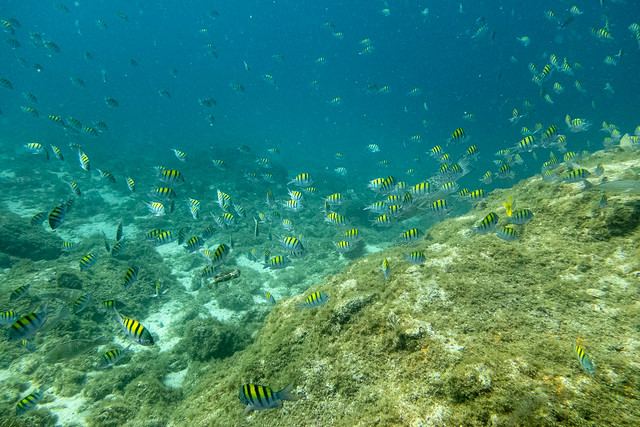
Sergeant Majors

Graybar Grunts

One of the few fish that sit still to be photographed are the Stone Scorpionfish. They are masters of camouflage, but once you know what to look for, they're not too hard to spot. Usually I'll spot one of the side fins that stand out because the pattern is a little too regular. (center of this photo) They are ambush predators so they're used to sitting still. They also have venomous spines so, as usual, you don't want to try to grab one. This one appeared to have sat there long enough for the sea star to start climbing over it.

Stone Scorpionfish & sea star

This was one of the few that had picked an exposed spot to sit and was quite obvious.

Stone Scorpionfish

Stone Scorpionfish

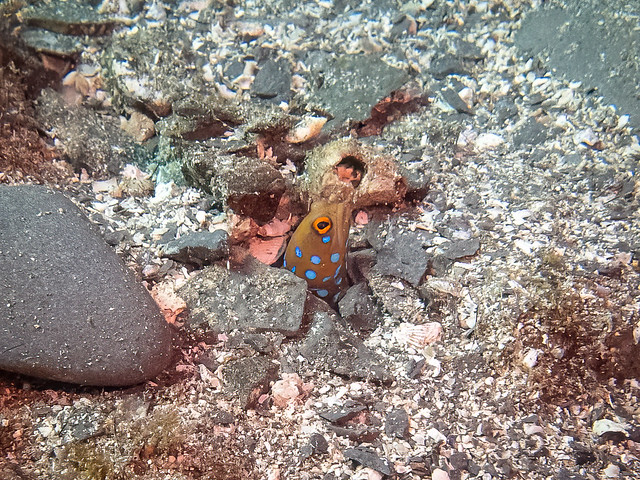
Bluespotted Jawfish are a little trickier to photograph because they withdraw into their burrows when you get close. If you add a stone to the wall around their burrow and wait, sometimes they will pop up and push the rock away with their head. It's amazing that they can dig a burrow like that with no arms or legs.

Bluespotted Jawfish

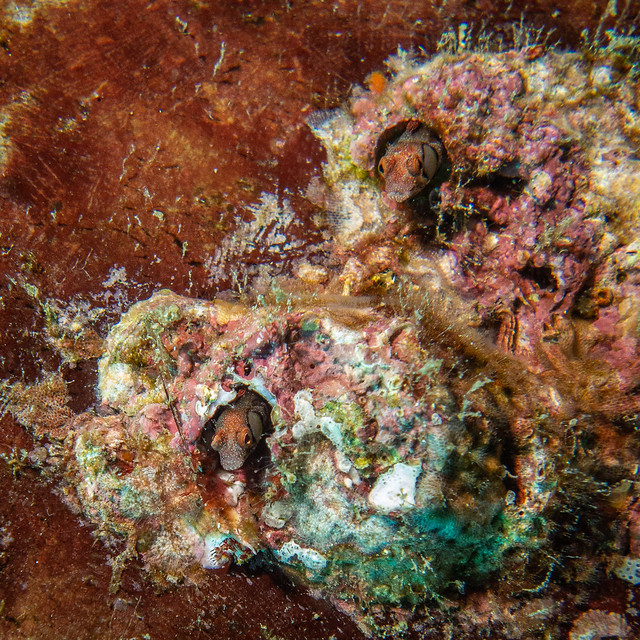
The little blennies also hide but they usually use abandoned worm tubes.

Browncheek Blenny

Pixy Hawkfish liked to hide in the coral. It was often worth looking closely at the the infrequent hard coral - there were often multiple creatures hiding in them. I saw fish, crabs, shrimp, and brittle stars.

Pixy Hawkfish

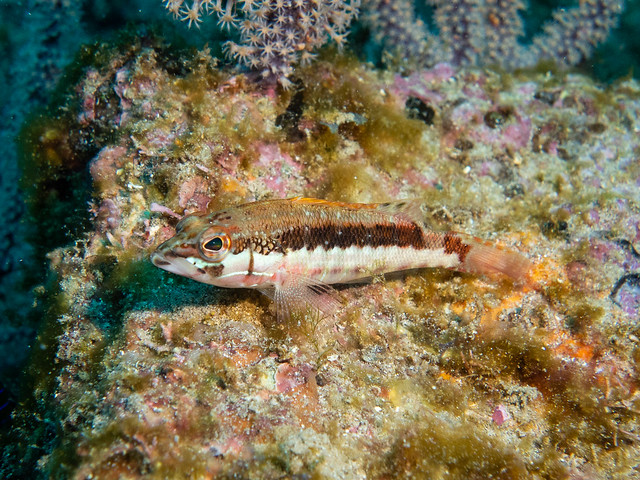
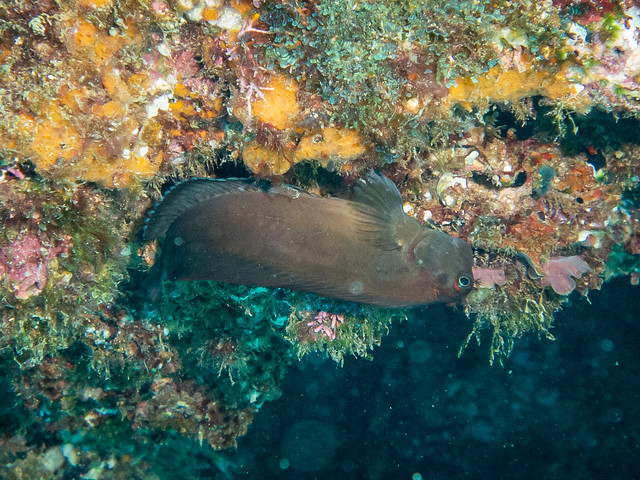
There were other fish that you'd find sitting on the rocks, but unlike the scorpionfish, they would take off if you got too close.

Pacific Graysby

Giant Hawkfish

Barred Serrano

Panamic Fanged Blenny ?

Occasionally fish will be curious and come to check you out, like this pair of Cortez Angelfish.

Cortez Angelfish

The other common angelfish are the King Angelfish.

King Angelfish

Giant Damselfish are a little easier to photograph because they have a small territory that they stick to and defend.

Giant Damselfish

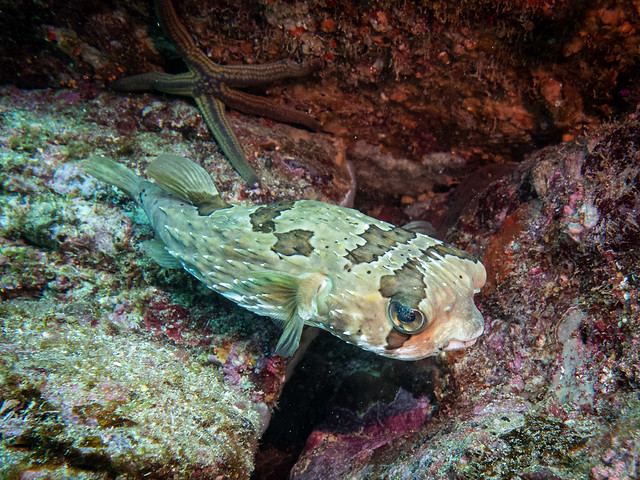
I like some of the odd shaped fish, like the Spotted Boxfish, Porcupinefish, and Guineafowl Puffers.

Spotted Boxfish

Long Spined Porcupinefish

Guinnea Fowl Puffer

Baja doesn't have as many colorful fish as a more tropical coral reef, but it still has some brilliantly colored ones, like these Blue & Yellow Chromis (aka Limbaugh's Chromis)

Blue & Yellow Chromis

And some of the tiny ones like this Bluebanded Goby are also very colorful if you can get a close look.

Bluebanded Goby

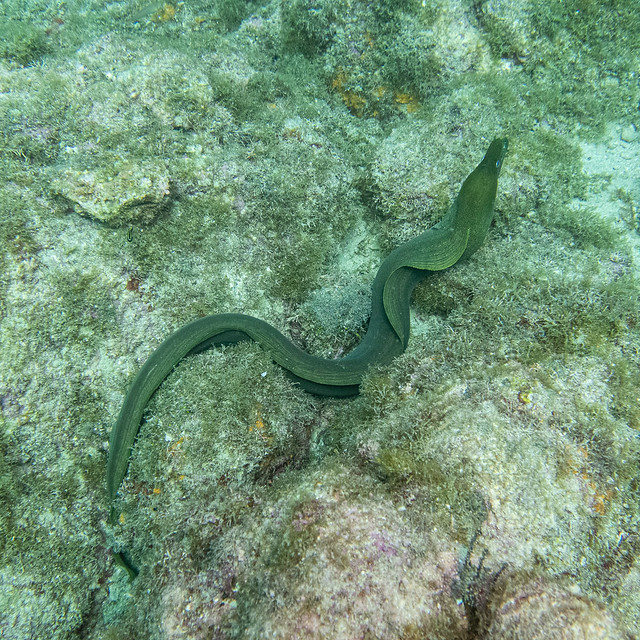
Moray Eels are fairly common, although they're easy to miss hiding between rocks and in crevices. Technically they are a kind of fish. The most common are what we have always called Green Moray Eels, but iNaturalist calls them Chestnut Moray Eels. Apparently the color can vary from brown to green, but the ones we've seen have been quite green. They often look quite fierce with their gaping mouths and pointed teeth but the open mouth is mostly because that's how they breathe. Occasionally you see them out swimming around.

Chestnut Moray Eel

Chestnut Moray Eel

We also saw a few Jewel Moray Eels:

Jewel Moray Eel

Stingrays are usually hidden in the sand. Often what you spot is their straight tail which stands out. Next you might see an eye looking at you. You can get quite close if you move slowly.

Stingray

I was slowly approaching these two when a couple of fish came over to see what I was looking at and scared the stingrays away.

Stringrays

We didn't see many eagle rays, and only from a distance so I didn't get any good photos. It took some heavy editing to make the eagle ray clearer in this shot.

Eagle Ray

And we only saw one sea turtle, also from a distance. No photos of it I'm afraid.