The landing zone and camping at Dunlap is next to a pond which had turtles and frogs and birds.
I noticed the first frogs as they jumped into the water when I approached the shore. Then I noticed eyes sticking out of the water.
I spotted one that hadn't jumped in the water which was how I identified them.
Bullfrogs are native to eastern North America but they have been introduced into a wider range where they are often considered invasive species since they out compete native species. They are common in California. They are also harvested for food (frog's legs) in some places. They can grow up to 8 inches and almost 2 lbs!
The most common birds on the pond were coots, although there were also Canada geese.
And some nice reflections in the morning light.
Away from the pond Western Fence Lizards (aka "bluebellies" for the obvious reason) were common.
Driving on a back road we saw something crossing and Shelley stopped the car. She thought it might be a big beetle but it turned out to be a large spider. I think it was a California tarantula.
I grabbed my camera and jumped out of the car. I ran around and blocked its path so it wouldn't disappear into the ditch.
It was about 2 or 3 inches across. I got Shelley to put her foot near it to give an idea of scale. Understandably, she didn't want to get too close!
Tarantula spiders are mostly nocturnal so you don't often see them. But in the fall the mature males (7 to 10 years old) wander around looking for females. The males die soon after mating but the females can live up to 25 years.
They are not usually aggressive and even if they do bite it's like a bee sting.
Looking for somewhere to stay close to the Monterey Bay Aquarium and Sand City we ended up in Carmel (at Vendange) which turned out to be a good choice. Monterey is quite touristy with the aquarium and Cannery Row (of Steinbeck fame). Carmel was quiet but still had some good restaurants. We even managed to make it out for a run in the nearby park. (Although us flatlanders aren't used to the hills.)
We spent part of a morning (before flying) at the Carmel Mission where I spent most of my time taking photos of the flowers and insects :-)
For a change I managed to get decent shots of both the top and underside of this butterfly. I think it's a Painted Lady (one of the most common)
The bees were also visiting the flowers. They were hovering, giving me a chance to catch them in midair.
They're not quite as colorful, but I still like the shapes and patterns of the agaves:
I even found a snail hiding in one:
Given my fascination with water I had to take some photos of the fountain. I like the way this one turned out. (backlit, of course)
Bougainvillea is always a favorite:
And just to prove that I was actually at the Mission:
We had a great two hours of flying at Sand City with our friend Craig Gamma. The coastal soaring was a nice change after the stressful SIV course. The steady wind off the sea hits the dunes and creates lift so you can fly up and down the shore. It was fun to fly with the sea gulls, turkey vultures, and hawks. (and a few other paragliders)
The Monterey Bay Aquarium is one of our favourite aquariums. It's large with many exhibits and has a good educational and conservation focus. Unlike some aquariums (and zoos) the glass is clean and not all scratched up. (i.e. good for photographs)
I don't normally shoot video, but I wanted to try to capture some of the movement. (shot with my iPhone)
It's nice that the aquarium is right on the water. Out on the bay we could see harbour seals and seabirds, and even a whale going by.
On the way into California we stopped at south Lake Tahoe for a few hours and went for a short hike.
After our paragliding course we spent the night in Napa. Had a great sunrise from our hotel room window, watched the ducks on the river, tasted some wine at St. Clair Brown Winery, and had a nice supper of Spanish tapas at Zuzu.
Shelley and I just finished a paragliding "SIV" course with Dilan Benedetti of Let Fly Paragliding. SIV stands for "simulation d'incidents en vol" which translates to "simulated incidents in flight". But the only "simulated" part is how they are induced, after that, the incidents are very real.
Some people get a thrill out of swinging, dropping, and spinning. Dilan is a great instructor, but he's also an expert acro (acrobatics) pilot, which means he enjoys doing crazy things with his paraglider (like infinity tumbles). For me these maneuvers are more like taking my medicine - it tastes bad, but I know it's good for me. I'm especially not a fan of spinning - on top of the disorientation, I tend to get motion sickness.
SIV is normally done over water which helps prevent injury if you come down under your reserve parachute. You normally get towed up behind a boat. Thankfully we had previous experience towing, whereas for everyone else it was another new thing to be nervous about. We also had some previous experience with SIV. We had done one day of basic maneuvers as part of a P3 intermediate course, and then Shelley had done an SIV clinic last summer (I just watched since I had broken my thumb.)
We started off with simpler maneuvers - pitch control (like on a swing) and then inducing collapses on one side of the wing (asymmetric) and then on the front of the wing (frontal). Modern paragliders are amazingly well designed. They will happily fly with half the wing disabled and flapping, and recover from collapses quickly and more or less on their own. (At least the safer wings that we have. High end, competitive gliders are not quite so forgiving and require more active control.)
We soon progressed to "autorotations". When you get a collapse on one side of your wing, it has a tendency to rotate. The goal of the exercise is to learn how to safely exit from this. But our wings are specifically designed to not rotate. Even holding a big collapse and throwing my weight onto the collapsed side, I couldn't get my wing to autorotate. I finally had to use my speed bar to make the collapse bigger. As you can imagine, it goes against all your instincts to deliberately do things to overcome and bypass the safety features of your wing. But you can't learn how to "fix" the problems unless you can make them happen.
Once you start rotating you have to be very careful not to release the collapse because the resulting surge as it reinflates can cause you to end up above your wing and then fall through the lines or worst case, fall into the wing itself (which is often game over since it's almost impossible to throw your reserve when you're "gift wrapped"). One of our group failed to hold his collapse and ended up falling through his lines, making the wing unrecoverable. We all listened and watched with wide eyes as Dilan calmly told him to pull his reserve. Thankfully he did and it opened nicely and he landed safely in the water.
Spiral dives are another technique that I'm not fond of. They are an important descent technique but a strong spiral is very unnerving and can be difficult to stop if you get too far in. I have a hard time forcing myself to go into a full spiral and tend to "pop out" because I'm tentative about it (and again, our wings are designed to resist going into a spiral)
One of the big hurdles in SIV is full stalls. Everyone gets nervous about it. I think that's partly because you are taught to never do anything to stall your glider. Going into a stall is easy, you just pull your brakes all the way down below your waist (which you would never do in normal flight). When the wing stalls it goes from a beautiful flying machine to a dishrag flapping in the wind. And since you're hanging from the giant flapping dishrag, you get tossed around (sometimes compared to being in a washing machine). Keeping your legs and arms from flying around is a challenge.
The next trick is coming out of the stall without causing problems. It sounds simple - raise your arms gradually and slowly until the glider starts flying backwards(!) And by the way make sure you keep your brakes symmetrical or you'll start to turn as well. My first stall was far from elegant. Concentrating on my hands, I forgot to hold my legs steady and when they flew around, then I didn't keep my hands steady. But subsequent stalls were easier and better. It's a bizarre feeling to stabilize in "back fly" going in reverse. It's actually quite stable and smooth when you get the brakes in just the right spot. Of course, pull slightly more brake and you're back in the washing machine, or let the brakes go up too much and your wing will try to reinflate and surge forwards. Which is what you do to come out of the back fly, but you have to be prepared to immediately pull the brakes again to "check" the surge. Get that wrong and you're back in risk of falling into your lines or wing. It's not as bad as it sounds, but it's still pretty nerve wracking for us beginners.
Over the three days we got used to following instructions over the radio. Especially when you have a speaker inside your helmet it almost sounds like the voice is inside your head. So I was a bit shocked when Dilan said "ok, now do some more full stalls on your own". It's one thing to have your instructor tell you to do something you really, really don't want to do. It's another thing to initiate it all by yourself. But, as my parents (British) would say "in for a penny, in for a pound". And in the end, you're really doing it yourself regardless.
Overall, it went really well. I wouldn't call it "enjoyable", but a good learning experience. We accomplished what we set out to, which was to learn more about how to handle our wings in a variety of situations.
Of course, being around water, I couldn't resist a few reflection photos.
A few photos from Twin Falls, Idaho. It was smoky from the forest fires so the views weren't as good. Still a spectacular spot. We had dinner at Elevation 486 overlooking this view. (Check out the drone video on their web site.)
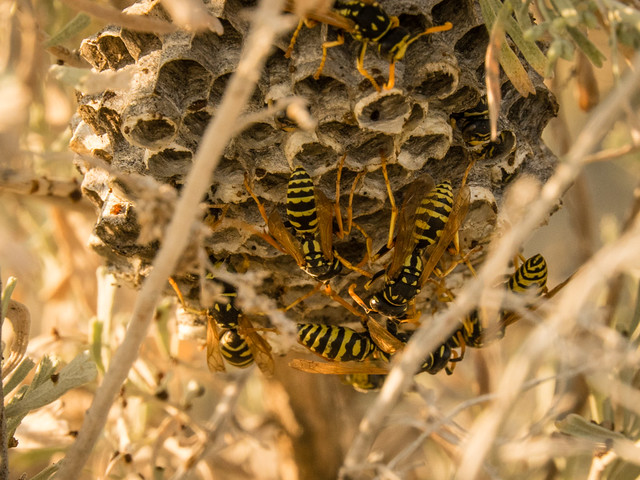
I have a feeling the last wasps I photographed were not paper wasps after all, just yellow jackets. But I think this time they really are paper wasps - skinnier, narrow "waist", orange antennae, and the nest looks like a paper wasp nest.