Thursday, November 19, 2015

La Paz Sea Lions

Several of our dives from La Paz were at the sea lion colony. The sea lions here were much more playful than the ones at Loreto. The young ones came down and tugged on your fins and chewed on your fist like puppies.

sea lions

It was funny seeing the sea lions watching us from the surface, deciding whether to come down and check us out.

sea lions

The sea lions seemed to ignore the schools of small fish, but presumably that's different when they're feeding rather than playing.
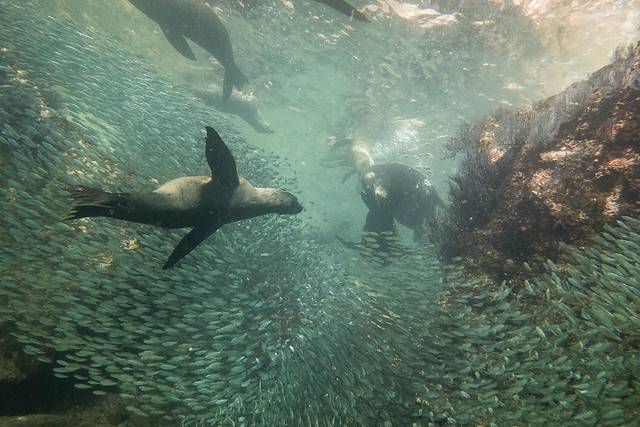
sea lions & school of fish

Part of what makes diving unique is being in a 3D environment for a change. I can't count the number of times I've spun around looking for Shelley and started to panic that she's gone, only to find she's just above or below at an unexpected angle. Lots of "blind spots" in 3D! Similarly, the sea lions would usually appear out of nowhere.

sea lion

It's the smaller juveniles and females that you interact with. The males are huge and a little scary. Occasionally one would cruise by to make sure we weren't trying to steal their women.

sea lion in school of fish

Our dive guide, Maria, had visited the sea lions many times and was an old hand at playing with them. She knew what to do to attract and play with them.

Maria playing with sea lion

On the other hand, they seemed to know Shelley was new at this game and liked to sneak up on her and grab her fin.

sea lion playing

One of the advantages of camping was that we got to the popular dive sites (like the sea lions) before the people coming from La Paz. We didn’t realize how many other dive boats had arrived while we were diving. The three of us were in a tiny “cave” with some sea lions when a big group of other divers arrived and proceeded to try to fit themselves in with us. Needless to say, we moved on!

Shelley took some great video of the sea lions

Shelley & sea lion

For more photos, see all 16 photos as a slideshow or overview

Wednesday, November 18, 2015

Isla Espirito Santo

As I explained in my last post, we camped on Isla Espirito Santo while diving near La Paz. It was great being on the island. The stars at night were fabulous. At dusk the native hares with their huge ears would come around the dining area (presumably looking for scraps).

In the morning a great blue heron would be fishing on the beach near our tent.

Great blue heron

Frigate birds circled overhead and cormorants fished in the bay.

cormorant

There was a nature trail to explore with cactus and flowers and lizards and hummingbirds.

cactus

cactus flower

butterfly

One kind of lizard had a black spot behind its front legs.

lizard

The other kind had a black spot ahead of its front legs. This kind also had what looked like salt around its nostrils. Some birds and lizards can excrete salt through salt glands rather than in their urine, to conserve water.

lizard

We left our hike till later in the day to avoid the heat. The sun was just going down as we returned to camp on the beach.

Untitled

sunset

We were also treated to a nice sunset on our boat ride back to La Paz.

sunset

For more photos, see all 27 photos as a slideshow or overview

La Paz Diving

From Loreto we took the bus to La Paz, about a four hour ride. The buses are quite modern and comfortable, even wifi (if it’s working!). In La Paz we stayed at Posada de las Flores, a small hotel we’d stayed at previously. It’s a bit of a walk from downtown, but a nice place.

Most of the diving around La Paz is near Isla Espirito Santo, which means long boat rides (e.g. 1.5 hrs). We found that Fun Baja offered diving combined with camping on the island. That meant only a single trip out to the island, and more contact with the outdoors.

The ride out to the island was a little rough but not too bad. It was only the two of us and our dive guide so we just had a small boat. The camping was quite civilized, in large tents you could stand up in, with cots to sleep on. Meals were provided. There were even showers. One downside was that they didn’t really have facilities for rinsing dive gear which isn’t ideal for the equipment. They did have a fresh water rinse tank for underwater cameras but it wasn’t especially clean.

There was a free diving competition group also staying there. It was interesting hearing them talk about their sport. Among the results was a new national record for the USA at 93m (305 ft)

The diving was great. Although Loreto, La Paz, and Cabo Pulmo are not that far apart, it's interesting how you see different kinds of fish and other sea life at each location.

Panamic fanged blenny

We enjoyed the wreck dive on the Fang Ming, not so much for the wreck itself, but for the sea life around and on it. There was a big sea turtle lying on the top of the wreck. Usually sea turtles swim away when they see you, but this one is obviously used to people.

sea turtle

There were jewel and green moray eels.

Jewel eel

Green moray eel

There were lots of trumpetfish around the wreck and for a change they let us get a little closer.

Trumpetfish

Around the sea lion colony (another post to come on that) there were large schools of small fish - I think sardines?

school of small fish

We saw several kinds of jawfish. They live in holes on the bottom and usually hide when you come close, but sometimes they can be lured out.

Giant jawfish

Finespotted jawfish

I love the bright colors of some of the fish. The small ones tend to dart around so much that they are hard to photograph but occasionally you get lucky.

Untitled

Coral hawkfish

We did three dives per day and the first two days we were lucky to be just the two of us and our dive guide, Maria. After that some other divers came out and things got a bit more confused. The head office of FunBaja attempts to shuffle people and boats and guides around to minimize their costs, which is understandable, but unfortunately they don’t seem to take into account the inconvenience to their customers. We got shuffled from one boat to another several times, struggling to ensure all our gear stayed with us. Some of the people had booked snorkelling with whale sharks instead of their third dive but they wanted to keep everyone together so we ended up joining with them, which meant a couple of hours extra boat travel for us. And then they were so late (we waited two hours for them) that it got dark before we had a chance to even look for whale sharks.

The package we’d booked included a night dive. However, this turned out to not be a regular night dive. Instead, they shine a big light in the water, attracting plankton etc. which in turn attracts the mobulas (small manta rays) to feed. The dive boat was overcrowded and unlit and it turned into a bit of a circus getting ready and getting in the water. They had given us instructions to sit on the bottom to watch, being careful to not to stir up the silt and ruin visibility. Shelley and I were the first ones down and we followed instructions and settled carefully on the bottom. But the next person down proceeded to kick up a big cloud of silt. At which point we were motioned to not sit on the bottom. After 20 minutes I’d had enough and I signalled Shelley to go up. The others came up shortly after. It was nice to see the mobulas, but I’d much rather it was in a more natural setting. (Besides, it's hard to take photos in the dark!)

Mobulas at night

For more photos, see all 60 as a slideshow or overview

Wednesday, November 11, 2015

Loreto Diving 2

Finally finished going through the rest of my diving photos from Loreto. (Now I just have to work through the La Paz ones before I start taking more at Cabo Pulmo!) We had a great six days of diving, including some nice long (over 80 minute) dives. It was nice when our dive master, Rafael, was also taking photographs because then we had plenty of time to poke around. Often, especially with bigger groups, there isn't much time for photography.

One of the highlights was a huge school of Mexican barracuda.

Mexican barracudas

At one point our dive master signalled and I looked over to see a turtle disappearing into the distance. I was behind the rest of the group so there wasn't much point trying to chase it. But when I looked around there were two more turtles close to me. One of them swam right by me. The rest of the group missed them since they were focused on the other one in the distance.

sea turtle

We saw lots of moray eels, both green and jewel. Shelley also saw a zebra. Usually all you see is the head poking out of a hole in the rocks. Sometimes all you'd see was a slice of green moray through a gap in the rocks and it was a challenge to figure out where the head and the rest of it was.  Occasionally you'd see one out swimming in the open. We saw one huge green moray that was by far the largest I've seen.

green moray eel

I took more photos of the territorial giant damselfish. This one has the grey head of a breeding male.

giant damselfish

and the cute big eyed porcupinefish

porcupinefish

I love the small details of underwater life. Like the christmas tree and feather duster worms

christmas tree worms

feather duster worm

and the coral and sea stars

coral closeup

sea star closeup

(One advantage of higher resolution cameras like the Sony RX100m2 I'm using (20mp), is that you can crop small parts of an image and get good detail. Which is a good thing, because my underwater photography skills aren't up to capturing these kinds of closeups otherwise!)

For more photos, see all 53 as a slideshow or overview

Around Loreto 2

Another batch of miscellaneous photos from our time in Loreto. The first few are from a short nature walk on Coronado Island. Nice to find flowers, butterflies, lizards, and spiders on a "desert" island.

flowers

It's always a challenge to catch flitting butterflies and fast moving lizards but these ones cooperated briefly.

butterfly

lizard

Nice to have supper overlooking the ocean and watch the sunset.

sunset

I always like it when there are house geckos around. We had a bunch of them living on the ceiling just outside our door. They would hide inside the light fixtures during the day and if you walked by, but if you moved slowly you could catch them out on the ceiling. It was funny to see their feet sticking out from under the light fixtures. Amazing how they can hold on to the ceiling so effortlessly. (And amazing how well modern cameras can handle low light, night time shots like this.)

House gecko

As well as the sea birds, there are a variety of other birds around Loreto. I didn't see as many this trip as other times, but we still saw hummingbirds, hooded orioles, and gila woodpeckers.

Gila woodpecker

In the past there were large groups of resident dolphins around Loreto, but sadly we hear they are much less common the last few years. We only saw a handful, and only from a distance.

dolphin

Like the blue-footed boobies, Sally Lightfoot crabs are found in Baja as well as Galapagos. They are quite skittish, but there are lots around so I got plenty of photos. I love their bright colors against the dark rock, but I did convert one almost silhouette to black and white.

Sally lightfoot crab

Sally lightfoot crab

And, of course, I love all the bougainvillea everywhere! (Shelley in the background.)

bougainvillea & Shelley

For more photos, see all 34 as a slideshow or overview

Thursday, November 05, 2015

Loreto Sea Lions

One of the fun spots to scuba dive or snorkel at Loreto is the spot where the sea lions hang out on Coronado island. Sometimes they are more curious or playful (especially the young ones) and they come to hang out with you. This time they seemed to be bored with humans. They would look down from the surface at us and then go back to whatever they were doing. A couple came zooming by but that was the extent of it. Still it's fun to see them in the wild and to be in the water with them.

sea lions

sea lion

sea lions

sea lion

See all 15 photos as a slideshow or overview