Thursday, October 08, 2009

Vancouver Island Sea Life

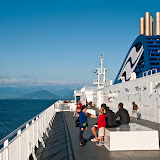
More photos from our trip to Vancouver Island at the end of August.


2009-08 Vancouver Island sea life

We went scuba diving with Ocean Planet Adventures. They're a small outfit but they seem like a good bunch of people. The water was cold for wet suits, around 13c. Remember to bring your thermos of hot water to pour in your wet suit between dives! You can see why everyone switches to dry suits if they're going to be diving much. Despite the cold, it was definitely worth it. I love poking around in tide pools as well, but underwater is a whole other world.

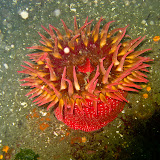
The sea life is very different from tropical coral reefs, but it's just as rich in its own way. It was pretty murky and dark so all the underwater shots are with the flash. It's amazing how much more color stuff has when lit up by the flash. It looks much more drab in the low light.

Tuesday, October 06, 2009

Fine Feathered Friends

We have a bird feeder in the tree outside the dining room window and I love to see the birds that visit it.

Red-breasted Nuthatches like the one on the right are pretty cute. We had a Downy Woodpecker last evening. I thought it was a Black-capped Chickadee at first because of the black and white head. They're another favorite.


Of course, I picked a dark, cloudy day so it's not the greatest photo. I'll have to try to remember to take some pictures on a sunny day!

Driving Mentality

I was walking home yesterday after work, through residential streets. I approached an intersection. There was a car coming from the side street, but it was a ways back and not going too fast so I continued walking across the intersection.

The car slowed down for me (it didn't even need to stop) but at the same time it blasted its horn repeatedly at me. I assume for having the nerve to impede its progress. The driver raised her hands at me as if to say "what do you think you're doing". Uhhh ... I'm crossing the road, legally and properly, at an intersection. I didn't step out into traffic or anything silly. It was broad daylight.

What happened to pedestrians having right of way? It's obviously a thing of the past. Interestingly, a woman with two small children was waiting on the other side of the intersection to cross. She obviously knew that pedestrians no longer had rights and didn't even attempt to cross when there was a car anywhere in the vicinity.

I realize this is not the normal case. That's when you stand by the side of the road and watch the cars zoom by without them even considering slowing or stopping to let you cross. After all, we're walking, and therefore second class citizens, and must have all the time in the world to wait. Whereas they are driving, and all drivers are on urgent missions and have to get wherever they're going as fast as possible. Heaven forbid you should get in their way.

Saturday, October 03, 2009

Tuesday, September 29, 2009

Thanks for Not Driving

Once more, I give thanks that I get to walk or bicycle to work this way instead of sitting in a car in traffic.


This is the river end of the connecting path to Innovation Place. It wasn't that many years ago that it was a dirt track between a field and the railway tracks. The trees on the right between the field and the path are growing up nicely. And I have to admit that when it's wet the paved path is nicer than the mud used to be.

And here's a shot of a solitary end of season flower taken with my iPhone on the way to work.


The Smaller Majority

If you like nature and don't mind "creepy crawlies" have a look at The Smaller Majority by Piotr Naskrecki. Your local library probably has it (the Saskatoon library did).

The photographs are amazing and the text is great too.

Sunday, September 27, 2009

Only in Saskatchewan

Shelley and I had planned to go kayaking this weekend but the weather didn't cooperate (rain and 50 km/hr winds) so we went down to Regina so Shelley could take part in the police memorial parade. Looking for somewhere to stay, I googled for "regina boutique hotels" and this was one of the top results:


Pretty sad when a Holiday Inn Express is the "premier boutique hotel"!

We ended up staying at the Hotel Saskatchewan - the price wasn't much different (via Expedia) and it's a little classier :-)

Sunday, September 20, 2009

Weather Ups and Downs

I just got back from an overnight kayak trip on the Hanging Heart Lakes and Crean Lake near Waskesiu. (Shelley was on call so I was on my own.)

The two days of weather couldn't have been much different. Saturday was 30c, sunny, very little wind. I started at the dock at Heart Lakes. (satellite view is best) There were all kinds of people out enjoying the day. The paddling was easy and relaxing. I kept going until the sun was getting ready to set.

It was too hot for the bugs on Saturday. ( I wonder why they don't operate in hot weather?) I sat outside and ate my supper and watched the sunset and wasn't bothered by a single mosquito. But as soon as the sun went down and the temperature dropped a few degrees swarms of them appeared like magic and I quickly retreated to the tent. Of course every time I went out and came back in it took several minutes to eradicate all the mosquitoes that snuck in with me.

This morning (Sunday) was much cooler at 7c, windy, and raining. I camped in a relatively sheltered spot but once I got out in the open water it was ... interesting. The waves bounced me up and down, spun me around, and slapped me in the face. It was a bit like a Disneyland ride, only I didn't have to pay, there were no lineups, and it lasted two hours. Crean is a pretty big lake (over 10 km across) and the growing whitecaps made me a little nervous. But the kayak is pretty stable and the spray skirt kept most of the water out, and I was close to shore if I did get tipped. Despite going mostly against the wind I made steady progress.

In the middle of this, two bald eagles appeared and flew around me for a while. I had to be careful not to get too distracted watching them and get creamed by one of the bigger waves. 

Once I got off Crean and into the Heart Lakes it was a lot calmer and I could relax, although I started to get cold once I wasn't exerting myself as much. Despite the rain gear and the spray skirt I was still pretty wet and sitting in a puddle of water. I can see why paddlers wear rain gear that seals around your wrists - getting a wave pouring water down your sleeve is a tad unpleasant!

Nevertheless, I still enjoyed the paddle back through the rain. Out of the wind it was quite peaceful. I had to stop a few times and listen to the sound of the raindrops hitting the lake. It was an almost musical pitter patter. The loons were also adding their own accompaniment. (When I searched I also found this video of a poem about loons.)

One advantage of the bad weather was that there were no other people anywhere to be seen. I was especially happy to be rid of the power boats. If you ask me, they should ban powerboats on at least some of the lakes. But that would no doubt be so unpopular as to be impossible.

I'm pretty lucky to be within relatively easy reach of more or less unspoiled countryside. The moss on the forest floor and the lichens on the trees, the ducks and loons and eagles - it's all pretty magical. I should get out here more often.

(sorry, no photos this time)

Thursday, September 17, 2009

Summer's Final Fling

The weather lately has been gorgeous, warm and sunny and not even too windy. I've been trying to make the most of it - running, cycling, having coffee where I can sit outside. It's supposed to get up to 30c today!

Of course, it is the middle of September and the days are getting shorter, the leaves are starting to fall, and the Canada geese are congregating.

Although our winters are harsh, I still love the cycle of seasons we have here. If you compared winter to summer you'd think it was two different places entirely.

Tuesday, September 15, 2009

No Fly Zone

It's becoming increasingly obvious (to me) that flying isn't sustainable due to it's impact on climate change. Depending on whose numbers you believe, it's about 10 times worse than buses or trains. And unfortunately, there are no obvious (or even obscure) ways to make flying sustainable. You can have cars and buses and trains powered by electricity generated in sustainable ways. But airplanes require a concentrated fuel. Even hydrogen isn't a good fit.

The trip to Peru we've got planned this winter will contribute somewhere in the neighborhood of 4 tons of CO2 per person - more than what we should be producing in an entire year. I can buy carbon offsets but that doesn't change my impact, it just means I expect someone else to cut back.

So after Peru I'm going to quit flying for a while. For someone that loves to travel that's a hard pill to swallow. But if I'm not willing to sacrifice, how can I expect other, less motivated people to do anything?

People are willing to do things that don't require much sacrifice - changing light bulbs, recycling, insulating their house. But that will only go so far. The changes we really need require a lot more sacrifice and that's a show stopper for most people.

It's not all bad. In a way I'm excited about the possibilities. Constraints often end up encouraging enough creativity to more than compensate for the limitations they impose. I don't intend give up traveling entirely - there's lots of places I'd like to visit in North America that I can reach by bus, train, bicycle, etc. Even our Prius with two people in it is a lot better than flying. (And I'm less likely to travel as far by these means so that helps too.) Saskatoon is a Via Rail stop so I can get east or west that way. I could even get to Churchill Manitoba to see the polar bears before they're gone. The Amtrak rail network in the USA goes lots of places and connects to Canada in Vancouver and Quebec. Unfortunately, it's not easy to go south from Saskatoon - neither the trains or the buses go across the border except in Vancouver and out east. And once you're in the US the trains primarily go east/west except on the coasts.

Traveling by bicycle would be even better, but distances in North America are large. One option might be to travel by train or bus with my bike. For example, I could take the bus to close to the Saskatchewan border, bike across and then use buses or trains in the US. Of course, that might be a little tougher in the winter! Maybe I need a Montague folding bike (there I go again falling into the trap of needing more "stuff")

Shelley thinks I'm a little crazy, and she's not the only one. Of course, they're right, but not necessarily because of this :-)

Too many people are keeping their heads in the sand, even people that are supposedly committed to solving the problems. For example, I recently ran across the International League of Conservation Photographers. It sounded great so I went to see what they do and found they're organizing a conference in Merida, Mexico. So a whole bunch of people are going to fly long distances to go and talk about how they can save the planet. Maybe they'll talk about not flying?

The standard defense is the old "the end justifies the means" - that the good they're doing makes up for the damage. Come on, can you really get people to stop doing something by doing exactly what you want them to stop doing? Bah!
The campaign against climate change is an odd one. Unlike almost all the public protests which have preceded it, it is a campaign not for abundance but for austerity. It is a campaign not for more freedom but for less. Strangest of all, it is a campaign not just against other people, but also against ourselves. - George Monbiot, Heat

Sunday, September 13, 2009

Tofino Sunrises

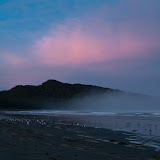
I've been working my way through my photos from our recent trip to Vancouver Island. It's taking a while so I thought I'd post a first batch. When we were in Tofino I got up for the sunrise a few mornings to take pictures. I even used my tripod. Thankfully it was late enough in the summer that sunrise wasn't too too early.

2009-08 Tofino Sunrises

Leopard Frog

It was a beautiful day yesterday and I was out roaming around on my bike. This Leopard Frog (probably a Northern Leopard Frog) jumped out of a puddle on a trail close to the river. It's nice to see it around because they're not doing so well these days. I'm not sure where it came from, as far as I know the only permanent water around is the river and I don't think they can breed in moving water like that. Maybe it came down the river from somewhere else. Or maybe it they are breeding in people's backyard ponds.


I took the photo with my iPhone since it was all I had at the time. It does a surprisingly good job for a phone. The fairly wide angle lens means you have to get quite close but I moved slowly and the frog cooperated for a few shots before leaping off into the undergrowth.

A couple of years ago I did a series of blog posts on some Leopard frog eggs that I brought home and raised:

Tadpole Progression
Tadpoles Grow Legs
Tadpoles to Frogs
Formerly Known as Tadpoles

Saturday, September 12, 2009

Saskatoon Bicycling Paths

At Jan Gehl's talk in Saskatoon recently the city was handing out a brochure on "Spaces and Places to Ride in Saskatoon".

It's nice to see the city thinking about bicyclists. Saskatoon does have some good paths, along the river and a few other places.

Saskatoon has two "Exclusive-Use On-Road Cycling Lanes" - along part of Preston and part of Spadina. I use both regularly and it is really nice to have a separate lane for cyclists. Of course, because the lanes are "just" for cyclists, and because they're at the edge of busy roads they tend to get full of gravel, which doesn't make the nicest (or safest) cycling.

On the map in the brochure the most prominent network, outlined in red, is "Shared Use On-Road Cycling Lanes". It also has the most "Proposed" sections. This is the one type of "path" that is not explained in the brochure. As far as I can tell, it simply means a road that bicycles are allowed to use. In other words, a regular road. Having cycled on many of the outlined streets, I don't recall anything special about them - no signs or markings.

In other words, the big red network is hype. Bicyclists will realize this. The problem is that non-bicyclists (most people) will see it and think "what are these bicyclists whining about, look at all the cycling paths they have".

And that's not the only part of the brochure that's hype. The map in the brochure shows the Spadina section extending from 33rd to College Drive. This is pure fabrication. Spadina on this part is barely wide enough for one lane in each direction plus parked cars on one side. And on top of that, it's full of potholes. As far as I'm concerned the only time it's safe to bicycle on this section is when there's no traffic (e.g. when Shelley goes to work at 5am). There's certainly no "exclusive use cycling lane". They are currently resurfacing this section (which should at least fix the pothole issue) and maybe they plan to add a cycling lane, although I doubt it because there's no room for it.

I don't think this hype is conspiracy or malicious or even deliberate. I just think most of the people involved are out of touch. I bet they haven't even looked at most of the paths in person, let alone cycled on them. The other symptom of this is discontinuous paths - bike lanes that suddenly end and sections of path that don't connect. They look ok on paper and add to the stats, but they're not so good for actual use. (Check out the path along Whiteswan, it's a crazy collection of discontinuous pieces.)

I think, at least unconsciously, there's this image of cycling as being something you go out and do on a sunny Sunday afternoon along the riverbank. Not something as mundane as trying to do your shopping or commute to work. That's pretty obvious when you look at where the good trails are - along the river. Where the shopping is it's almost impossible to cycle. This is true even in areas that are supposedly more "enlightened" like Broadway. Try maneuvering between stores on 8th Street on your bicycle.

It's also obvious when there is absolutely no provision for pedestrians or cyclists, only cars. For example it's almost impossible to get from my house in Richmond Heights to the restaurants and shops very close by on 42nd Street. You have to play Frogger and dodge traffic across 6 lanes of busy Warmen Road, then get across the train tracks (ignoring the no trespassing signs) scramble up and down the embankments, and then cut across a car sales lot. And it's even more fun in the winter with the snow and ice.

Studies show that traffic expands to fill the available space. Enlarging roads or parking to reduce congestion almost always has the opposite effect - it just increases traffic. The best way to reduce traffic is actually to shrink roads and parking. So on Broadway, for example, where people would say there's no room for a bike lane, we could just convert the parking lanes into bike lanes, at least for the summer. Of course, the drivers would complain and they have a bigger lobby so it's unlikely to happen.

It would also be nice if the city demonstrated a little more interest in input from people. Deliberately or not, the brochure did not give any way to contact anyone. No phone number, no email address. Only the web site for the city as a whole (saskatoon.ca) There is an advisory committee for cycling in Saskatoon, but from what I hear, the city primarily uses it to announce what they plan to do, not to actually get input.

Oh well, I shouldn't complain, it's nice to see some attention to cycling.

Monday, September 07, 2009

Where Are We Headed?

I'm in the middle of reading Heat by George Monbiot.  It's a few years old but still an excellent read.

Check out a couple of his recent blog posts.

Not Even Wrong

Should We Seek to Save Industrial Civilisation?

I find it very hard to know what to think of our current situation. Should I retreat to a cabin in the woods and attempt to live a pre-industrial life? But a few people doing that won't save us. Or do I give up and live it up while I can?

The middle ground of making some feeble personal attempts to "reduce, reuse, and recycle" seem almost pointless when the people around me are buying SUV's and McMansions. And when I, myself, hypocritically continue to travel by air, eclipsing any savings I might have made other ways.

Saturday, August 15, 2009

Minnesota Zoo

I always try to go to the zoo when I travel. I love to see the animals, although I'm conflicted because I also hate to see them caged up. In the balance I think zoos are good because they make people more sympathetic to the plight of animals, but not everyone agrees.

The Minnesota Zoo (in Minneapolis / St. Paul) is quite a nice zoo. It's not huge in terms of numbers of animals, but it's in quite a large park-like area with lots of trees and ponds. And the animal enclosures are quite large and natural - not too many overt bars and cages. They also had a good butterfly exhibit (as you can tell by the photos!).

2009-08 Minnesota Zoo

The only negative was when I came out the main gate to find these signs:

The zoo may not have done this themselves, they may contract out the grounds maintenance. Maybe it wasn't even zoo property, although it was immediately outside the gate. Even so, for a place like this, that makes a big deal out of conservation and protecting the environment, it seems a little contradictory to be spraying poison around within 100 yards of animal enclosures. Not to mention all the kids and babies passing by going in and out of the zoo.

I emailed the zoo about this, but got no response. (I know they received it because they had problems receiving the photo.) This seems to be the norm when you report issues to most organizations. I can't understand it - it seems so totally "wrong" to me. How hard is it to reply? Even if it's just to say "we received your message". It wouldn't even cost them anything to say they'll look into it. To me, the worst possible response is to ignore it, or at least to appear to be ignoring it. I can't imagine that my software business would have survived if we had ignored customers reporting problems.

I even told them I'd be blogging about it and that I'd be happy to include their response. I thought that might help elicit a reply, but I guess that was wishful thinking.

Of course, I got home to find similar signs on the park half a block from my house, only this time they were poisoning the gophers. Even if you have no qualms about poisoning gophers, do you really want poison that kills small mammals being sprayed all over where your kids play? I'm sure the chemical company says it's safe, but given their track records I wouldn't put a lot of faith in that. Personally, I enjoy seeing the gophers and their antics and I'm not sure what they're hurting. Obviously they offend some people. Some of those people offend me, but I'm not allowed to poison them.

Friday, August 14, 2009

Gear for Superior Trip

In case there are other gear junkies out there (and for my own records) here's what I used on my recent 9 day backpacking trip on the Superior Trail.

My pack was a Marmot Eiger 48 that I bought recently, partly with this trip in mind. It's about the right size and it's fairly light (just over 3 lbs). I wouldn't say it's the most comfortable pack I've carried. At the beginning of the trip, with about 40 lbs in it, I had sore hips and shoulders by the end of the day. By the end of the trip I was no longer sore, but after eating all my food, it only weighed about 25 lbs. I wouldn't want to carry much more weight in it, but then again, it isn't big enough to carry much more. Despite the initial comfort issues I'm pretty happy with the pack.

My tent was a Mountain Hardwear Spire 2. This is the lightest two person, four season tent I've had. The Spire 2 is just over 4 lbs - the newer Spire 2.1 is slightly heavier for some reason. At first I wasn't sure about the side doors and vestibules - I'm used to vestibules at the ends. But I've grown to like it a lot. They have a three season version, the Skyledge 2.1, but it's only a few ounces lighter. For this trip it would have been fine, but in the mountains I tend to prefer a four season tent, since it can snow and storm even in the summer. I considered taking our Black Diamond Firstlight tent since it's a pound lighter, but I'm glad I didn't because it rained quite a lot at night and the Firstlight is not great for lengthy downpours.

It wasn't that cold at night so I took my North Face Kilobag. I tend to avoid down bags because they're useless if they get wet, but with a good tent, and enough good weather to dry it out, it was a good choice for this trip. Of course, the nice part of a down bag is that it's light and packs small. Under the bag I used a 3/4 length ProLite 3 Thermorest.

On my feet I wore Salomon Fastpacker goretex boots. I've had quite a few pairs of Salomon trail shoes that I really like and these boots have a similar fit. I considered wearing trail shoes, but for carrying a pack over a rough trail in possibly wet conditions I figured I was better off with the boots. They worked well, keeping my feet dry and providing some ankle support, but not weighing much more than a trail shoe.

I only took cold food - granola for breakfast, trail mix for lunch, and homemade energy bars for dinner. I had originally planned to take my Jet Boil stove to make tea and coffee but in the end it didn't seem worth the hassle. Especially since you can't take fuel on the plane so you have to track it down when you arrive. And hot drinks aren't as important in the summer as they are in colder weather. It did mean no coffee for 9 days - yikes! - but I survived :-)

I used an MSR HyperFlow Microfilter water filter. Unfortunately, it lived up to its reviews - very fast and easy to pump when it's new, not so good after it's been used for a while. At least I knew what to expect, and it was still usable. As a backup I had taken Aquatabs water purification tablets. Since I had them and they're so easy to use, I ended up using them in addition to filtering the water. Better to be safe than sick.

That's about it for gear. It all worked well and if I was doing it again I don't think I'd change anything.

Thursday, August 13, 2009

Hiking the Superior Trail

It all started when I picked up a copy of Thru Hiker's Guide to America: 25 Incredible Trails You Can Hike in One to Eight Weeks. One of the trails it praised, the Superior Trail, also happened to be one of the closest to Saskatchewan. I've been wanting to do a backpacking trip and this seemed like a good choice.

Lake Superior forms the north-east corner of Minnesota and the Superior Trail runs for 280 miles parallel to the shore. I did about 180 km (110 miles) of the trail over 9 days at the end of July. Although the biggest hills are only about 300 feet, some sections of the trail go up and down a lot, so it takes some effort. But the trail is very well maintained and marked and only foot traffic is allowed so it's very pleasant. And the trail guide available from the Superior Trail Office is excellent, giving details of each stage and all the campsites.

It turned out to be a little awkward to get to the start of the trail. I flew to Minneapolis, took an airport shuttle to Duluth, and then a taxi to Two Harbors (no other public transportation that I could find). I could have rented a car, but it would just have sat the whole time I was hiking so that didn't make much sense. From Two Harbors there is a trail shuttle that offers transportation to various points along the trail. Most people park their car at one end of the section they're hiking and then use the shuttle to get to/from the other end. I used it to get to the beginning of the trail, and then again to get back from my end point.

The weather was mixed, it rained every day, but not a lot, and I only ended up hiking in a downpour for one hour out of 9 days so I can't complain. And as you can see from my pictures, I got lots of sun too.

The bugs can be bad in this area, but they weren't for me. A couple of mornings they irritated me enough to put on insect repellent. They were out in the evenings as well but I could hide in the tent then.

I didn't see a lot of people on the trail, usually only 2 or 3 per day. (Other than where the trail went by roadside tourist attractions like waterfalls.) The back-country campsites were small, usually only a handful of tent sites at each. I only shared a campsite with other people one night.

The trail goes through a lot of forest, but it regularly tops out on ridges and high-points with great views. And there were lots of streams and rivers and waterfalls. I didn't see a lot of big animals - a few deer and a moose. But the plants and birds and insects and frogs etc. gave me more than enough to enjoy.

If you like backpacking, I'd give this trail two thumbs up. I think it would be awesome when the fall colors were out.

Of course, I took lots of photos.

2009-07 Superior Trail

Wednesday, August 12, 2009

New Pentax K7 Camera

I recently traded in my Pentax K10D camera body for a new Pentax K7. I kept the same Tamron 18 - 250 mm zoom lens (equivalent to 27 - 375 mm on this body). Despite the camera shop salesman telling me its quality isn't really up to the new camera, I love the huge range from mild wide angle to decent zoom. As I've mentioned before, I'm just not ready to carry around several lenses and switch back and forth. Besides, my main quality issue isn't the lens, its hand-held shots without a tripod!

The first four shots were from a batch taken in the backyard as soon as the battery was charged enough to use. The next four were from a kayaking trip to Redberry Lake the next day. And the last four were from walking to work the following day. They're drawn from a limited number of shots with the new camera, but so far I'm pretty happy with it. It seems to focus faster, expose better, and have better low light capabilities - all things I was looking for. And it's slightly smaller and lighter than the K10D which is a nice bonus.

2009-08 new Pentax K7
The other big new feature is that it can shoot video. It always seemed funny that almost every little point and shoot camera does video, but dSLR's didn't. Now that's changing, with most of the new models supporting video. But it's first generation technology and there are limitations - for example, on the K7 there's no auto-focus while shooting video. But unlike some point-and-shoot camera, you can zoom the lens while shooting.

Although you can shoot 1536 x 1024 video it's hard to find anywhere to post video at this resolution. The example here was stabilized with iMovie (to remove the jitter from my usual hand-holding) and then exported at HD resolution (1280×720).


To see it in HD, click on "Vimeo" to go to the video on their web site, then view full-screen. Depending on your screen resolution it'll probably look better if you turn off scaling.

The content of the video is nothing special, it was mostly just a test. It's too bad there's no easy way to post the full resolution version since it's quite a bit nicer.

Walking Across China

A time-lapse video made by Christoph Rehage as he walked 4646km across China.


I recently read Planetwalker: 22 Years of Walking. 17 Years of Silence. about another walker.

I find the idea of long distance walks strangely appealing, but I can't see myself ever walking these kinds of distances.

Saturday, August 08, 2009

Dams Go Down

Explorer - As Dams Go Down, Kayaking Rises - NYTimes.com

I recently read Derrick Jensen's Endgame and he talks a lot about taking down dams, mostly about how it isn't happening. So it's great to hear that it actually is happening to some extent.

Thursday, August 06, 2009

Cheap Food

We seem to have an expectation that food should be cheap, that it's somehow "wrong" for good food to be more expensive.

But that seems strange to me. Don't we normally expect "better" to be more expensive? You expect "better" cars to be more expensive, better tv's, better cameras, better holidays. So why is food different?

Over recent history, the percentage of income we spend on food has declined drastically. People in many other countries expect to pay a much bigger percentage of their income on food

Maybe we've gotten so used to this dropping cost that when we encounter more expensive food it somehow seems "wrong". Then again, maybe it's corporations like MacDonalds that have brainwashed us into thinking that cheap is the only choice.

When you consider that we're talking about our bodies and our health, our life itself, you'd think we'd place more importance on food. But no, MacDonalds is cheaper so we'll eat there, even though in most other things we wouldn't be caught dead going for the "cheapest" choice.

I'm not talking about people that are starving or can't afford to buy food. I'm talking about us privileged people who spend all kinds of money on consumer goods, but still resent having to pay for good food.

It seems to me, that when I buy an apple and it's coming all the way from New Zealand, that it ought to be expensive!

Personally, I'm lucky to be able to afford good food, local food when & where I can get it, organic food where possible. And I don't mind one bit paying a premium for it. My only frustration is that it shouldn't only be people that are well off that can afford to eat well.

Where's the happiest, greenest country?

Nature Canada Blog: Happy Planet Index 2.0 - Where's the happiest, greenest country?

Canada is 89th on the list. :-(

Nine of the top ten are in Latin America.

Wednesday, July 22, 2009

A Few Days in the Rockies

After our mini-epic on Mount Brock we took it easy for a few days, doing some hiking and some renting bikes to ride some of the trails.

2009-07 Kanaskaskis

And in case you're looking for the restaurant reviews, we did fit in a nice supper at Grappa in Kananaskis Lodge :-) And, of course, a few cold ones at Woody's

Tuesday, July 21, 2009

A Long Day on Mount Brock

This last weekend we headed out to the Rockies. On our first day of climbing we decided to tackle the South-East Pillar of the West Rib of Mount Brock (map), as described in Selected Alpine Climbs by Sean Dougherty.

The route goes up the left hand pillar on the edge of the sun and shade.

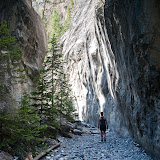
We got up at 5am in the dark and were on the trail by 6am, headed up King Creek. It's a nice canyon, but the trail criss-crosses back and forth across the creek on makeshift log bridges so it's a little slow.

In typical guidebook speak we were to follow the north fork past five gully systems until below a prominent drainage. We counted and recounted gullies and I think in the end we went up the right one.

The gully below the climb was still full of steep snow and we were in approach shoes without ice axes. The snow was just soft enough to kick steps. It would have been a long slide if we'd slipped.

We reached the bottom of the pillar about 9 am - 3 hours and the guidebook said 3 -4 hours so we were doing ok. We probably should have started a bit further up the gully but we'd had enough of the snow.

The climbing was reasonable, loose in places but that's to be expected in the Rockies. Some sections were nice and solid. According to the route description there should have been a ledge cutting across the face after two or three pitches where we figured the normal start would join up with us. We never found anything that fit the description.

That's Shelley highlighted, heading for the sun.

We were moving way too slow, mostly because of searching for protection and belay anchors. The rock tended to be either solid, but no cracks, or loose mounds of rubble. Neither are very amenable to placing protection.

According to the guidebook after about 6 pitches we should have reached easier 3rd class climbing. After 8 pitches, it had eased a bit but it still wasn't 3rd class scrambling. We started to wonder if we were on the right pillar. There'd been some signs of other climbers lower down but nothing after the first few pitches. And what we did see were signs of people rappelling off in retreat. Was that because they realized they were on the wrong pillar?

9 pitches took us six hours. It was 3 pm. The top still seemed a long way away. And it wasn't clear how we'd get to the descent ridge, which was supposed to be "easy downclimbing", but who knows what that meant. We had to make a decision whether to go for the top and hope for an easier descent, or cut our losses and try to descend the way we'd come up. At the speed we were going, either way we'd be lucky to get off by dark.

We decided to retreat. On the way up I'd been thinking I was glad we weren't going to have to come down this way. So much for that idea.

10 rappels later we reached the ground at 9 pm. Again, way too slow. Again, mostly because of searching for anchors. And, of course, trying to find the way down, keeping a clear line to pull the rope without snagging it. It meant leaving gear behind. A few spots we were able to loop horns. We rapped off single anchors more than I'd like. Not to save money, but to save enough gear for the rest of the descent. We always backed them up for the first person, but it's still riskier than I'd like.

After 12 hours of climbing on loose crap without either of us getting nailed, Shelley got hit in the leg by a rock I knocked off trying to straighten the ropes on the very last rappel. Luckily it wasn't bad enough to stop her walking out.

Damage from falling rock.

We made it down the steep snow and headed downhill to the creek in increasing darkness. Surprisingly, and thankfully, we found an easier route down than we'd taken on the ascent. I think there were a lot of nice wildflowers but it was hard to tell in the dark. And we actually found a path down the north fork of the creek that we'd missed on the way up.

By the time we reached the car it was almost 1 am - close to 19 hours since we'd set out. We hadn't taken more than a five minute break the whole day so we were pretty bagged. Amazingly, we'd had perfect weather all day. A bit windy in the afternoon, and a few high clouds, but nothing threatening. It would have been a miserable descent in the rain.

Looking at the mountain the next day, I think we were on the right route. It was hard to tell how high we reached. It might have been quicker to continue up and over the top, but I think we made the right choice. At least descending we knew the route.

In the end it all worked out ok, other than not reaching the top. We underestimated the length of the climb, and weren't in practice to move quickly enough. And I should have done a little more research, for example this report rates it 5.8 not 5.6 and they ended up having to bivy (didn't make it in a day). At least we avoided a cold bivy.
Tuesday, July 14, 2009

iPhone Photos

A few of the photos I've taken with the iPhone. I like the macro (close-up) ones best.

If you click on the slideshow to go to the album you can see how the photos are geo-coded (their location is automatically recorded). You can even see miniature photos at their location on a map.

Garter Snake iPhone Video


I was walking to work and I saw something up ahead on the path. As I got closer it started to look like a snake but it wasn't moving. I figured it was dead, probably run over by a bicycle or a maintenance vehicle. But when I got close enough, I could see it's head up and watching me.

I had my new iPhone in my pocket, listening to a podcast, so I pulled it out. I shot a still photo but I knew it wouldn't look like much. Then I realized that I could shoot a video clip. It was lucky that it was a cool rainy morning - on a warm day the snake would have been long gone before I could video it. I'm not sure what he was doing out and about in the cold weather, maybe he was snacking on the worms that were out on the sidewalk due to the rain.

Wednesday, July 08, 2009

The Dominant Animal

"It would indeed be the ultimate tragedy if the history of the human race proved to be nothing more noble that the story of an ape playing with a box of matches on a petrol dump."
-- William David Ormsby Gore, 1960

I just finished reading The Dominant Animal by Paul and Anne Ehrlich. I have to admit I'm starting to avoid these kinds of books. I don't need any more convincing and they just make me depressed.

Nonetheless, it's a good book, worth reading.

Step One: Change Government ?!

I just watched this video of a talk by Lawrence Lessig about the problems with the US political system, especially congress. Most of it also applies to our Canadian system, in the basic ideas if not the details.

I tend to agree that if we're going to get anywhere on the big problems of environment, climate, etc., first we have to change how our government works.

But I'm afraid that's not really a very encouraging conclusion. It just adds another impossible task to the growing list.

Saturday, July 04, 2009

Dave Matthews - Digging a Ditch


Sometimes my current programming project feels like "digging a ditch" :-)
and the current state of the world certainly "weighs down on me".

Digging a Ditch
by Dave Matthews

Run to your dreaming
When you're alone
Unplug the TV, turn off your phone
Get heavy on with digging your ditch

Cause I'm digging a ditch where madness gives a bit
Digging a ditch where silence lives
Digging a ditch for when I'm old
Digging this ditch my story's told

Where all these troubles
That weigh down on me will rise
Run to your dreaming
When you're alone
Where all these questions
Spinnin' around my head
Will die, will die, will die...

Run to your dreaming
When you're alone
Unplug the TV, turn off your phone
Get heavy on with digging your ditch

Cause I'm digging a ditch where madness gives a bit
Digging a ditch where silence lives
Digging a ditch when I am through
Digging this ditch I'll dig in for you
Where all these worries
Weighing down on me will rise
Where all these habits
Pull heavy at my heart
Will die

Run to your dreaming
When you're alone
Not what you should be or what you've become
Just get heavy on with digging your ditch

Cause I'm digging a ditch where madness gives a bit
Digging a ditch where silence lives
Where all these disappointments, grow angry out of me
Will rise...
Will die...
Will die...
Will die...

Run to your dreaming
When you're alone
Unplug the TV
And turn off your phone
Get heavy on with digging your ditch

[from lyricsmode.com]

Thursday, July 02, 2009

Souleio - A New Restaurant/Deli/Shop

Shelley and I went to Souleio for lunch today.
Souleio Foods embodies the true meaning of the word “organic” - authentic, artisanal foods produced with care and attention to the natural environment, encouraging both pride of place and pride in people within our own community and other communities around the globe.
The food was great (we shared a salad and a panini) and the store section had some interesting items. They're also selling some wine which is a brand new experience here, since until very recently you could only buy at government liquor stores.

But ... I was very disappointed to first get our food in a disposable takeout container, and then get our drinks in disposable plastic cups. Just to be clear, we were sitting in the restaurant area, there was no confusion that we wanted takeout.

For a place that makes a big thing about "sustainable" and "care and attention to the natural environment" I expect better. I emailed them to urge them to consider alternatives.

Wikimedia Pictures of the Year

Commons:Picture of the Year/2008 - Wikimedia Commons

Some great photographs. Even one of Mt. Yamnuska near Calgary.

Thursday, June 25, 2009

Lunch at the Berry Barn

We went to the Berry Barn for lunch today and wandered around the gardens. We even found some frogs in a small pond beside the wedding area.

2009-06-25 Berry Barn

Trailguru

Track ID#7AAJ (Running) | Saskatoon, SK, Canada - Trailguru

I recently bought an iPhone and I've been looking at the various running applications. This track is from one called Trailguru for a run I did this morning.

The GPS had some trouble in the lower unpaved trail through the trees, but it seemed to handle it ok, catching up when it did get a signal, although I think that's what threw off the max speed. (I didn't really run over 20 km/hr!)

The gap in the track is when I left the app to pick a new podcast to listen to. When I resumed, it wouldn't track until I turned off "Airplane" mode (cell and wifi disabled) which I'd done to conserve power. But it had worked up till then in Airplane mode. Strange.

The other ones I've been looking at are MapMyRun and RunKeeper. I haven't decided which one I like best.

If I'm going to use the iPhone on runs I'm going to have to buy an armband carrier. Holding it in your hand, like I did today, is not the most convenient. But I'm not convinced I really want to. One of the things I like about running is that it's low tech.

Monday, June 22, 2009

Old Dogs Still Have a Few Tricks

Shelley and I were in the Urban Adventure Race in Saskatoon this weekend. We entered for fun and to support the event. Neither of us had really been training much and we weren't particularly competitive or expecting to do that well.

Surprisingly, we ended up winning!

There were 21 teams with 2 or 3 people per team. Half the race (2 hours) was on bike, the other half was on foot. We were the oldest racers and I'm sure we weren't the fastest - there were triathlon people, and bike racers and marathon runners. That's the nice thing about adventure racing in general, and even more so, score competitions* like this one - it's not enough to be fast, you also have to make the right strategic and tactical decisions. I think our experience with score competitions like the Navigation Marathon helped. And we also know the city and river bank trails pretty well. And I've spent a lot of hours reading maps, especially from planning the Prairie Pitch races. (The maps were from Google Earth which added a good twist. Most of the streets weren't labeled, but you could identify other features which wouldn't have been on a street map.)

The start was amusing. They handed out the maps a few minutes before start time and while everyone was studying them the start time came and passed. Finally Shelley asked "can we start" and they said yes so we took off, leaving everyone still standing around. So we had everyone chasing us for the first few points. (Although, you have to be careful not to rush too much because not spending enough time planning your route can also cost you.) Of course, this didn't last very long - one of the nice things about a score competition is that people make different route choices and scatter, instead of all chasing each other around the same course. Even when you do see other teams you have no idea whether they have more or less points.

* A score competition is where you have a fixed amount of time to collect as many marked locations as possible. Some locations may be worth more points e.g. if they are further away or harder to find. If you exceed the time limit then you get points deducted from your score.

Hoedown from Rodeo

Hoedown from Rodeo from Eleanor Stewart on Vimeo.


Very cool. Worth switching to full screen (the four arrow icon next to "Vimeo")

Sunday, June 21, 2009

2009-06 Kayak Trip

Last week I spent three days kayaking down the North Saskatchewan river from North Battleford to Saskatoon, about 100 km.


Although it runs through developed farmland, the river and banks are still mostly wild. I didn't see any other people during the trip, other than the one bridge I passed under about halfway. I did see lots of wildlife - moose, deer, coyotes, beavers, muskrats, and of course, geese, pelicans, and other birds.

I had great weather, if anything a little too hot, which led to some afternoon thundershowers. But the mornings were beautiful.

2009-06 Kayak Trip
I didn't take a lot of photos. On the water I tend to keep my camera in a dry bag, but that means when I see wildlife I usually can't get the camera out in time to catch them.

The river was quite shallow and slow (~ 2 km/hr) so it took me longer than I had expected. Four days probably would have been better. I spent about 10 hours a day on the water, which might sound like a lot, but with 16 or more hours of daylight it still leaves time to relax.

Friday, June 19, 2009

Finding Coral

Day 9 - The Search | findingcoral.com

These folks are doing a great job of publicizing this project. Otherwise, you'd never hear about a bunch of scientists out doing research.

We think our world has been explored to the last detail, but it's amazing how much we don't know about the underwater world.

Jordy Gold and Urban Sustainability

TheStar.com | News & Features | 'Icebreakers' seek common ground:
He may not be the green Messiah but he sees dark days coming. And, amiable as he is, when he talks about what he thinks it'll take to ward them off, he exhibits the proselytizing zeal of a hellfire-and-damnation evangelist.

That doesn't, he insists, make him a prophet of doom.

'If you were a pessimist, you might as well just give up right now,' he says. 'All I want is for people to act like adults.'
via WorldChanging Canada

Wednesday, June 17, 2009

Bixi: the Bicycle-Taxi

WorldChanging Canada: Bixi: the Bicycle-Taxi for a Bright Green City

Cool.

Of course, our winters in Saskatchewan would be a problem.

Balloon Ride

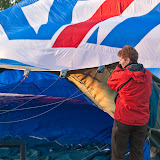
We finally got our balloon ride after three years of trying. Every time we were booked, the weather would be wrong - too windy, too calm (!), rain, clouds, etc. Then you'd have to rebook a month or two in advance so you only got a few tries per summer. I was starting to wonder if it would ever happen. But in the end we had a beautiful morning, as you can see from the pictures. It's a very peaceful experience.

2009-06-12 balloon ride

California State Parks Closing?

Schwarzenegger proposes closing 80 percent of California state parks - San Jose Mercury News

I'm not sure what to think about this.

My first reaction was that it was awful.

But if they just close the gates to vehicle traffic, maybe that's not so bad.

The concern is that there will be vandalism and other abuse, but if you can't drive in, will that really happen?

Wednesday, June 10, 2009

Sharkwater

I watched the documentary Sharkwater last night. There's some beautiful underwater photography. But it's also depressing.

We (people) have killed about 90% of the sharks so far. About the same as we've done to most large fish. The difference is that we don't eat the sharks like we did the fish, we just cut off their fins for shark fin soup and discard the rest.

Shark fins don't even have much flavor (they're just cartilage). But people, mostly the Chinese, will pay large amounts of money for it. And because there is so much money involved (literally billions of dollars) governments don't stop it. Even where it's illegal like in Galapagos, the government turns a blind eye.

Of course, it doesn't help that sharks are commonly portrayed and thought of as monsters. So people aren't as concerned about them being wiped out as they are about cuddly panda bears.

Part of the film is with Paul Watson of Sea Shepherd. He was one of the founders of Greenpeace but left to form Sea Shepherd because Greenpeace wasn't radical enough. (my oversimplification) I have a lot of admiration for people who don't just talk and inform, but actually take direct action.

Tuesday, June 09, 2009

Walkability

Get Your Walk Score - A Walkability Score For Any Address

Our current address gets a "Somewhat walkable" 52 out of 100. We avoid driving by riding our bikes.

If Rivergreen Ecovillage gets off the ground and we move there, we'd rate 90 out of 100 - "Walker's Paradise"

How does your address rate?

Sunday, June 07, 2009

Talking About Running

I just finished reading What I Talk About When I Talk About Running by Haruki Murakami, a Japanese novelist, runner, and triathlete.

I really enjoyed this book and identified with what he talked about. I'm not a serious runner, I don't enter any races. But I've run fairly regularly since I was a kid. Nor am I a serious writer, but I've done a little, and I'm certainly a serious reader, and in some ways my programming is a similar solitary creative pursuit. I'm also reaching a similar age as Murakami writes about - the point where you have to face the fact that your physical performance is past its peak.

Here are some of my favorite quotes from the book:
"Sometimes I run fast when I feel like it, but if I increase the pace I shorten the amount of time I run, the point being to let the exhilaration I feel at the end of each run carry over to the next day. This is the same sort of tack I find necessary when writing a novel. I stop every day right at the point where I feel I can write more. Do that, and the next days work goes surprisingly smoothly. I think Ernest Hemingway did something like that. To keep going, you have to keep up the rhythm. This is the important thing for long-term projects. Once you set the pace, the rest will follow. The problem is getting the flywheel to spin at a set speed - and to get to that point takes as much concentration and effort as you can manage.
This seems very true for my big programming projects.
"It might be a little silly for someone getting to be my age to put this into words, but I just want to make sure I get the facts down clearly: I'm the kind of person who likes to be by himself. To put a finer point on it, I'm the type of person who doesn't find it painful to be alone. I find spending an hour or two every day running alone, not speaking to anyone, as well as four or five hours alone at my desk, to be neither difficult nor boring. I've had this tendency ever since I was young, when, given a choice, I much preferred reading books on my own or concentrating on listening to music over being with someone else. I could always think of things to do by myself.
I've always been happy on my own as well, preferring to run on my own, and happy to read or work on projects on my own.
"I'm in my late fifties now. When I was young, I never imagined the twenty-first century would actually come and that, all joking aside, I'd turn fifty. In theory, of course, it was self-evident that someday, if nothing else happened, the twenty-first century would roll around and I'd turn fifty. When I was young, being asked to imagine myself at fifty was as difficult as being asked to imagine, concretely, the world after death. ... For me - and for everybody else, probably - this is my first experience growing old, and the emotions I'm having, too, are all first-time feelings. If it were something I'd experienced before, then I'd be able to understand it more clearly, but this is the first time, so I can't. For now all I can do is put off making any detailed judgments and accept things as they are. Just like I accept the sky, the clouds, and the river. And there's also something kind of comical about it all, something you don't want to discard completely.
"I look up at the sky, wondering if I'll catch a glimpse of kindness there, but I don't. All I see are indifferent summer clouds drifting over the Pacific. And they have nothing to say to me. Clouds are always taciturn. I probably shouldn't be looking up at them. What I should be looking at is inside of me. Can I see kindness there? No, all I see is my own nature. My own individual, stubborn, uncooperative, often self-centered nature that still doubts itself - that when troubles occur, tries to find something funny, or something nearly funny, about the situation. I've carried this character around like an old suitcase, down a long dusty path. I'm not carrying it because I like it. The contents are too heavy, and it looks crummy, fraying in spots. I've carried it with me because there was nothing else I was supposed to carry. Still, I guess I have grown attached to it. As you might expect.
"I expect that this winter I'll run another marathon somewhere in the world. And I'm sure come next summer I'll be out in another triathlon somewhere, giving it my best shot. Thus the seasons come and go, and the years pass by. I'll age one more year, and probably finish another novel. One by one, I'll face the tasks before me and complete them as best I can. Focusing on each stride forward, but at the same time taking a long-range view, scanning the scenery as far ahead as I can. I am, after all, a long-distance runner.

Friday, June 05, 2009

The Day the Earth Stood Still

Warning: Potential spoiler - I give away some of the story.

I recently watch the movie The Day the Earth Stood Still. I didn't know much about it, just that it was science fiction and starred Keanu Reeves. It's a remake of a 1951 classic.

So I was pleasantly surprised when I got to the part where you find out the aliens are here to wipe out humanity because we're destroying the earth. (I wonder if that was in the 1951 version?)

After that I was cheering for the aliens, although I'm sure you're supposed to be cheering for the poor humans struggling not to get snuffed.

By almost any definition, homo sapiens is an incredible pest. If any other animal or plant had spread as much as we have and altered the planet as much as we have, we'd certainly be trying to "control" it (a euphemism for wiping it out).

Wiping out people entirely might be a little extreme, but certainly the earth would be better off with a lot fewer of us.

Often, pandemics are listed as potential problems of the same order as environmental destruction. But even the worst pandemic (depending on your definition), the bubonic plague, only killed roughly 50% of the population. That would still leave us with billions of people. But if we destroy the environment, that could kill not only all humans, but huge amounts of other life as well.

I was disappointed with the ending of the movie. The humans (mostly Jennifer Connelly) convince the aliens (represented by Keanu Reeves) that humans shouldn't be wiped out because we are actually nice people who care about our kids, and we can change, even if our track record is abysmal. Come on, how gullible are these aliens?

Oh well, I didn't really expect the movie to end with humans getting wiped out, as pleasing as that might be to a rabid environmentalist.

Wednesday, June 03, 2009

Logging Banned in Manitoba Parks

Logging Banned in Manitoba Provincial Parks | Canadian Parks and Wilderness Society, Manitoba Chapter

This is great news, but naively I would have assumed logging wasn't allowed in provincial parks.

Regardless of whether you think parks are for recreation for people, or to protect the environment, I can't see how logging fits into the picture.

Or at least, the only way I can see how it fits is that profit driven logging companies and money driven governments were cashing in.

Of course, I don't think hunting or motorized vehicles (e.g. snowmobiles, atv's, jetski's, powerboats) should be allowed in parks either. But that does depend on whether you think parks are for recreation or protection. I think parks can server both purposes, but only if you stick to self-propelled recreation.

I guess the next question is what about the other provinces? Does Saskatchewan allow logging in our provincial parks?

Tuesday, June 02, 2009

Australia Revisited

I know it's long out of date, but I never finished posting our Australia photos, so here's a batch from Perth.
2008-09 Perth, Australia

Monday, June 01, 2009

The War on the Car

From WorldChanging Canada: City Changing: Re-mixing Built Environments:

Recently, Toronto's city council approved plans to transform Jarvis Street from a five-lane car-only street to a four-lane street with bike lanes. This came after significant resistance from council members who claimed that an alteration of the street was but one battle in an alleged "war on the car". Dissenting council members also claimed that all parties involved—the some 27,000 cars that traverse Jarvis Street on a regular basis—had not been consulted. Instead, the city had sponsored an ad in NOW Magazine querying public opinion on the idea of bike lanes. Because NOW is a local, youth-oriented publication, it was assumed that thousands of drivers were being excluded from the conversation at the expense of Toronto's cyclists, who appeared at public planning meetings in droves to exhort city planners to move forward with the bike lanes.

While the approval of the lanes is good news for both environmental improvement and cyclist safety, the length and speed of the debate indicates the kind of uphill battle in store for people who want to engage in what we might consider "urban re-mix."
I love the "war on the car" part.

DSLR Cameras

Although I'm quite happy with my Pentax K10D, I could always use higher ISO and better auto-focus. There never seems to be enough light to use a fast enough shutter speed for hand held shooting, or a small enough aperture for more focus lattitude. Thank goodness for image stabilization or I'd be even worse off.

So I can't help but covet the Nikon D3's awesome low light abilities. Of course, it also costs roughly $5000 and is a huge heavy beast, so I don't really want one.

The Nikon D700 also performs well and it's somewhat cheaper and smaller. But, like the D3, it has a full-size sensor (the actual size of 35mm film). The bigger sensor is one of the reasons for the better performance. The problem is that I like the increase in focal length that the smaller sensors give you. On a full size sensor, my zoom would be 18 to 250mm. But on my Pentax with a smaller sensor, it's equivalent to 27 to 375mm. You could use a tele-extender but then you lose another stop of light, and this zoom is already quite slow. Of course, there are other lenses, but that's a whole 'nother story!

I've looked at the Nikon D300, which has a smaller sensor, but it's performance isn't as impressive as the D700 (or the D3). The Nikon D90 which is actually a more "consumer" oriented model, actually does better for low light, also does video, and it's considerably cheaper.

One of the reasons I bought the Pentax was because it had in-camera image stabilization, which means you're not buying expensive image stabilization in multiple lenses. But so far, I've stuck to my one super-zoom lens, so the argument doesn't really hold. And the image stabilized Nikon version of this lens is actually 18 to 275mm (as opposed to 250mm).

I also like how the Pentax will output standard DNG format instead of just a proprietary format like most other cameras, although this isn't a huge factor.

To complicate things, Pentax is coming out with a new K7 model this summer. Full test results aren't out yet so it's hard to tell how it will compare. It shoots video like the D90. And it's small and light and weather/dust proof which is a plus for me. The auto-focus is supposed to be better. And it would work with my existing lens. The resolution has increased, which is good in some ways (more room to crop), but higher resolution means smaller pixels on the sensor, which usually means more noise (i.e. worse low light performance). e.g. My Pentax K10D sensor with 10mp rates higher than the more expensive K20D with 14mp. (Of course, there's a lot more to a camera than just the sensor.)

Of course, I don't really need a new camera at all. An expensive camera is no guarantee of good pictures!

PS. For some reason I haven't got interested in Canon cameras, although I've had several smaller Canon's, and I'm sure their DSLR's are good too. The Sony Alpha's also have good specs but I don't know much about them either.