Showing posts with label photography. Show all posts

Saturday, August 01, 2015

Photo of the Day

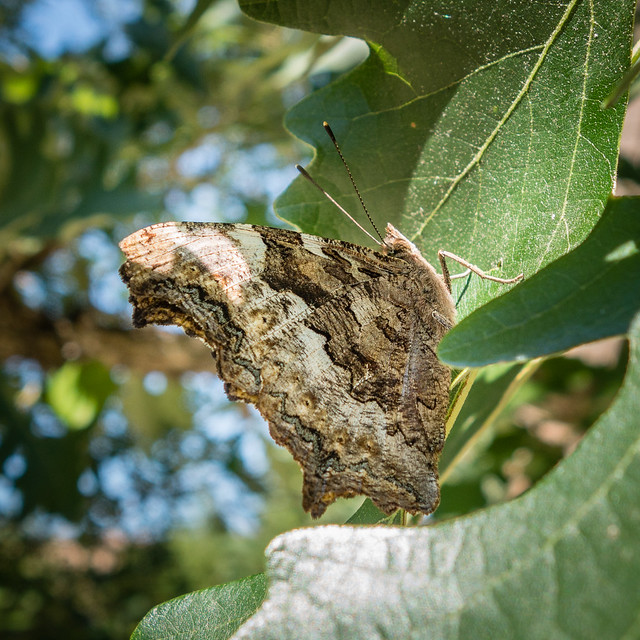
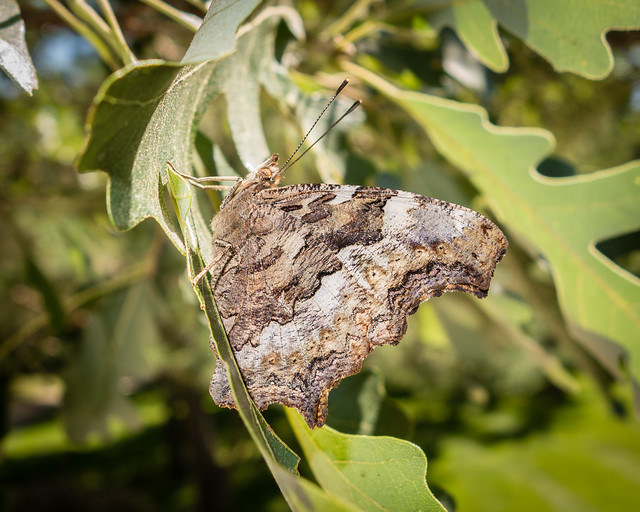
butterfly

I spotted this butterfly landing on a tree as I was walking back to my office after lunch by the pond at Innovation Place. I stopped to look at it, assuming it would fly away shortly since usually they don't sit still for too long. It stayed for a while, even letting me get quite close so I backed off and pulled my camera out of my pack. As soon as I took the first shot I knew it wouldn't be very good since I was shooting towards the sun and a bright sky, making the butterfly too dark.


This is probably recoverable on the computer, but it's better to start with something decent, rather than try to rescue it later.

I could have adjusted the camera exposure to make the butterfly brighter, but then the background would have been "blown out" (too bright). So I turned the flash on. Usually I'd lower the flash power so it wasn't overpowering, especially up close. But I figured with sunny mid-day I wouldn't need to. Looking at the photos on the computer I probably should have still lowered it a little bit.

I also tried moving around so I was shooting away from the sun and didn't need the flash, but it wasn't as good an angle, although more natural looking without the flash.

butterfly

Why do I think this is a butterfly rather than a moth? There's no simple answer, but a bunch of clues:

  • thin antenna with "clubs" on the end
  • out during the day (most moths are nocturnal)
  • resting with wings together (moths usually rest with wings open)
  • butterflies are often more colorful than moths, and although the underside of this one is fairly drab, the top side was a much brighter orange
However, butterflies usually have smooth slender bodies, whereas this one was stouter and furry looking like a moth.

From my butterfly app I'm guessing this is a California Tortoiseshell (Nymphalis californica), although Saskatoon is on the edge of its range. (It's usually found in forested areas in the mountains.) 

Tuesday, May 19, 2015

The Road More Traveled

I'm normally a fan of the road less traveled. But it can be problematic. Since 2007 I've been using Pentax DSLR's (K10, K7, K5ii, K3) And I've been happy with them, at least until the K3 started giving me problems. I'll leave that story for another day when the saga is over but the end result is I've had enough of Pentax.

I'd already been wondering how long I'd stick with Pentax since their market share is tiny. Which means things like lenses aren't always available in Pentax versions.

These days Canon and Nikon pretty much have the market cornered. Both are good and which is "better" is heavily debated. Canon probably has the lead in video, but I shoot very little video.

I wanted an APS-C sensor, for a smaller camera and for longer reach with lenses. (due to the crop factor.) That meant either the Nikon D7200 or the Canon 7D mk2.  DSLR's seem to be focusing on full size sensors, while people willing to settle for smaller sensors are moving to mirrorless cameras. I like my little Sony but for certain types of photography, a DSLR is still the best choice. I decided to go with the 7200. One (minor) factor was that the 7200 takes two SD cards whereas the 7D takes one SD and one compact flash (which would be useless to me). Both are recent releases so the models won't be outdated too soon. (The Nikon D5500 is quite a bit smaller and has much the same sensor, but it doesn't have the same level of controls and displays.)

I'm not really looking forward to the switch. I have the Pentax in muscle memory and now I have to learn a whole new set of controls. Admittedly the functionality is mostly the same but the way you control it and the quirks are all different.

Any complex system has parts you don't like. And Nikon and the 7200 are no exception. One thing I found right away is that there's no easy way to reset the settings. This isn't unusual, my Sony RX100 is the same. Maybe it's just because I'm forgetful, but too many times I've altered settings for a particular shot and then unintentionally continued to use those settings, ruining a bunch of subsequent shots. I liked Pentax in this respect. It had a green button that would reset the basic exposure. And you could also define what settings should be kept or cleared when you powered off. I had mine set to clear almost all the settings when powered off. At first I thought I had found the Nikon equivalent - two buttons with green dots that you held down together. But you have no control over what it does and it clears way too much, including switching to JPEG mode! I find it hard to believe that JPEG should be the default. On a relatively high end camera like this surely most people are shooting RAW. On the other extreme, turning off the camera doesn't seem to reset anything. You can turn the camera off in the middle of a bracketing sequence and when you come back in a week it'll want to finish the bracketing. I guess that makes sense if you have to turn off the camera to change batteries or memory cards, but that'll be the exception. For me it'll be much more common that I'll end up shooting with the wrong settings. But I'll live with it, like I do with the Sony.

Another quirk is that for bracketing the 7200 requires you to either press the shutter multiple times or switch to continuous mode, whereas Pentax automatically allows continuous for bracketing.

One good feature of the 7200 is that you can still shoot RAW in full auto mode. On the Pentax full auto forces JPEG.

One theoretically big difference is that Pentax has image stabilization in the body, whereas Nikon (and Canon) have it in the lenses. To me it makes sense to have it once in the body instead of in every lens. But Pentax lenses weren't especially cheaper because of this, and as long as you have stabilized lenses there's not much difference.

As far as image quality goes I'm not expecting much difference from the K3. There's a minor increase in resolution - the 7200 is 24mp whereas the K3 was 20mp. Low light performance and auto-focus might be a little better. However, for the last six months I've been forced to use my older K5ii while my K3 has been away getting "serviced", so there will definitely be a bump in quality from what I've been using lately.

Of course, this means replacing lenses, flash, remotes, batteries, etc. On the positive side, I replaced the 18-250 with the Nikon 18-300, and will be replacing the Sigma 150-500 with the 150-600 (due out shortly), so I'll have a little more reach with both. (With the tradeoff of slightly larger size.) Hopefully I'll be able to sell the Pentax gear and recoup at least some of my costs.

I haven't taken many photos with the 7200 yet. As a true geek (of a certain sort) I've been studying the manual first :-) These two were taken in the backyard while experimenting.
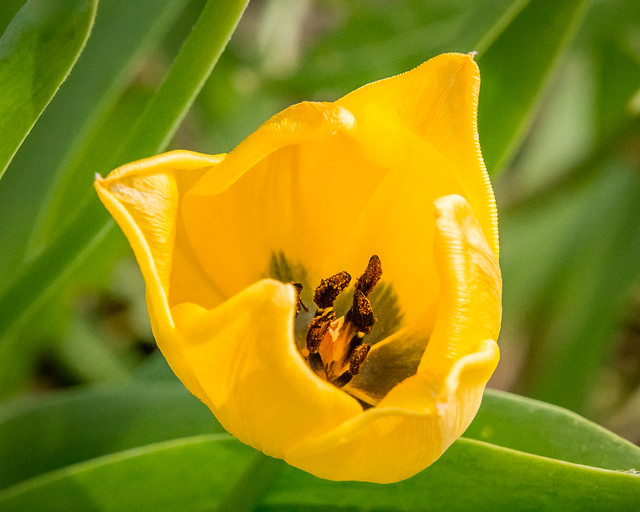
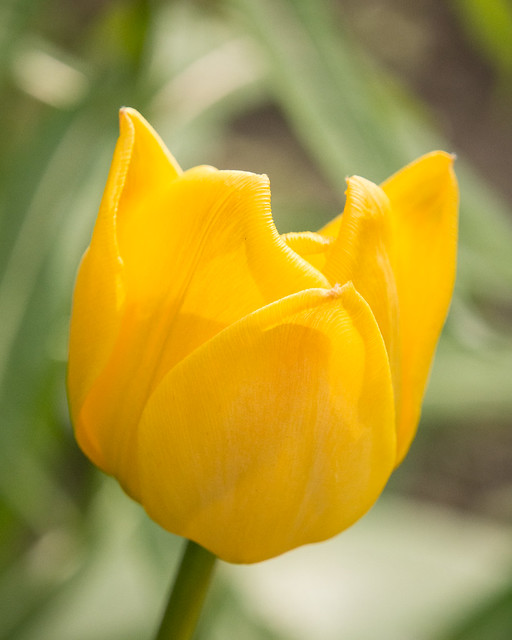
flowers

flowers

I'm a little sad to be joining the mainstream. Never liked to be one of the crowd. The first thing I have to do is replace that gaudy Nikon neck-strap since I have no desire to be a walking advertisement!
Wednesday, January 15, 2014

Macro at the Mendel

I've been known to say "it's not the camera" when people equate good photographs with good cameras. I don't mean that in an insulting way, just that you can take good photographs with a basic camera, or bad ones with a fancy camera.

However, there are things that are hard to do without the right camera gear. One of those is "macro" photography - extreme close-ups. It seems a little odd that it's called "macro", which means "big", when it deals with small stuff. But the "big" that it's referring to is the photographs, not the subjects.

I've done a fair bit of macro type photography with my Tamron 18-250 zoom lens, but it's not really designed for it. I really enjoy this type of photography so I decided to buy a specific macro lens - the Pentax 100mm Macro.

There aren't many flowers or bugs around this time of year so I headed over to the Mendel Conservatory to try it out. I took a few shots on the way there. I'm amazed this one turned out so well since it was quite windy and everything was blowing around. I've taken photos of these fluffy seeds before, this is a close-up of where they attach to the stem.

seeds

There weren't too many flowers, even in the conservatory, so I took some photos of the cactus:

cactus

The depth of focus gets really shallow with macro photography, which can be frustrating when you don't get sharp photos, but it can also lead to some interesting effects:

flower

The lens also works well at not so close range (although these are still small flowers).

flower

It was a cloudy day which meant it was a little dim inside the conservatory so for some of the shots (like that last one) I was using the flash on the camera with a homemade diffuser (to make the light less harsh).

homemade flash diffuser

See all 16 photos as a slideshow or overview

Sunday, September 29, 2013

New Camera

I've been considering the Sony RX100m2 (or II) since it was announced a few months ago as an upgrade to the original RX100. I've been happy enough with the Canon G12 as my "small" camera, but I was attracted by the small size and high image quality of the Sony. I finally gave in and bought one on Friday (From Don's Photo since I believe in supporting local retailers even if it costs a little more).

It's substantially smaller than the G12, but it has a larger sensor, higher resolution, and better low light performance (high ISO). It doesn't have a fully articulated screen like the G12, but the screen does tilt up and down which is almost as useful. And the screen is double the resolution. What I will miss are the external controls on the G12. It had separate dials for many functions whereas the RX100 relies more on on-screen menus.

Sony Rx100 II versus Canon G12

My first test was of a flower from a bouquet on the dining room table. It was quite low light, but it came out pretty well.

Untitled

I took a few more shots at the Farmer's Market Saturday morning, somewhat awkwardly because I had a shopping bag and a coffee in one hand and was trying to operate an unfamiliar camera with the other hand.

Untitled

It was a beautiful sunny day so when the sun got a bit lower in late afternoon I wandered down the back alley and over to the nearby community garden to see what I could see. I took a bunch of closeup shots. The RX100 does quite well at this but it will only focus close when fully zoomed out to wide angle. The G12 is similar but it will focus closer than the RX100 when you zoom. However, the RX100 has double the resolution so you've got more leeway to crop.

ladybug

slideshow or overview of set (31 photos)

It's going to take awhile to get accustomed to all the features on the RX100, but I'm definitely impressed by the quality of the images. (All of these images were shot Raw and processed in Lightroom.) And the tiny size will be great for everyday carry and travel.

One of the factors in choosing the RX100 is that it's one of the top rated compact cameras for underwater photography. There are several companies making underwater housings including Ikelite, Recsea, and Nauticam.

The user's manual that comes with the RX100 is pretty skimpy, especially considering how many features the camera has. I picked up Gary Friedman's guide (in ebook) which is helpful.

Monday, August 12, 2013

Focus Stacking

When shooting close-ups, especially with a fair bit of telephoto, you end up with a very shallow depth of focus. I took these two shots to see whether it would look better with the focus on the bud or the larger petals.


But neither of them really excited me. Flipping between them, I realized they were so similar that I could probably "focus stack" them in Photoshop. i.e. merge the two photos, retaining the best focused parts of each. It was a good opportunity to try a new technique. The result still wasn't one of my favorites, but it's pretty cool how well it works, especially since the process is fully automatic.


The normal advice is that you need to use a tripod to do focus stacking to ensure that you don't move between shots. But this seemed to work ok even though it was handheld. You'd also normally take more than two shots.

It would be nice if my K5ii had a focus bracketing feature - that would make it a lot easier to get just the right focus (or to do focus stacking). Exposure bracketing is more common, along with the equivalent stacking for HDR (high dynamic range).

[My apologies to the non-techies and non-photographics. If I'm not careful this is going to turn into a photography blog.]

Friday, July 19, 2013

Dinner with eagle and lens (and Shelley)

Our first night in Prince Rupert we walked up the hill to the Crest Hotel for supper. I took my camera and brand new telephoto lens with me, just in case.

We had a great corner table looking over the bay and shortly after we had sat down I realized there was a bald eagle on a crane down by the water. At first I wasn't going to get my camera out but eventually I couldn't resist. I took a few shots through the window and then moved out to the deck. I'm afraid Shelley (and my food) got somewhat ignored!


A bit later (halfway though salad) the eagle left its perch and flew up to land in the tree much closer to us. Out came the camera again. These shots were a bit better.  He flew away again, but during dessert he showed up back at the original spot. And then flew up to the tree. And from there to a tree on the other side of the hotel where I got a few last shots.

(click to view 4 photos)
Bald eagle


Tech Notes

Obviously, I finally took the plunge and bought a bigger lens - a Sigma 150 to 500mm. I've resisted for a long time, not wanting the size and weight and having to change lenses. But much as I like my small Tamron 18 to 250mm, it just isn't quite long enough for birds and other wildlife. (Note: The K5ii has a 1.5 crop factor so the Tamron is equivalent to 27-375 and the Sigma 225-750)

Originally I put the Pentax 300mm f4 and a 1.4 teleconverter on order. But then I found out that autofocus doesn't work with teleconverters on the K5ii. I'm not prepared to manually focus so I scrapped that idea. I looked around for other options and found the Sigma. It gets mostly good reviews, especially in terms of value for money. It's not cheap, but you could easily pay ten times as much for an equivalent "pro" lens. It's not a fast (bright) lens at f5-6.3, but that's the same as the 18-250. You can mostly get around that with the ability to shoot at high ISO.

Don's in Saskatoon didn't have the Sigma in stock, so I emailed McBain's in Edmonton and they had it. I knew it was big, but I was still a little shocked when I first saw it. Zoomed out to 500mm, with the lens hood on, it's long!

Tamron 18-250
Sigma 150-500
Sigma 150-500 at 500 with lens hood
I took a few test shots with my camera in the store. It seemed to autofocus well, and even hand held at 500mm I could still get some reasonably sharp images. The lens has built in optical image stabilization in addition to the image stabilization built into the camera. I was afraid I'd be forced to use a tripod to get decently sharp shots, but with a little creative use of trees and railings for support it's not bad.

So far I've been pretty happy with it. I wouldn't have been able to get these eagle shots with the old lens.

See also: other posts and the collection of photos from this trip.

Sunday, April 21, 2013

Print of the Week

Sunrise over Carmen Island, from Loreto, Baja, Mexico.

Baja sunrise
(Click to view larger)


When Shelley would get up early to go for a run before it got too hot, I would head for the beach with my camera. The island made the shots a little more interesting than just sky and water. I like the reflections in the water as much as the clouds.

I took the plunge and printed on 17x22" paper for the first time (Epson Exhibition Fiber again). I was happy with how it turned out. I used Perfect Resize to resize it to 360dpi before printing, although that probably didn't make a big difference in this case. (4700x3100 => 7900x5200). I tried tweaking it with the Nik software that I recently bought (the price has been reduced by 70%), but I decided I was happy enough with it just from Lightroom.

I always struggle with how to adjust the color on these kinds of shots. You want rich colors, but not to look too gaudy. To complicate it, actual prints are not as brightly colored as backlit screens.

See also: other print posts

Sunday, April 14, 2013

Print of the Week

shining water
(click to view larger)


This photo was taken on our recent train trip around the United States, at Rockfish Creek just south of Charlottesville, Virginia. It was a pretty little creek with a few miniature waterfalls like this one. I love flowing water and reflections - I took a bunch of photographs here, but this is one of my favorites.

I've been posting some of my favorite photos on 500px and this one got the best response I've had so far. That surprised me a little since it's not particularly colorful and somewhat abstract.

I like the dark blues at the top, with the patch of warmer orange colors, balanced by the white foam at the bottom. I also liked the way the sun glinted off the falling water and made bright lines.

I slowed down the shutter as much as I could (by setting the ISO to the minimum of 80, and the aperture to f/32) which gave me a shutter speed of 1/15 of a second. It was a bright day so I would have needed a neutral density filter to go any slower, or to come back closer to sunrise or sunset. But 1/15 is about as slow as I can handhold anyway (no tripod as usual!) even with the camera's image stabilization. To be as stable as possible I was sitting with my elbows braced on my knees. The other trick is that I didn't include any static objects like rocks or trees since they would have shown up any shake more than the flowing water.

This was my first print on Epson Exhibition Fiber paper. I really like the results. It has nice deep blacks and good contrast. It's expensive paper, but no more so than buying lattes! I chopped up a 13x19 sheet into nine 4x6's to use for test prints. I use cheap glossy 4x6 paper at first, but to really judge the final result you need to use the same paper. I used a color profile I'd made myself with the ColorMunki and it seemed to match pretty well between screen and printer. I also used the soft proofing in Lightroom. Since I'm still getting used to the new printer and paper I just printed on 13x19. (I haven't used the 17x22 paper yet.)

See also: other print posts

Sunday, April 07, 2013

Print of the Week

Recently I've been making a point of making a print of one of my photographs each week. Partly for practice, and partly to hang up the prints and enjoy them.

This week I chose a photo of a wood duck that I took at the New Orleans Zoo on our last trip. I've seen these ducks before and I love how colorful they are, but I've never managed to get a decent photograph until now.

(click to view larger)
Wood Duck


I would have liked to have a lower view point rather than shooting from above. But I was happy with the very plain background. It almost looks like he's suspended in the air. (As with most birds, it's the male that's colorful.)

I also would have liked a little better depth of focus, so that the whole bird was sharp, but at least the head and eye are good, which is the most important thing. One of the tricks I learned on this trip with the new Pentax K5 II is to push the ISO higher. The camera by itself (on automatic) is quite conservative with ISO. Most of the time I'm happy to trade slightly more noise from a higher ISO for a faster shutter speed and greater depth of focus (from a smaller aperture i.e. higher F-stop).

I printed this 13" x 19" on the last of my Ilford Galerie Smooth Pearl. I've bought some new Epson Exhibition Fiber paper to try next. My first test small prints were too dark as usual, even though I have the brightness turned down on my monitor. Part of the learning process.

This was the first large print on my new Epson 3880 printer, an upgrade from my previous Epson R1800. The 3880 will print up to 17" wide as compared to 13" for the 1800. I'm looking forward to doing some 17" x 22" prints on it.

Along with the new printer, I also got an Xrite ColorMunki Photo device to calibrate my monitor and printer. So far, it's been easy to use and I had no problem calibrating my iMac display and creating color profiles for the printer. It's hard for me to tell how much difference it made, but in theory it will help ensure that colors match between the display and prints.

If anyone is interested in a print of one of my photographs I'd be happy to practice my printing skills.

See more of my photos on Flickr. This particular photo came from the New Orleans Zoo set in the 2012 Train Trip collection.

See also: other print posts

Sunday, March 24, 2013

Photo Notes

Osprey launch
Osprey launching from a tree (click to view larger)

It was quite frustrating trying to take photographs of birds during our kayak trip on the Suwannee river. The forest was quite thick so it was hard to get a good view. And if a bird was in sight, then as soon as I would pull my camera out and go to take a picture, it would fly away. The worst were the Great Blue Herons - instead of just flying away, they would just move ahead a few hundred yards so you could repeat the frustrating process multiple times! (Eventually I did manage to get a few shots of them, like this and this.) There were kingfishers and northern cardinals around that I would have loved to capture but they were too elusive.

On top of that, the kayak is always moving, and if there is a strong current, you can drift past before you have a chance to take a picture.

When I took this I was actually trying to get a picture of the osprey sitting on a branch.  But just as I went to press the shutter it launched into the air.

In this case, by pure luck, it worked out really well - the spread wings reaching for the air make a much better shot than a static bird on a branch.

It was also fairly early in the morning so the light was quite nice and warm, and the sky wasn't overpoweringly bright, but there was still enough light for a reasonably fast shutter speed.

You can tell in this shot from a few seconds later that it was keeping an eye on me.


As usual, it isn't as sharp as I'd like but given the circumstances I was lucky to get the shot at all. Often when I try to catch a bird in motion the camera can't focus fast enough and refuses to fire at all. And it was good enough (for me) to print at a reasonable size.


See also: other print posts