I should have written this as soon as I got back, but things have been busy, as always. Lots of memories from the trip (even though it already seems like I was never gone!) Here's how it went...
43 hours after leaving Saskatoon I arrived safely in Kathmandu with my luggage intact. Hurdle number one passed.
I wasn't as excited about Kathmandu this time. It's still a neat place and I enjoyed revisiting favorite spots, but I wasn't as excited about being there as I have been in the past. The political turmoil didn't help - soldiers and police everywhere, tanks rolling down the streets, curfew keeping us shut in the hotel. In the Thamel tourist district, where our hotel was, it was pretty quiet and there were few signs of the problems. But from the rooftop terrace of our hotel we could hear teargas and gunfire and see the pillars of smoke from demonstrators burning tires in the streets.
Because of the problems we were delayed a day and ended up taking a helicopter from Kathmandu to Kodari on the border with Tibet. It cost us an extra $300 each but I think it was worth it. We were glad to "escape" from Kathmandu.
Although I was climbing solo I traveled and shared a base camp with 7 other climbers (one pair and 6 more solo) who had also signed up with Asian Trekking.
We skipped the night at Zhangmu and went straight to Nyalam, putting us back on schedule. Two nights there, then on to Tingri for another two nights of acclimatization. Neither place is any joy. Cold, windy, dirty. The same chinese food every day. On the positive side, it makes you happy to get to basecamp!
A little headache and nausea at Nyalam but not too bad. Maybe altitude or maybe just the food or water. Several of our group were hit quite badly by traveler's diarhea and vomiting.
The end of the road (Chinese Base Camp) was as desolate, windy, and dusty as I remembered. The difference was the Tibetan teahouses where you could eat and sleep (for a price). Nothing like that last time I was here.
Another difference was the road all the way to the intermediate camp. For $50 four of hired a jeep to drive us up. I felt a little guilty not walking, but there didn't seem much point in walking up the road!
We had only planned to stay overnight at the intermediate camp (more Tibetan teahouses!) but that night it started to snow and continued for two days. Even when it stopped we couldn't continue because the snow was too soft and deep for the yaks. We ended up staying four nights.
I felt great the day we hiked up to advanced base camp (the real basecamp). We were one of the last groups to leave, but I steadily passed people until just before ABC I caught up with the trail breaking crew (two Tibetans with shovels plus four yaks with no loads).
To be honest, I got a bit pessimistic. From the start, nothing really went the way I wanted! On the way in I didn't acclimatize as well as I would have liked. Part of the problem was the usual stomach problems. I had one miserable time at Base Camp where I spent the night spewing from both ends at once. Not something I'd recommend to anyone, but not unusual on these kind of trips. A cocktail of Immodium (for diarrhea), Cipro (antibiotic), and Stematil (for nausea) eventually settled me down. Then the first time I tried to carry a load to Camp 1, I didn't make it (too tired). Then when I tried to carry to Camp 2, I also didn't make it (too slow). When I was planning to go to sleep at Camp 2 (and make an acclimatization climb to Camp 3) the weather turned bad and I had to go down. Meanwhile, most of the others seemed to be doing a lot better. Needless to say it was a little depressing, despite knowing that these expeditions always have their ups and downs.
So when I headed up for my summit attempt I was somewhat dubious - I hadn't even slept at Camp 2 let alone visited Camp 3. I headed up the day before everyone else, spent a day at Camp 2 to acclimatize, and then when the weather looked good, headed up from Camp 2 at 2:30am. (I didn't have the time or energy to establish a Camp 3, and I think if you can get away without it, you're better off as it's high enough to be debilitating) It had snowed and blown the day before so I had to break trail from Camp 2 to Camp 3 in the dark. (The funny part is that I broke trail for Fernando, who had oxygen, and his Sherpa!) Despite breaking trail I made Camp 3 in 3 hours. I had timed it so it would get light about the time I got to Camp 3 so I could see where to go. I thought the people in Camp 3 would be leaving for the summit, but for some reason no one in Camp 3 went up that day, despite the great weather. It was a bit windy and of course cold on the way to Camp 3, but after the sun came up the wind died down and it was a beautiful warm day. Again, because of the recent snow and wind there were no tracks to follow so I had a true solo summit day which was rather nice actually. Better than following a line of people up a well trodden path! Fernando and his sherpa took a different route so I didn't see anyone above Camp 3. It's actually quite a steep climb from Camp 3 to the summit plateau. Not hard, but you wouldn't want to slip. Once you reach the summit plateau it's another 1/2 km to the actual summit with only a very gradually rise. At 8100 - 8200m it's a terribly slow slog. Any excuse like weather or time and I'm sure I would have skipped it, but the weather was perfect and I was in good time so I dragged my butt to the real summit where you finally get a view of Everest on the far side of the mountain. Got there at 12 noon, took some pictures of the prayer flags and junk (oxygen bottle) on the summit and then headed down.
I was very conscious about being safe on the way down with the steep ice and loose rock. Finally made it back to Camp 2 at 4 pm. Over the 14 hour "day" I drank only a liter of water (although I carried three) and ate only 4 gels! The next day I packed up my Camp 2 and carried a big load down to Camp 1. Packed up Camp 1 and continued on to ABC. (I have to confess I left a load at Camp 1 for a porter to retrieve.)
Climbing is all about "style", not just getting to the top, but how you do it. This might seem strange, but if you think about it, it makes sense. If all you cared about was getting to the top, you could take a helicopter! I was pleased not only with being successful, but also with the style I did it in. Unlike everyone else in our group (and most other groups), I carried all my own gear up (no porters or sherpas), established my own camps, didn't use other people's tents etc. didn't use oxygen, and went from Camp 2 instead of Camp 3 (longer). Not bad for an old guy! (I turned 46 at Camp 1)
Although the climb isn't "difficult", it's still not something to take lightly. A sad reminder of the risks came a few days later when a German slipped on the way down from the summit and fell to his death.
Showing posts with label chooyu. Show all posts
Showing posts with label chooyu. Show all posts
Tuesday, June 20, 2006

Sunday, June 04, 2006


Success on Cho Oyu!
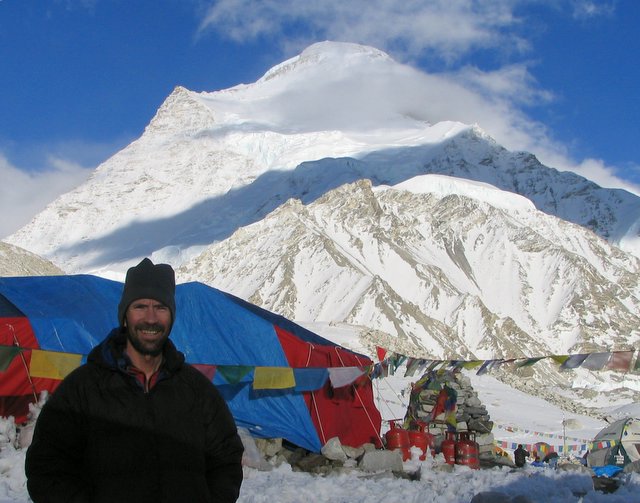
I'm happy to report I made it to the summit of Cho Oyu on May 7, 2006. Even better, I did it solo, from Camp 2 (skipping Camp 3), without oxygen or sherpas. I was very lucky to have beautiful weather on my summit day, sunny, warm (relatively), and little wind. I'll post more details when I get a chance.
Saturday, April 01, 2006


Monday, March 20, 2006
Gear for Cho Oyu
I spent a fair bit of thought (and money!) on gear for this trip. I wanted to go as light as I could without sacrificing safety.
I'm taking two tents - a Bibler (Black Diamond) I tent (1.95 kg / 4 lb 5 oz) and a Mountain Hardwear EV-2 (2.21 kg / 4 lb 14 oz). Both are lightweight, single wall tents. The Bibler is pretty cramped for two people but for one, it's fine (as long as you're not too tall!) The EV-2 has a built in vestibule so it's roomier. I've had a bunch of Mountain Hardwear tents over the years and I've always been really happy with them. Getting the poles inside the Bibler can be a bit of a struggle - the EV-2 has external poles which seem easier to me. Although it's normal to have three camps on Cho Oyu, I'm hoping to get away with two by going for the summit from Camp 2. If this doesn't work I'll just have to take my tent with me when I go from Camp 2 to Camp 3.
For the last while I've been using an Arcteryx Bora 80 which I really like, but it's pretty heavy (3.1 kg / 6 lbs 12 oz). This time I decided to try a Wild Things Andinista at only 1.75 kg / 3 lbs 14 oz. I was pretty tempted by the Spectra version which is 12 oz lighter, but it's also twice the price and has to be custom ordered so I decided to pass. I was able to get a large to fit my long back, but with a small hip belt to fit my skinny waist. I was a little concerned about how the Andinista would carry without any kind of frame, but I've been carrying it with about 50 lbs for 5 or 6 hour hikes and it's actually not too bad. The minimalist hip belt and shoulder straps aren't the most comfortable, but the lack of frame hasn't been a problem.
The last few trips I've had some concerns about keeping my feet warm enough. On Aconcagua they got cold enough to go numb. By itself this isn't so bad but once you lose feeling you can't tell if they're freezing. I decided to splurge and bought some Millet/One Sport Everests. These are specifically designed for high altitude climbing with a built in overboot/gaitor. They're known as the warmest boots available. The new model is supposedly 10% lighter and at the same time 10% warmer. In addition to being lighter and warmer, you avoid the hassles of trying to put crampons on insulated overboots (and having them fall off at the worst possible moment!). I ended up buying these in Chamonix on our recent trip to Europe. Probably paid too much, but they're a specialty item and at least there I could try them on.
I've got the room this time so I'm taking two sleeping bags so I can leave one at base camp and the other up on the mountain. This saves some carrying. My mountain bag is a Mountain Hardwear Quantum 3rd Dimension which is a synthetic -20 C / 0 F bag. I can't say I'm sold on the "Quantum Expander" idea - I figure the extra zipper has to add to the weight. But otherwise I've been happy enough with it. I'm a believer in synthetic bags, but they are bulky. I really want a -30 C bag, but instead I've got the Quantum 3D upgrade which is a separate inner bag that adds another 10 degrees or so. For extra warmth up high I can always sleep in my insulated pants and down jacket, since I'll be carrying them anyway. For base camp I've got a MEC Hybrid (down/synthetic) -20 C bag. For sleeping pads I've got a full length thermarest for base camp and a 10mm closed cell pad for on the mountain. The thermarest is more comfortable, but I'd hate to spring a leak up high. And repeatedly blowing it up can end up getting moisture inside which destroys the insulating value.
I've got two MSR Superfly butane stoves with the hanging kits (which I hear are no longer sold, unfortunately). Butane stoves have their drawbacks, especially when it's really cold, but for ease of use and safety cooking inside the tent, it's really the only way to go. For the first time I've rigged up some copper strapping to attempt to transfer some heat to the cartridge since otherwise they tend to freeze up. Warming the cartridge with your hands or (carefully) with a lighter works but it's not ideal. I'll see how well it works in practice.
For clothes I've got Arcteryx goretex bib pants, Alpha SL goretex jacket (only 347 g / 12 oz!), Mountain Hardwear Alchemy soft shell jacket (a favorite), and some old Mountain Equipment Coop fleece bibs which I've had for years and am quite attached to. Up till now I've avoided down suits. Maybe if I was going to Everest, but I'm not. Instead I've got MEC primaloft pants, a lightweight primaloft pullover, and a lightweight down jacket. If it's windy I wear my goretex over the insulated pieces. And of course, synthetic long underwear - for up high I prefer one piece "union" suits. I recently picked up an N2S (next to skin) windstopper shirt which seems pretty good. And of course, a selection of gloves and mitts, including, for up high, Mountain Hardwear Absolute Zero mitts.
Miscellaneous gear includes: Black Diamond Alpine Bod harness, Petzl expedition ascender, figure 8 descender, Grivel Airtech Racing ice axe, Black Diamond Flick Lock expedition ski poles, Petzl Tikka Plus and Myo 3 headlamps, and Black Diamond expedition duffles.
I almost forgot the gadgets. First, what I'm NOT bringing - no satellite phone, no laptop, no internet or email, no solar chargers or generators. We had all this stuff on our first trip to Cho Oyu and I swear I spent more time messing with it than I did climbing! I have a Suunto Observer watch with compass and altimeter and a Garmin Geko 301 GPS with compass and barometric altimeter. Hopefully these will keep me from getting lost up high! My camera is a Canon Powershot S1 IS digital camera with 10x zoom and image stabilization. I've got four 1gb memory cards for it. I'm using lithium AA and AAA batteries in everything - expensive, but pretty much a necessity in the cold.
I've probably forgotten stuff, but that's the bulk of it.
I'm taking two tents - a Bibler (Black Diamond) I tent (1.95 kg / 4 lb 5 oz) and a Mountain Hardwear EV-2 (2.21 kg / 4 lb 14 oz). Both are lightweight, single wall tents. The Bibler is pretty cramped for two people but for one, it's fine (as long as you're not too tall!) The EV-2 has a built in vestibule so it's roomier. I've had a bunch of Mountain Hardwear tents over the years and I've always been really happy with them. Getting the poles inside the Bibler can be a bit of a struggle - the EV-2 has external poles which seem easier to me. Although it's normal to have three camps on Cho Oyu, I'm hoping to get away with two by going for the summit from Camp 2. If this doesn't work I'll just have to take my tent with me when I go from Camp 2 to Camp 3.
For the last while I've been using an Arcteryx Bora 80 which I really like, but it's pretty heavy (3.1 kg / 6 lbs 12 oz). This time I decided to try a Wild Things Andinista at only 1.75 kg / 3 lbs 14 oz. I was pretty tempted by the Spectra version which is 12 oz lighter, but it's also twice the price and has to be custom ordered so I decided to pass. I was able to get a large to fit my long back, but with a small hip belt to fit my skinny waist. I was a little concerned about how the Andinista would carry without any kind of frame, but I've been carrying it with about 50 lbs for 5 or 6 hour hikes and it's actually not too bad. The minimalist hip belt and shoulder straps aren't the most comfortable, but the lack of frame hasn't been a problem.
The last few trips I've had some concerns about keeping my feet warm enough. On Aconcagua they got cold enough to go numb. By itself this isn't so bad but once you lose feeling you can't tell if they're freezing. I decided to splurge and bought some Millet/One Sport Everests. These are specifically designed for high altitude climbing with a built in overboot/gaitor. They're known as the warmest boots available. The new model is supposedly 10% lighter and at the same time 10% warmer. In addition to being lighter and warmer, you avoid the hassles of trying to put crampons on insulated overboots (and having them fall off at the worst possible moment!). I ended up buying these in Chamonix on our recent trip to Europe. Probably paid too much, but they're a specialty item and at least there I could try them on.
I've got the room this time so I'm taking two sleeping bags so I can leave one at base camp and the other up on the mountain. This saves some carrying. My mountain bag is a Mountain Hardwear Quantum 3rd Dimension which is a synthetic -20 C / 0 F bag. I can't say I'm sold on the "Quantum Expander" idea - I figure the extra zipper has to add to the weight. But otherwise I've been happy enough with it. I'm a believer in synthetic bags, but they are bulky. I really want a -30 C bag, but instead I've got the Quantum 3D upgrade which is a separate inner bag that adds another 10 degrees or so. For extra warmth up high I can always sleep in my insulated pants and down jacket, since I'll be carrying them anyway. For base camp I've got a MEC Hybrid (down/synthetic) -20 C bag. For sleeping pads I've got a full length thermarest for base camp and a 10mm closed cell pad for on the mountain. The thermarest is more comfortable, but I'd hate to spring a leak up high. And repeatedly blowing it up can end up getting moisture inside which destroys the insulating value.
I've got two MSR Superfly butane stoves with the hanging kits (which I hear are no longer sold, unfortunately). Butane stoves have their drawbacks, especially when it's really cold, but for ease of use and safety cooking inside the tent, it's really the only way to go. For the first time I've rigged up some copper strapping to attempt to transfer some heat to the cartridge since otherwise they tend to freeze up. Warming the cartridge with your hands or (carefully) with a lighter works but it's not ideal. I'll see how well it works in practice.
For clothes I've got Arcteryx goretex bib pants, Alpha SL goretex jacket (only 347 g / 12 oz!), Mountain Hardwear Alchemy soft shell jacket (a favorite), and some old Mountain Equipment Coop fleece bibs which I've had for years and am quite attached to. Up till now I've avoided down suits. Maybe if I was going to Everest, but I'm not. Instead I've got MEC primaloft pants, a lightweight primaloft pullover, and a lightweight down jacket. If it's windy I wear my goretex over the insulated pieces. And of course, synthetic long underwear - for up high I prefer one piece "union" suits. I recently picked up an N2S (next to skin) windstopper shirt which seems pretty good. And of course, a selection of gloves and mitts, including, for up high, Mountain Hardwear Absolute Zero mitts.
Miscellaneous gear includes: Black Diamond Alpine Bod harness, Petzl expedition ascender, figure 8 descender, Grivel Airtech Racing ice axe, Black Diamond Flick Lock expedition ski poles, Petzl Tikka Plus and Myo 3 headlamps, and Black Diamond expedition duffles.
I almost forgot the gadgets. First, what I'm NOT bringing - no satellite phone, no laptop, no internet or email, no solar chargers or generators. We had all this stuff on our first trip to Cho Oyu and I swear I spent more time messing with it than I did climbing! I have a Suunto Observer watch with compass and altimeter and a Garmin Geko 301 GPS with compass and barometric altimeter. Hopefully these will keep me from getting lost up high! My camera is a Canon Powershot S1 IS digital camera with 10x zoom and image stabilization. I've got four 1gb memory cards for it. I'm using lithium AA and AAA batteries in everything - expensive, but pretty much a necessity in the cold.
I've probably forgotten stuff, but that's the bulk of it.
Thursday, March 16, 2006
Three Weeks to Go
Recently an old climbing friend emailed me to find out how things were going for Cho Oyu. Here's what I told him:
I leave in less than three weeks (April 4). It's the usual mixture of excitement, nerves, and the occasional tendril of fear if I let my mind wander to thoughts of getting whited out on the summit plateau at 8000m. Everything's booked, my gear is all ready to go (not that that stops me from fussing with it!). I'm at the point in my training where nothing I do now will make much of a difference. You always wonder if you could have trained more, but I'm feeling pretty strong. Up and down Blackstrap for two hours today with big boots and pack and no breaks. But the real test will be on the hill.
It's strange to be going without Shelley, she's been my constant climbing partner for 10 expeditions over the last 20 years. Also strange to not have a team for the first time, but I'm kind of looking forward to that part. No one else to worry about, no one to fall behind or get ahead, no big logistics. It's a much simpler game, just me and the mountain, and that's appealing. With the right partner can be better than solo, but big teams can be worse.
Of course, so much of it is a crap shoot - I just have to hope I acclimatize, stay healthy, and get decent weather.
I leave in less than three weeks (April 4). It's the usual mixture of excitement, nerves, and the occasional tendril of fear if I let my mind wander to thoughts of getting whited out on the summit plateau at 8000m. Everything's booked, my gear is all ready to go (not that that stops me from fussing with it!). I'm at the point in my training where nothing I do now will make much of a difference. You always wonder if you could have trained more, but I'm feeling pretty strong. Up and down Blackstrap for two hours today with big boots and pack and no breaks. But the real test will be on the hill.
It's strange to be going without Shelley, she's been my constant climbing partner for 10 expeditions over the last 20 years. Also strange to not have a team for the first time, but I'm kind of looking forward to that part. No one else to worry about, no one to fall behind or get ahead, no big logistics. It's a much simpler game, just me and the mountain, and that's appealing. With the right partner can be better than solo, but big teams can be worse.
Of course, so much of it is a crap shoot - I just have to hope I acclimatize, stay healthy, and get decent weather.
Wednesday, February 15, 2006
Unfinished Business
Here is a brief article I wrote for our local alpine club section newsletter:
As usual, people keep asking, “Where are you going next?” Well, this spring I'm heading back to Cho Oyu on the border between Tibet and Nepal. Nine years ago, in 1997, Shelley and I organized and led our first big expedition there. A lot has changed since then.
That was one of our first expeditions. This will be my 11th.
It took us a year of unreliable long distance faxes and snail mail to arrange things with the Chinese Mountaineering Association. This time I simply emailed Asian Trekking in Kathmandu and told them I wanted to go.
Then we had a group of 11 people. This time I'm going on my own.
High altitude doesn't seem to agree with Shelley any more and rather than organize another group I decided to try a new challenge and climb solo. Cho Oyu is normally climbed unroped anyway and I'm familiar with the route so it seemed like a good choice.
Asian Trekking will arrange transportation from Kathmandu and provide a cook at base camp. After that it's all up to me - no sherpas and no oxygen. I'll be carrying all my own loads and setting up my own camps. Not that I'm likely to be "alone". It’s a popular mountain and there will be other climbers around.
In '97 our group was successful in getting two people to the top but neither Shelley or I summited, mostly because the weather turned bad and we ran out of time. Cho Oyu is known as the "easiest" of the fourteen 8000m peaks but that doesn't mean it's easy - just that the others are even harder.
At 8201m, Cho Oyu is the sixth highest mountain in the world and although it's not technically difficult, it's still a very big mountain and the altitude and the weather are tough obstacles to overcome.
It never seems like you can train enough for these kinds of trips but you still have to try. In the fall I did lots of running, both hills and longer (e.g. 25 km) runs. Now I'm concentrating more on stairs and carrying a 25kg pack for 15 to 20 km hikes.
I leave on April 4, flying from Saskatoon to Los Angeles to Bangkok to Kathmandu. After a few days in Kathmandu to make final arrangements I'll travel by road across the border and through Tibet to the mountain. Even on the drive you gain a lot of altitude so we’ll have to stop extra days along the way to acclimatize. From the end of the road it's a two day walk to base camp with yaks to carry everything. Then I'll have 25 days to work my way up and down the mountain, gradually acclimatizing to higher and higher altitudes, resting at base camp in between. Then it's a matter of hoping for three or four days of good weather to go for the summit. (And get down again!)
As usual, people keep asking, “Where are you going next?” Well, this spring I'm heading back to Cho Oyu on the border between Tibet and Nepal. Nine years ago, in 1997, Shelley and I organized and led our first big expedition there. A lot has changed since then.
That was one of our first expeditions. This will be my 11th.
It took us a year of unreliable long distance faxes and snail mail to arrange things with the Chinese Mountaineering Association. This time I simply emailed Asian Trekking in Kathmandu and told them I wanted to go.
Then we had a group of 11 people. This time I'm going on my own.
High altitude doesn't seem to agree with Shelley any more and rather than organize another group I decided to try a new challenge and climb solo. Cho Oyu is normally climbed unroped anyway and I'm familiar with the route so it seemed like a good choice.
Asian Trekking will arrange transportation from Kathmandu and provide a cook at base camp. After that it's all up to me - no sherpas and no oxygen. I'll be carrying all my own loads and setting up my own camps. Not that I'm likely to be "alone". It’s a popular mountain and there will be other climbers around.
In '97 our group was successful in getting two people to the top but neither Shelley or I summited, mostly because the weather turned bad and we ran out of time. Cho Oyu is known as the "easiest" of the fourteen 8000m peaks but that doesn't mean it's easy - just that the others are even harder.
At 8201m, Cho Oyu is the sixth highest mountain in the world and although it's not technically difficult, it's still a very big mountain and the altitude and the weather are tough obstacles to overcome.
It never seems like you can train enough for these kinds of trips but you still have to try. In the fall I did lots of running, both hills and longer (e.g. 25 km) runs. Now I'm concentrating more on stairs and carrying a 25kg pack for 15 to 20 km hikes.
I leave on April 4, flying from Saskatoon to Los Angeles to Bangkok to Kathmandu. After a few days in Kathmandu to make final arrangements I'll travel by road across the border and through Tibet to the mountain. Even on the drive you gain a lot of altitude so we’ll have to stop extra days along the way to acclimatize. From the end of the road it's a two day walk to base camp with yaks to carry everything. Then I'll have 25 days to work my way up and down the mountain, gradually acclimatizing to higher and higher altitudes, resting at base camp in between. Then it's a matter of hoping for three or four days of good weather to go for the summit. (And get down again!)
Subscribe to:
Posts (Atom)