Showing posts with label belize. Show all posts

Sunday, April 28, 2019

Belize Diving misc.

Finally, the last batch of diving photos from Belize.

We saw spotted eagle rays a few times. They are such graceful animals as they "fly" through the water. Faces only a mother could love, though :-)

Spotted eaglerays

Spotted eagle ray

Southern stingrays were more common. I think the fish follow them in hopes of getting food that they stir up from the sand.

Southern stingray

Despite local lobster fishing, there were still quite a few around. They are the most bizarre creatures when you look at them close up.

Caribbean Spiny Lobster

The Channel clinging crabs were a little harder to find. They got quite large, maybe 8 inches across the body and an arm/claw span of 2 feet or so.

Channel clinging crab

We always like to look inside the sponges. Usually there's nothing, but occasionally you get a surprise, like this Channel clinging crab in a big barrel sponge:

Channel clinging crab inside barrel sponge

Usually all you see of the moray eels is their heads sticking out of holes. But occasionally they are out swimming around (hunting?) like this one.

Green moray eel

It seemed curious and started swimming towards me. At first I was happy to get a closer view, but it kept coming closer and closer. I held my camera out in front of me and it bumped right into the lens! Perhaps it could see its reflection? After that it took off. They seldom attack people but they have an impressive mouthful of teeth. As well as the usual green moray eels we also saw quite a few spotted. They were usually smaller.

Spotted moray eel

There weren't a lot of sharks around. We saw a few nurse and reef sharks. A lot of divers want to see sharks more than anything else. I can't quite understand it. They're just big fish, and not very colorful!

Nurse shark

My favorites are the sea turtles. The first few days we didn't see any, and I was a bit disappointed, but our luck changed and we saw quite a few in the end. Including a few curious ones that didn't just disappear into the distance.

Hawksbill turtle and Cardinal

Hawksbill turtle and Jeff

Hawksbill turtle

See all 35 photos in this album

Saturday, April 06, 2019

Belize Diving - coral & sponges

An amazing variety of coral and sponges form the backdrop to diving in Belize (and other places). Some of them might look like the equivalent of plants on land, but they're actually animals.

Brain coral

Corals are colonies of invertebrate polyps. A given coral colony consists of "clones" growing as the polyps reproduce asexually. Corals also reproduce sexually, releasing gametes into the water to establish new colonies. It's a bit similar to how groups of aspen trees consists of asexually produced clones, but they also sexually reproduce via seeds. Except that corals also have a "coenosarc" a living tissue that is shared by the whole colony. And to complicate things further, corals actually get most of their energy and nutrients from single celled half animal half plan dinoflagellates that live inside coral. Coral bleaching results from the loss of these symbionts.

When people think about coral and coral reefs they are thinking about hard or stony corals. These corals build up a "skeleton" of calcium carbonate (like shells). These are the corals that gradually build up reefs. But there are also soft corals that don't have a rigid skeletons.

soft coral

coral

Some of the corals make great abstract patterns. It's hard to reconcile this with idea of them being a colony.

coral closeup

Fragile saucer coral ?

Photographs are great for viewing the details of the corals that are often hard to see while you're diving.

coral closeup

Maze coral ?

Some of them do look more like colonies.

coral

coral closeup

Especially when there's a bit of a current, the polyps will be open and feeding.

Branched finger coral ?

Some of the corals form "plates" (these were dinner plate size)

coral

Cactus coral ?

Some of the names don't make a lot of sense to me. Spiny flower coral don't look spiny:

Spiny flower coral

And smooth flower coral don't look smooth. (I keep thinking I must have the names backwards, but I don't think so.)

Smooth flower coral

This one does look a bit like lettuce:

Thin leaf lettuce coral ?

Sponges are also animals (as opposed to plants) but they are single organisms, not colonies like coral. Sponges were the first to branch off the evolutionary tree from the common ancestor of all animals. They are quite "primitive" and do not have nervous, digestive or circulatory systems.

My identification of corals and sponges is even sketchier than my fish ids. Corrections are welcome. I think this is an orange icing sponge and a coral. But I'm not sure if the sponge is growing on the coral, or the coral is growing on the sponge.

Orange icing sponge

sponge

Sponge

I love the variety of colors of the sponges.

vase sponge

These were mostly watermelon size, but some of the big barrel sponges were huge - six feet high and as big across.

Brittle star in Azure vase sponge

Red encrusting sponge ?

Who needs science fiction aliens when you've got real life creatures like these!

sponge

I think this next one is the dead "skeleton" of a sponge

dead sponge ?

Most of the sponges didn't have the intricate detail of the corals, but a few came close

Stinker sponge ?

See all 37 photos in this album

See also: Belize Diving - small stuff and Belize Diving - fish

Sunday, March 17, 2019

Belize Spinytail Iguanas

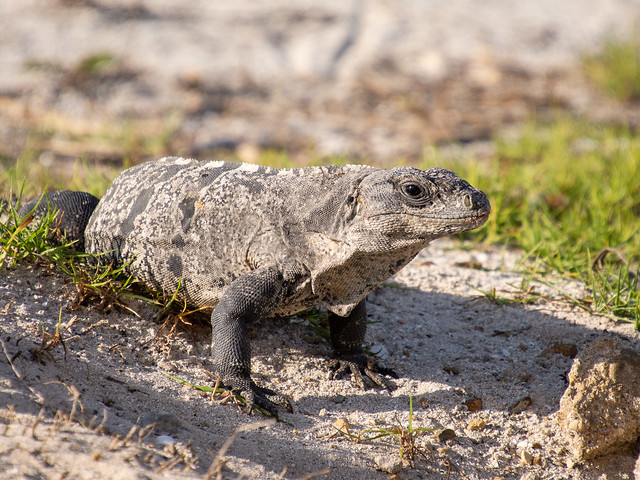
These lizards were common on Blackbird Caye. My first thought was that they were iguanas. But looking closer, that didn't seem right. The locals said they weren't iguanas, they were "Garrobo". Which didn't help much because it seemed to be a local name. I think they are spiny-tail iguanas or ctenosaurs, maybe Black spiny-tailed iguana (Ctenosaura similis) (Which apparently have been introduced into Florida and Texas.)

Spinytail iguana

Spinytail iguana

Part of the confusion was that the smaller ones had much more distinct coloring than the larger ones.

Spinytail iguana

This larger one had a hidey hole under a slab of rock behind our cabin. I'm not sure when it fed, we only ever saw him sunning beside his hole.

Spinytail iguana

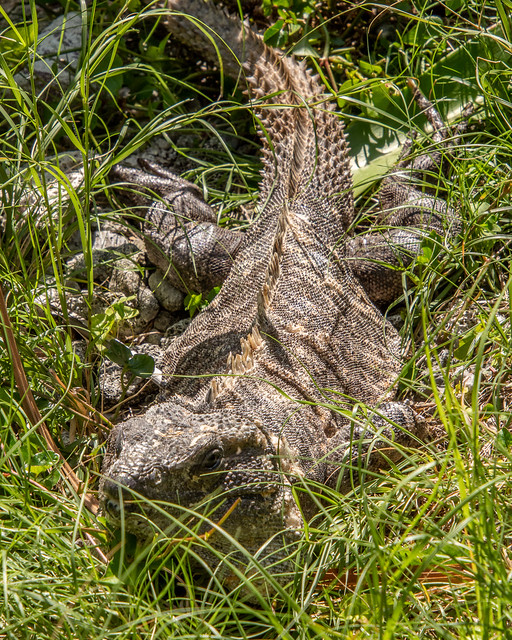
The older ones also had more obvious "spiny tails". This was one of the largest we saw. (They get to about 1 meter (39 inches) long.)

Spinytail iguana

As long as you moved slowly and didn't try to get too close, they were fairly tolerant of people. But if you did spook them, they would skedaddle. Spiny-tailed iguanas are the fastest lizards in the world, clocked at almost 35 km/hr.

Most of the ones I saw were on the ground, but they would also climb on the buildings and trees .

Spinytail iguana

Spinytail iguana

They are omnivorous, feeding on leaves, flowers, fruits, and seeds as well as small animals.

See all 18 photos in this album

Sunday, March 10, 2019

Belize Diving - fish

We saw lots of different fish diving at Blackbird Caye in Belize. There weren't a lot of big fish, but that's probably due to people fishing, since it's not a protected area. My photographs only covered a small fraction of the types of fish - just the ones that cooperated!

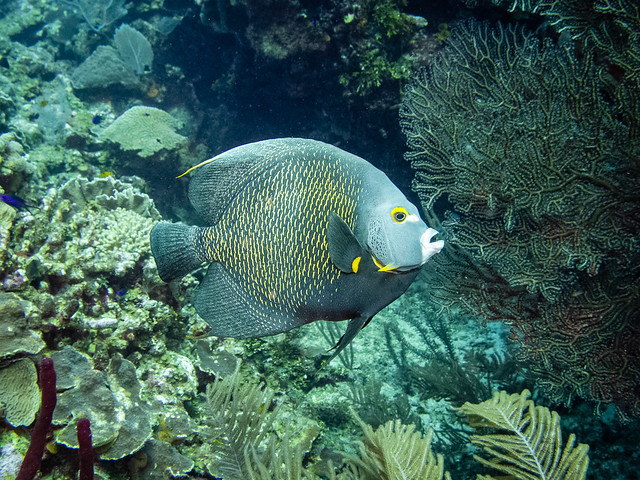
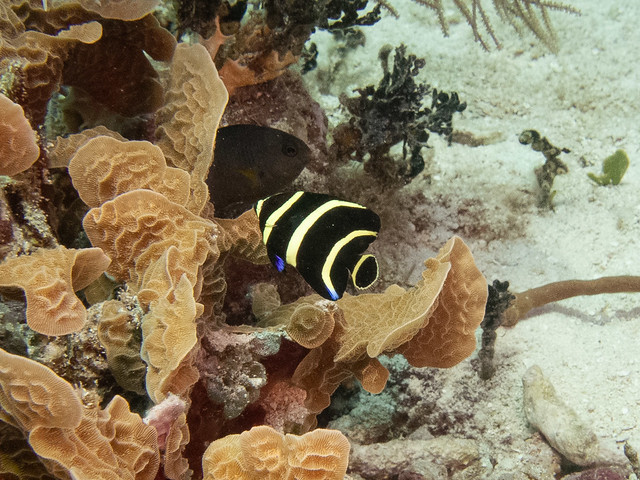
French angelfish

It took me a while, but I think I identified them all. Some are easy, like this French Angelfish, but others are tough. It's a bit like bird watching, except there is much variety.

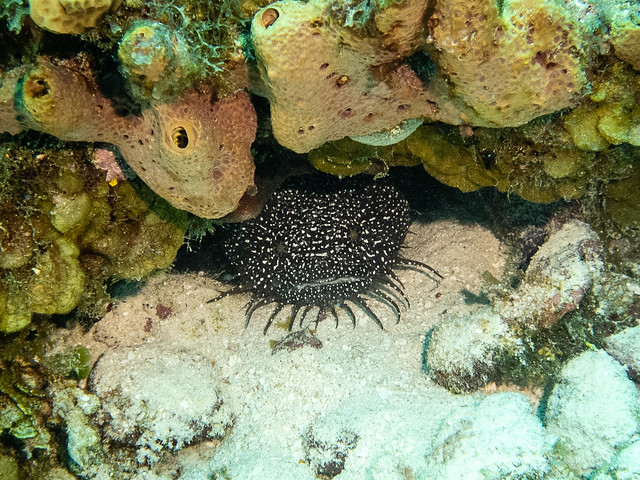
Some of the fish hide, like this White-spotted toadfish (found only in Belize). We would never have seen them if our dive master didn't spot them.

Whitespotted toadfish

The dive masters would feed the toadfish chunks of lionfish that they would spear. Lionfish are a destructive invasive species so they try to get rid of them. It's too bad because they are beautiful fish.

Lion fish

The Peacock Flounders are another one that can be hard to spot. They are in the left-eye flounder family with both eyes on top of the left hand side of their heads. Baby flounders have one eye on each side of their bodies like ordinary fish, and swim like other fishes do, but later on, as they are becoming adult, the right eye moves to the left side, and they start to swim sideways, which allows them to settle down flat on the bottom.

Peacock flounder

With the scorpionfish, often what I'd spot was their fin. Then I'd have to try to see the body it was attached to. The eyes are the other identifiable part.

Spotted scorpionfish

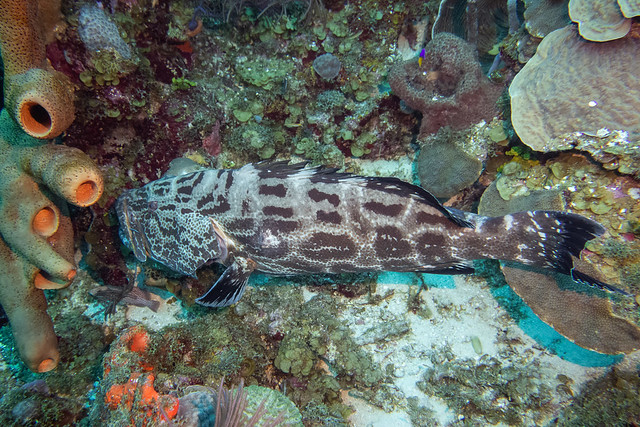
There were a few larger groupers around, up to about three feet long. This Tiger Grouper was at a "cleaning station" where smaller fish or shrimp will eat their parasites. The small fish will even swim into their mouths or gills to clean. (A certain amount of "trust" is required!)

Tiger grouper at cleaning station

We also saw Black Groupers, Nassau Groupers, and the related Red Hinds:

Black grouper

Nassau grouper

Red hind

The long skinny Trumpetfish are interesting. They are actually related to sea horses. Sometimes they will hide by positioning themselves vertically in among soft coral. They can also change their color for camouflage.

Trumpetfish

There are also fish that live in holes they dig in the sand, like this Sand Tilefish (and also jawfish and garden eels)

Sand tilefish

And big eyed Balloonfish that can puff themselves up - like a balloon to deter attackers.

Balloonfish

And so many more ...

Longspine squirrelfish

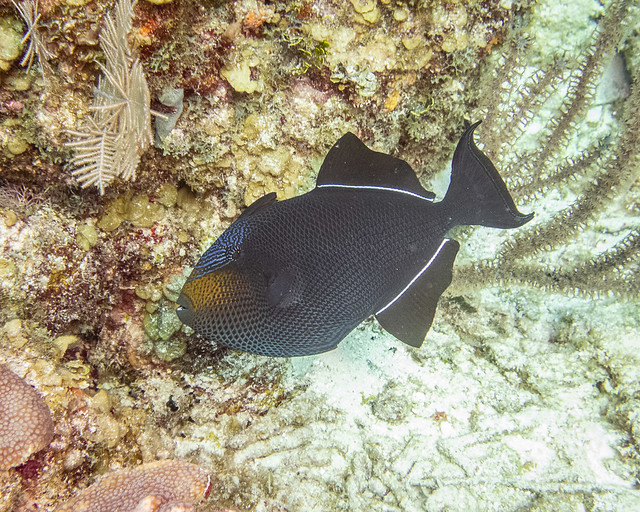
Black durgon

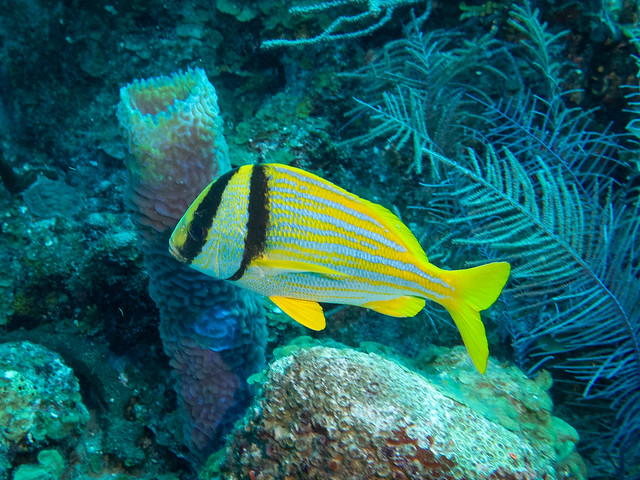
Porkfish

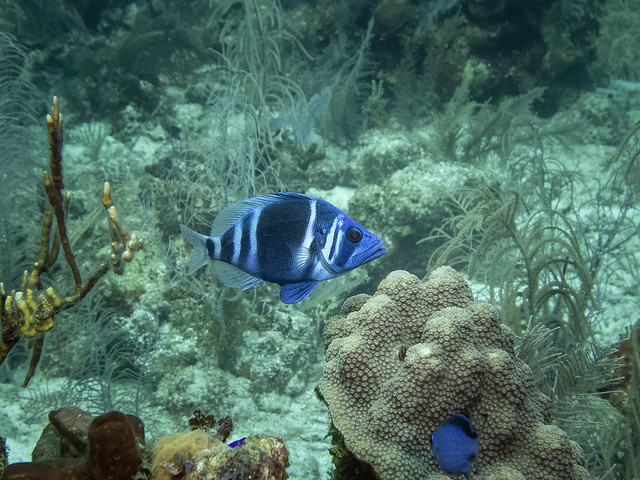
Indigo hamlet

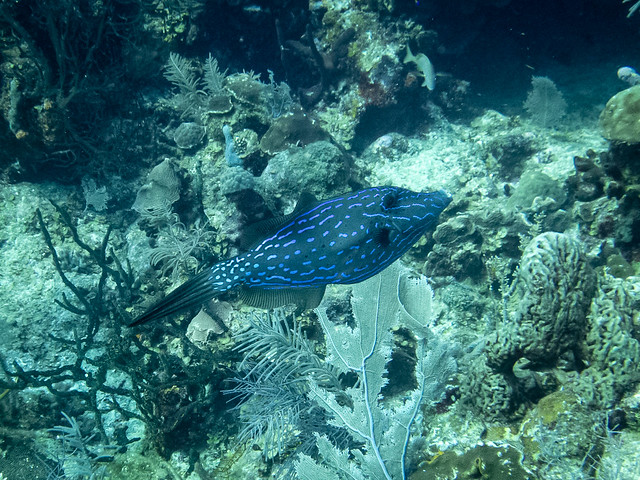
Scrawled filefish

Whitespotted filefish

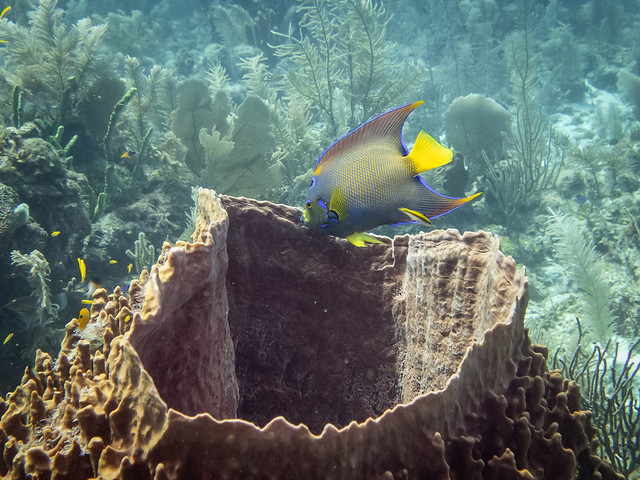
Queen angelfish and Barrel sponge

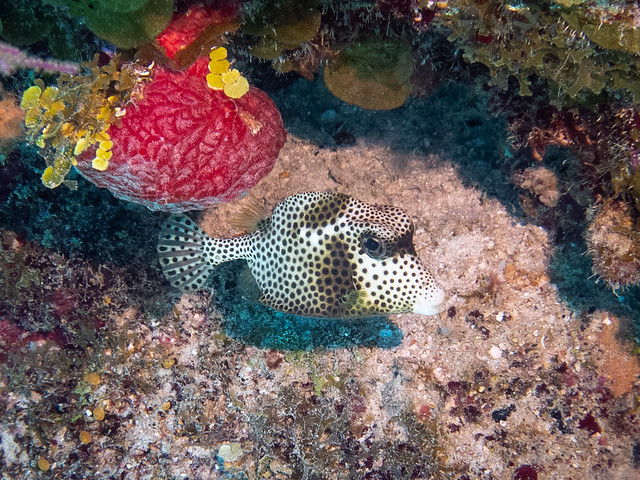
Spotted trunkfish

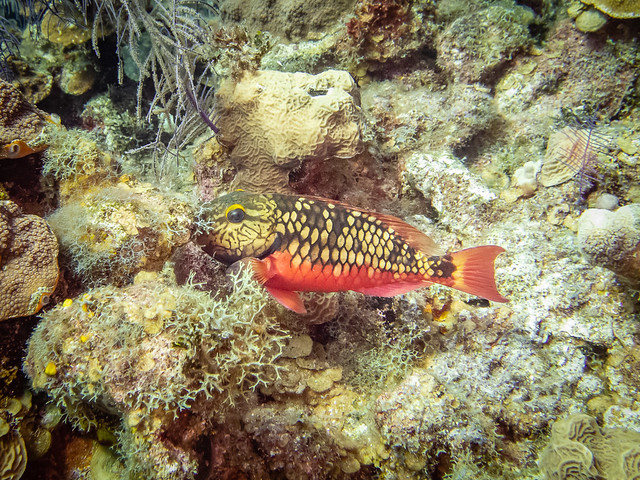
Like birds, male and female fish can look quite different, as with these Stoplight Parrotfish. But unlike birds, parrotfish (and others) can change sex.

Stoplight parrotfish (female)

Stoplight parrotfish (male) and Black-ball sponge

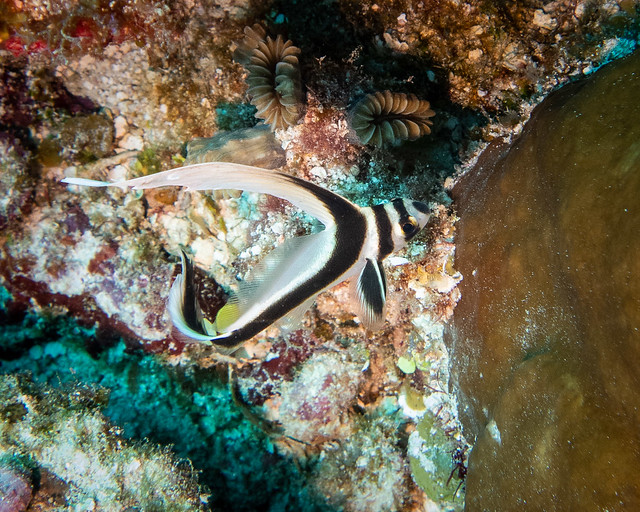
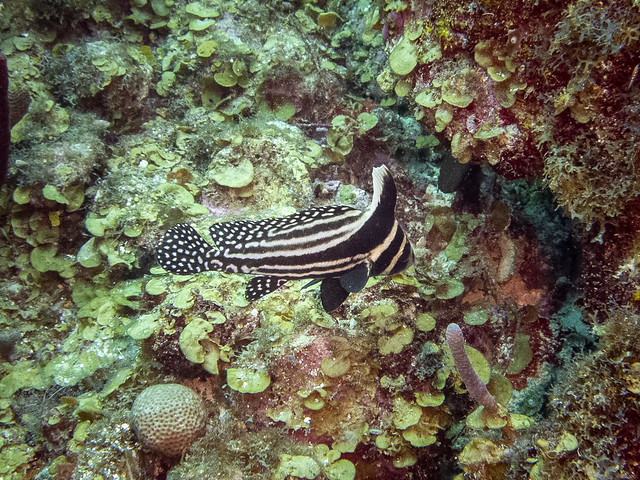
Fish often look quite different as juveniles. For example, juvenile Spotted Drums don't actually have spots:

Spotted Drum

But at least they look a bit like the adults:

Spotted drum
Whereas this juvenile French Angelfish doesn't look anything like the adult (the very first photo in this post)

French angelfish (juvenile)

And of course, there were schools of different fish (like Horse-eyed Jacks) in the more open water:

diver and school of fish

See all 68 photos in this album