Beautiful time lapse video of Patagonia by Adam Colton.
As usual, it's worth viewing it larger size.
Tuesday, July 26, 2011

Wednesday, July 20, 2011

Tuesday, July 19, 2011
Sunday, July 17, 2011
Urban Friends

The pelicans were out cruising the river. They are such beautiful flyers, although a little awkward looking taking off and landing.
A Northern flicker was out in the grass. They are the only woodpeckers that feed on the ground, often on ants. They are even known to crush ants and rub the resulting formic acid on themselves to kill parasites. I've seen quite a few of these this year.
A couple of Yellow warblers were hopping around in the bushes and trees. Such colorful little birds.
After my run, when I was sitting on a bench watching the river go by, a short-tailed weasel (aka stoat) ran across the path in front of me. It didn't seem to notice me and stopped under my bench for a moment before running a bit farther down the path and disappearing into the underbrush.
Life is good.
Wednesday, July 06, 2011
Fern Meadow
A beautiful meadow carpeted with ferns. This was from our recent Appalachian Trail hike. The video is not the greatest quality but I hope you get a feel for how beautiful it was. The music is, suitably, Copland's Appalachian Spring. (I thought I was using a short enough clip of the music to be legit, but it got detected and can't be played in Germany because of copyright.)
For a bigger version, click on the Vimeo button at the bottom right.
Shot with a Canon G12 and stabilized with iMovie.
2011-07-07 Update: The video quit working on YouTube, probably because of the copyright issue, so I switched to Vimeo.
For a bigger version, click on the Vimeo button at the bottom right.
Shot with a Canon G12 and stabilized with iMovie.
2011-07-07 Update: The video quit working on YouTube, probably because of the copyright issue, so I switched to Vimeo.
Tuesday, July 05, 2011
Spreading the Word - EcoFriendly Sask

And so EcoFriendly Sask was born.
My sister Penny has a blog as well (Wanderlust and Words). I really liked the way she told the stories of people and their passions. She also has a weekly Flavourful Saskatoon post about local food happenings.
What if we were to start a blog (and Facebook and Twitter, of course) to talk about local environmental stories and happenings?
At first we were both a little sceptical as there are already so many environmental organizations and websites. But there aren't any websites focusing on the local environmental news and issues in Saskatoon and Saskatchewan. No one was gathering the news from all the different organizations, each with their own focus. And no one was telling the stories of the local people and their passions.
Did you know that Saskatchewan's newest national park, Grasslands, was recently expanded? Did you know that the Canadian Center for Policy Alternatives has a Saskatchewan office that recently released a report on Sustainable Power Options to Complement Wind and Solar? Do you know which businesses are out there if you want to install solar panels or geothermal? Do you know what events are going on this month related to the environment? That's the kind of information we wanted to share.
The more we thought about it, the more it made sense. I was already following the environmental news, and Penny had already developed a reporting style that we thought would work well.
We brainstormed for names and ended up with EcoFriendly Sask. We're not sure where we'll end up, but we're going to start by gathering the news and stories on the environmental front in Saskatoon and Saskatchewan and passing it on via blog, Facebook, and Twitter. We hope to raise awareness, educate, and encourage.
I hope you'll join us at EcoFriendly Sask, and please Like us on Facebook, and follow us on Twitter.
Monday, July 04, 2011

Sunday, July 03, 2011
Pool of Possibilities
I stopped by the Mendel today for coffee at Museo and to check out the Pool Project exhibit of Courtney Milne's photographs.
If you get a chance I would definitely recommend having a look at the exhibit - wonderful photographs.
My father went on photography workshops with Courtney and was always envious of his photographs and his success. I also wish I could take such beautiful photographs.
A nice video about Courtney and his pool project. Best full screen.
Saturday, July 02, 2011
Complete Streets
Complete Streets: It’s About More Than Bike Lanes - interesting video on the issues of bike lanes, pedestrians, and traffic in New York.
One thing I noticed in this video is that not only are the bike lanes inside the parked cars, but there is also a space between the parked cars and the bike lane so you don't get wiped out by someone opening their car door.
One thing I noticed in this video is that not only are the bike lanes inside the parked cars, but there is also a space between the parked cars and the bike lane so you don't get wiped out by someone opening their car door.
Unfortunately, this also reminds me about how minimal our biking infrastructure is in Saskatoon. If you want to get wiped out by a car door in Saskatoon I suggest biking south on the downtown part of Spadina. Although this is nominally a bike route, you're squeezed between busy traffic and people frequently getting in and out of parked cars. If someone does open their door in front of you, you'd better be able to stop since your only other option is to swerve out into the traffic. Saskatoon's idea of bike infrastructure is to paint a few sharrow chevrons on traffic lanes and fantasize that somehow that makes it all better for bikers. Sorry, but that's pathetic. A recent study doesn't show much benefit to cyclists. (Their conclusions are the opposite, but aren't supported by the data as far as I can see.) I guess they might be better than nothing, but not by much.
Friday, July 01, 2011
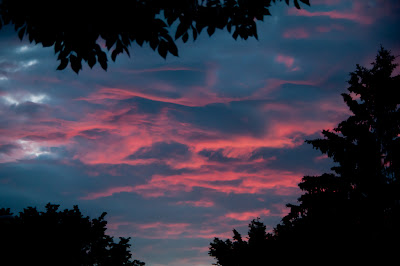
Prairie Skies
The living room faces the sunset so when I see colors like this through the trees sometimes I have to grab my camera and try to capture it. The mosquitoes also enjoy the opportunity to feast on me while I'm standing in the driveway taking pictures!


Tuesday, June 28, 2011
Conservation in the Real World
Kareiva began by recalling the environmental "golden decade" of 1965-75, set in motion by the scientist Rachel Carson. In quick succession Congress created the Clean Air Act, the Clean Water Act, and the Endangered Species Act---which passed the Senate unanimously.
Green influence has been dwindling ever since. A series of polls in the US asked how many agreed with the statement, "Most environmentalists are extremists, not reasonable people." In 1996, 32% agreed. In 2004, 43% agreed. Now it's over 50% who think environmentalists are unreasonable.
Peter Kareiva: Conservation in the Real World - The Long Now
Some interesting points in this summary of his talk.
Thursday, June 23, 2011
Reflections on Water
Here are a few photos I took wandering around the waterfront of the old town in Montreal. The blue and yellow tents are Cirque du Soleil. Some of the reflected color is from graffiti. I find water and reflections fascinating.
Note: These are all quite tweaked in Lightroom - boosting the contrast and saturation a lot. Here are the before and after versions of one of them:
 |
| (click to view photos) |
Note: These are all quite tweaked in Lightroom - boosting the contrast and saturation a lot. Here are the before and after versions of one of them:
 |  |
China's Unthinkable Population Problem
China’s Unthinkable Population Problem - Long Views: The Long Now Blog
We struggle to lower the birth rate, and then as soon as we do, the economists panic because their myth of infinite growth is threatened. You get, OMG, an aging population that isn't as good as consumer fodder and actually wants services back from the economy.
Countries, like Italy and Malaysia, try to increase their birth rate by giving financial incentives. And if they succeed, then what? About face and panic about the population problem?
I applaud China for not giving in to the economists and for maintaining their one child policy. It's those same economists that got us into our current bind.
Tuesday, June 21, 2011
Great Places don't have bottled water

But I was disappointed to see the speakers / panel with bottled water. Here's the email I sent them:
Thanks for the event last night, it was interesting.
One small suggestion - don't use bottled water for the speakers and panel. Even if the bottles are recycled/recyclable/compostable there is still a lot of energy involved in manufacturing and transporting them. All to get water that could just as well come from the tap. (and hopefully not served in disposable cups)
I realize that Great Places focus is not strictly environmental, but obviously the environment plays a large role in great places.
People attending these kinds of events look at them as good examples. If they see you using bottled water, they are going to think it's ok.
Sunday, June 19, 2011
Chebeague Island
I love the ocean. Maybe it's something to do with living on the prairies, after all, I love the mountains too. Or maybe it goes back to childhood summer holidays on Vancouver Island with many happy hours on the beach.
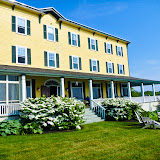
To see a little more of New England and to get to the ocean, Shelley and I took the train from Boston to Portland (Maine) and then the ferry to Chebeague Island where we stayed at the Chebeague Island Inn. The inn is expensive, but we figured it balanced out with our (free) nights of camping.
It was a nice quiet contrast to the hustle and bustle of Boston. The inn is a lovely place to stay. It has a great verandah to sit and look a the view, an attractive lounge, and a great restaurant (the only "fancy" restaurant on the island). The menu doesn't have any vegetarian main courses, but we threw ourselves on the mercy of the chef and he created wonderful meals for us. The deserts were also great, especially the homemade gelato and ice cream.
The island isn't very big, just four or five miles long. The inn provides bicycles and it's an easy ride around. There isn't a lot to do or see. (There is a small golf course right next to the inn, but we're not golfers.) But if I've got the beach, I don't need much more - I can spend hours poking around finding shells and crabs and watching the birds. When the tide was out we walked over to Little Chebeague Island. (Where you can camp.)
We didn't have much time in Portland, just enough to have lunch as we passed through to and from the ferry. On the way there we ate at the Green Elephant Vegetarian Bistro, and on the way back at the Olive Cafe. Both were good. (Thanks to Yelp and its iPhone app for helping us discover them.)
 |
| (click to view photos) |
Wednesday, June 15, 2011
Pedestrians and Falcons
On my way home I stopped in Albany instead of Schenectady. Due to track maintenance I had to take the bus from Boston, rather than the train. That's fine except the bus terminal is in Albany, and the train station is in Rensselaer, on opposite sides of the river. There is a bridge, but it's a freeway with massive cloverleafs (cloverleaves?) either end. Shelley and I had come this way heading for our hike. Google maps had shown a walking route across the bridge, but its walking info isn't always accurate. The bus terminal is under the freeway overpasses and we couldn't see any way to get up there. And it wouldn't surprise me if there was no allowance for those pesky pedestrians. After all, they just get in the way of the supremely important traffic. I asked if there was a way to walk across the bridge and they said no, you had to take a taxi. Which we did, but the taxi had no meter and charged us $15 for a two minute ride. To add insult to injury, from the taxi we could see what looked like a walkway across the bridge.
This time I had time to explore and found the entrance to the walkway just a short distance from the bus terminal, connected, logically (for a change) to the paths along the river. As it turned out, google maps was accurate.
In case anyone googles for this, here are some directions: from the bus, head towards the river, past the Holiday Inn. Take the underpass at the end of Broadway. The walkway starts just on the river side of the underpass. On the other side of the river (Rensselaer) you need to make a u-turn off the end of the ramp to get to the small bridge across the train tracks to the station. It's an easy 10 or 15 minute walk.
On my way across the bridge a pair of Peregrine falcons were swooping and circling, making alarm cries. I'm not sure what they were upset about, but there was some construction on the bridge. Maybe it had disturbed or was close to their nest on the bridge? I stopped to watch their flying skills from up close for a change. Beautiful birds and one of the (rare) conservation success stories since they were almost wiped out by DDT and other pesticides, but have since made a good recovery.
Saturday, June 11, 2011
Six Days on the AT
Our first day of hiking had a little bit of everything. We started by taking the bus from Rutland to Manchester. Then we had to find our way a couple of miles through and out of town to the start of the trail. I was glad to see the trail actually existed since all we had to go by was a line on on outdated topo map. The morning was already hot and humid with towering thunder clouds on the horizon. We were glad to get off the sunny streets and into the deep shade of the forest.
We didn't see any other people except a couple coming down the trail - a lucky meeting for us because they told us the trail we'd been planning to use to connect to the AT (Appalachian Trail) was impassable. (A windstorm had blown down an area of trees and the beavers had built damns that flooded it.) Luckily, there was another alternative trail we could take.
As the afternoon progressed, the distant rumbles of thunder gradually grew closer. When the rain finally arrived it was light and we were too hot to put on rain gear. But it turned into a downpour and we had no choice. Through the worst of it we huddled under the biggest tree we could find (not very big) as marble size hail fell. Once it slowed down we continued hiking. Needless to say we got pretty wet. But it turned out to be the only rain we'd get on the hike, so we can't complain.
We considered stopping at Bourne Pond but decided to continue on to Branch Pond. It had stopped raining by then and we found a good campsite by the pond. Unfortunately, the black flies liked the site (and us) too so we retreated inside the tent. It was still hot enough that we just hung out in wet clothes and gradually dried out.
Day two went smoother except for an annoyance that plagued me for the rest of the hike. Soon after we started hiking my left knee started to feel a little "funny". I thought it would be fine after warming up. But instead it started to give twinges of pain if I moved it the wrong way. It got steadily worse. Eventually I told Shelley I didn't think I wanted to walk on it any more that day.
Of course, I'd planned our hike to be away from roads and towns so at this point it was 20 miles to the next town and 20 miles back to where we started. Not a pleasant thought if my knee got much worse. On the positive side, I'd had a similar problem on my Lake Superior hike and it had improved after a few days. And it wasn't the joint - I could put my full weight on it - it just hurt to bend/lift the knee. It seemed like a tendon/ligament issue.
The next day I took some ibuprofen and borrowed one of Shelley's trekking poles and we started hiking. It still hurt but it didn't seem to be getting any worse so we kept going. As long as I could keep the leg straight it was fine. That was easy when the trail was smooth and level, but most of the time we were going up or down, over rocks and fallen logs. My good leg definitely got a workout compensating. Thankfully the knee gradually improved and by the end of the hike was much better. We went a little slower, but we still did the 20 km per day that we had planned.
A lush green forest overflowing with life is one of the most beautiful sights. And the green of new leaves with the sun filtering through is one of the most beautiful colors. I'm amazed at how much forest there is here (in the Appalachians). Above the populated valleys, the hills are totally covered with trees. Of course, it's all been logged before, multiple times, so the trees are relatively small - the big ones were 12 or 18 inches in diameter. In the towns you can find some older trees that are 3 feet or more in diameter. The original old growth forest must have been impressive.
Although you don't get many views hiking through the forest, we were glad of the cool shade since it was quite warm and humid. And the occasional views were all the same anyway - rolling hills covered in trees!
We saw a variety of wildlife - deer, beaver, porcupine, salamanders, garter snakes, tadpoles, frogs, and various birds (mostly heard but not seen). A porcupine visited our campsite the last evening just as it was getting dark. He approached with a rolling gait, stopped a couple of times to eye us, then continued on to a tree that grew at an angle. He climbed up the tree to where the leaves and branches were, about 50 feet off the ground and stayed there all night - munching away, judging by the sounds. He was gone by the time we got up in the morning. The salamanders were Eastern Newts. We saw a bright orange terrestrial juvenile "red eft" and several olive green aquatic adults.
The AT itself is well marked with white "blazes" (rectangular paint marks) on the trees. The trail is even marked when it goes through towns. We didn't run into many people on the trail, a handful each day, but there were usually people at the campsites and shelters. We tried to find campsites away from the standard spots but it was harder than expected in the thick forest.
Overall it was a great hike, definitely recommended if you're in the area.
 |
| (click to view photos) |
* A lot of these photos are by Shelley
Monday, May 30, 2011
Heading for the Appalachian Trail

The trail is 3,510 km long - we're only hiking about about 120 km of it over six days. (From Manchester, Vermont to Pittsfield, MA)
For summer trips we've stopped carrying a stove and our formula for food is simple - granola and milk powder for breakfast, trail mix for lunch, and bars and crackers for supper. (In this case we've also added peanut butter, dried fruit, and tofu jerky.) It might not be everyone's favorite diet, but it's simple and easy to obtain almost anywhere. We tracked down a local Whole Foods in Boston to do our shopping, but almost any grocery store would have been sufficient.
Since our trips have mostly been under a week, and us older types have slower metabolisms, about half a kilo (roughly a pound) per day per person works for us. Your mileage may vary.
In colder weather it's nice to have hot drinks and we might carry our Jetboil. But it's a hassle traveling with stoves and pretty much impossible to carry fuel on planes so it's definitely simpler to do without.
Franklin Park Zoo
This morning we went to the Franklin Park Zoo and then walked back on the Emerald Necklace walking tour through Frederick Law Olmsted parks. We didn't quite make it through all the parks because we got too hot and hungry. Nice parks though.
 |
| (click to view photos) |
Sunday, May 29, 2011
New England Aquarium in Boston
Here are a few photos from the aquarium. We enjoyed our visit - it's a nice aquarium, despite the holiday weekend crowds.
 |
| (click to view photos) |
Subscribe to:
Posts (Atom)