Friday, January 22, 2010

Diving in Bonaire


Bonaire 2010 Underwater
by Shelley

We've been in Bonaire for three days now and are quite enjoying it! Although it's been fairly windy, this tends to keep the hot temperatures bearable and, with both windows of our room open at night, means that we don't have to use the air conditioner and the "white noise" of the wind allows for a great sleep!

We're staying at the Sonrisa which is a fairly new small place and is very nice with a big spacious room. It's not right on the water but only a 2 minute walk to the beach, less than 5 minutes to where we're diving, and maybe 10 minutes to the centre of town.

After one day to find our way around and recover from a long day/late night getting here we started our diving.

Andrew already has his advanced certification and I figured this would be a great opportunity for me to get mine. We're diving with Bruce Bowker's Carib Inn which was recommended to us by friends who have been here a few times.

I'm taking the advanced course from an excellent instructor named Ralf (German). You have to choose 5 out of about 8 topics with navigation and a deep dive being mandatory. I started with "peak performance buoyancy" and despite thinking that my buoyancy totally sucks, I did fairly well on the practical test part of the dive. Next was the "naturalist" dive so beforehand Ralf brought out a book showing photos
of some of the local fish, hard and soft corals, and various other reef creatures. My job was to try to spot them once we got into the water. I have to confess that Ralf pointed out more than I identified on my own but we did see a good variety of interesting things, especially some of the very small things such as sea pearls, various shrimp, fuzz balls, and nudibranchs.

Today was the deep dive (amazing how colors change at depth) and the navigation dive. Ralf and I got a special treat seeing a spotted eagle ray and a southern sting ray just before we arrived back to the boat. Mark Rosin (my friend and Saskatoon's resident orienteering expert and teacher) will be happy to know I kicked butt on the navigation dive! I didn't tell Ralf beforehand that I knew a little bit about navigation just in case I totally messed it up! :-)

Tomorrow morning is the wreck dive which should be fun too. Then things will be a bit more relaxed as we do more diving. Andrew has either tagged along with me or gone off with other divers while I do the course dives. Most of the diving so far has been quite shallow - it's awesome to be able to stay in for so long (over an hour) without running out of air, having such clear beautiful water to dive in, and
an abundance of fish et al to look at and look for!

Thursday, January 21, 2010

Hats Off to Harry

by Shelley

We've mentioned in previous posts that in Lima we stayed at Villa Ponciana, owned by a man named Harry. (Click on the link to see some photos of it.) It's in a quiet residential area close to Miraflores (where many of the tourist hotels and shops are).

The "hotel" (actually more like a bed and breakfast) was designed and built by Harry himself. Although born in Peru his grandparents were European and he studied and trained in Switzerland as an architect. After a 30 year career he has "retired" to be a hotelier (and concierge).

Harry himself is a talker and definitely likes to socialize and share stories. He was extremely helpful in suggesting things to do and places to eat in Lima, to the point of printing off maps and dinner menus to help us out. He also suggested some side trips out of Cusco which we did and were some of our favorite excursions.  He arranged taxis for us whenever we came and went from Lima (we used his place as a base to stay and to leave things we didn't need for each part of our travels). He made phone calls to arrange bus travel and got his "researcher" (aka the kid who runs his computer system) to also check into some things for us. He also got his housekeeping staff to do some laundry for us.  And to top it off breakfasts were huge!  Although simple (bread, eggs and corn on the cob) it was often more than we could possibly eat.

In short, Harry went way above and beyond!  Without a doubt, more personal service than you would ever get at a regular hotel or any other place.

We would highly recommend Villa Ponciana!

Wednesday, January 20, 2010

Santa Cruz Trek


Santa Cruz Trek

We made it to Huaraz ok on the overnight Cruz del Sur bus. It was reasonably comfortable, and even Shelley managed to get some sleep. They claimed to have wifi on the bus (when in cell phone coverage) although we didn't try it.

We fought our way out through the taxi drivers and tour agents swarming the bus terminal. One guy (Oscar) followed us down the street and actually was somewhat helpful. He led us to the hotel we had picked out of the book (Casablanca) but it was full. The he led us to another hotel (Eldorado) and it looked reasonable so we checked in. Of course, he wanted our tour business, but he was helpful even after he realized he probably wasn't going to get any business out of us. We crashed for some more sleep. (It was only 6am)

When we got up we went to Bistro de los Andes for breakfast. It's on the second floor overlooking the main plaza. Seems like a decent place.

We decided to do the Santa Cruz trek (in four days). This is the most popular trek in the area but I hoped that there wouldn't be too many people in low (rainy) season.  The first challenge was to figure out transportation. We could try to take local buses but the start and finish are somewhat isolated and it wouldn't be easy. We decided to try to hire private transportation - it would cost more but would simplify things a lot. We tried a few agencies but they weren't really interested in organizing just the transport and told us we could take the bus. We could have tried to just hire a taxi, but we weren't sure our language skills were up to arranging a reliable pick up at the end.

Again, a guy (Max) started talking to us on the street and I reluctantly told him what we wanted. He said "no problem" (that always makes me nervous!) and led us up to the tour agency he worked for. It was a small agency but seemed legitimate. He said he had a car that could transport us. Just to check we asked to see the car. It turned out to be a friend with a taxi, but it was in decent shape. I have no idea if the price was reasonable, he originally said 500 soles and when I questioned it (out of principle) he came down to 450. (about $150). We later saw posted rates of 120 soles one way, if that was per person our rate was ok. It's a long way - about 4 hours there and 5 hours back.

Next we found a bus line (Movil) with a day time trip back to Lima. We found their office and bought tickets. We were early enough to get "first class" seats (only $5 extra).

So far so good. To reward our progress we found the California Cafe that had been recommended to us. (I'm not sure where "California" comes from - I think the owner is from Amsterdam.) It's a nice place with comfortable couches and chairs and a big book exchange. And good coffee :-) It seems to be the hangout for the Peace Corp kids.

Next on the agenda was to buy gas for the stove and food for four days. We shopped at a couple of the bigger "supermarkets" (not very big by our standards) and also bought a few things at the market. The markets are fascinating but the meat sections are somewhat gruesome, especially for vegetarians! At home we're not accustomed to being quite so "face to face" with the source of our meat.

The book said we were supposed to get park passes (Parque Nacional Huascaran) but that most people didn't because no one checked. Being law abiding Canadians we tracked down the park office and bought them (after wandering around the building till someone told us to go upstairs). As it turned out, they did check our passes at several places so it was good we had them.

We went for supper to Bruno's Trattoria, a little place just around the corner from California Cafe. (The owners were having a birthday party for their daughter.) Good ravioli and a cheese, potato, and mushroom crepe.  (Not exactly local food, but to be honest, we haven't been too crazy about most of the local dishes we've tried. Sorry, can't help being gringo tourists at heart.) The best part was profiteroles for dessert :-)

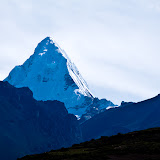
The next day we got picked up at 6 am and drove to Cashapampa, one end of the Santa Cruz trek. We had a flat tire along the way but the driver (Nino) was quick changing it. We were just glad we didn't get a second flat in the middle of nowhere. It was a beautiful clear day and we had great views of Huascaran and Alpamayo.  I thought about asking the driver to stop so I could take photos but I didn't (except for one of Alpamayo), thinking we'd be seeing lots more on our trek.  As it turned out, those were the only clear views we got all week - that damned rainy season thing!

Doing the trek in four days meant relatively short days hiking-wise (four to five hours per day).  The first day climbs about 800m from 3000m to 3800m, fairly steeply at first and then levelling out into the Santa Cruz valley. Lots of cattle and donkeys, but no people - we didn't see a single person, even a local, all day.  But the donkeys were friendly :-)

We camped at Llamacorral, one of the "established" campsites you are supposed to use. The only thing at these "campsites" was an outhouse building, but sadly these were all totally trashed - no doors, roof half gone, holes in the walls. I'm not sure if this was vandalism or just weather and animals. The cattle and donkeys kept the grass cropped super short, nice for tenting, but they also left cow pies everywhere. Despite being the only ones there, it was hard to find a spot that was flat, no cow pies (or at least no fresh ones!), and not under water. Did I mention this is the rainy season? The ground was water logged and there were streams, puddles, and swampy ground everywhere.

We were told that it would usually rain in the afternoons around 3pm. That was the case the first day, but after that it rained more often than not, most of the night and much of the day. By hiking early in the day we avoided a lot of it, but we still were hiking in rain gear much of the time.

The second day was mostly flat along the Santa Cruz valley, past two lakes. We got occasional glimpses of higher snowy peaks, but mostly the clouds were hovering low above our heads.

The third day we went over the Puente Union pass - about 4800m  (15,500 ft). There was fresh snow at that altitude but not too much. We met two other hikers at the top doing the trek in the opposite direction. They wanted to know if we thought they could complete the hike that day - theoretically feasible, but a long way on top of the climb they'd already made to the pass. I'm not surprised they wanted to finish - they were in running shoes and with an army duffel bag for a backpack. But they seemed in good spirits.

We descended from the pass and set up camp in the rain. We were joined by a group of 6 or 8 with a guide and mules, again going in the opposite direction from us. After having the trek more or less to ourselves for 3 days it was a bit of a shock to have a group of young people hooting and hollering as they're apt to do.  At least some of them were fellow Canadians so we were treated to a rousing rendition of "O Canada". But the sound of the raging creek and the rain on the tent covered most of the noise. And they went to bed relatively early, tired from the trek no doubt.

The last day we hiked out to Vaqueria. We were in a beautiful forest of trees with red peeling bark, with green, green moss everywhere.  We managed about an hour of hiking before it started to rain. It rained off and on the rest of the way. Our pickup was scheduled for sometime between 12 and 1pm. We arrived at 10:30 figuring we'd have a couple of hours to wait, but we'd only been there about 5 minutes and a taxi pulled up. It turned out to be our ride. It was nice that we got picked up early because it's a long ride back, about 4 hours to get back to the highway at Yungay and then another hour back to Huaraz. First you climb up and up steep switchbacks to a 4800m pass, and then descend down and down even more steep switchbacks. If the clouds weren't so low I think there would have been some awesome scenery.

Back in Huaraz we moved to the Olaza Hostel. It had been recommended to us and we had checked it out before we left for the trek. We would have stayed there at the start but were too worn out to go searching for it. It's a very nice place and only about 70 soles per night (about $30) with breakfast included. It's a little way from the centre of town, but only about 10 minutes walk. There's a great sitting area on the top floor with more tables outside on the roof when the weather is nice. Recommended.

The next day we took it easy until our bus left at 1pm. It was nice to travel during the day so we could see the scenery, on the other hand, 8 hours of riding a bus does go easier when you sleep through it. We had tons of room in first class - only three seats across the big bus.
We're back at Villa Poinciana in Lima. Harry (the owner) is once more looking after us well. He had a taxi waiting to pick us up at the bus terminal (as he had similarly done when we arrived at the airport).

And now for something completely different … next we head to Bonaire via Caracas (Venezuela) for some scuba diving. It will be nice to be in one place for more than a day or two!

Travel Tales

After our trek near Huaraz (more coming on that) we returned to Lima for a day before continuing on.

When we originally started planning our trip our return flights went through Caracas, Venezuela. That's close to the island of Bonaire which is known for it's great scuba diving so we decided to stop there on the way home. It seemed simple enough, but the reality has not been so easy.

First, flying out of Lima is chaotic. At best you have to go through four different lineups - check in, airport tax, immigration, and finally security. (not counting the lineup to board). Although we'd booked our flights through Air Canada, somehow our flight from Lima to Caracas ended up with Taca. Shelley's family had trouble with their Taca flights so we were a little nervous. We checked in online but even that was a big hassle - My booking number brought up Shelley, and Shelley's booking number was rejected. So I had to use the e-ticket number which involved an "entertaining" guessing game of figuring out which subset of the 20 digit number they wanted (not the whole thing, that would be too easy) The flight itself was ok, but the airport check in was crazy. First they told us to stand in one huge unmoving line. Then they came and moved us to another slightly shorter but still unmoving line. Finally they put us in the "special" line. There were no signs and no rhyme or reason to the various lines and shuffling. Every person checking in took forever. I have to think the system could be improved!

On the positive side, our flight was late leaving, giving us time for a bathroom break (heaven forbid you need to go while you're shuffling through the lines) and even time to pick up a coffee.

Because we'd booked our Caracas - Bonaire flight separately we couldn't check our bags all the way through. We weren't sure what to do. Shelley figured we'd have to go through immigration, pick up our bags, and then check back in. I wasn't sure and asked several people who sent us in various directions to wait in various lineups, only to finally find out that Shelley was right. At least she didn't say I told you so!
Arrivals was a zoo with a zillion people milling around. We had to leave our luggage cart and we had too many bags to carry (camping plus diving gear). So we got "picked" up by one of the luggage handlers and some other guy who babbled nonstop. Neither of them knew where our next flight check in was but it didn't stop them from running around the airport with us in hot pursuit trying to stay close to our bags. We lost the one wacky guy and the other eventually got us to supposedly the right place, although the sign said Mexicana, not Dutch Antilles Express. When we tipped the luggage guy $3 he told us it wasn't enough - he wanted $5. We gave it to him just to get rid of him. Eventually a few more people showed up looking for the same flight and we all stood around wondering if we were in the right place.

Amazingly, it was the right place. Then the charges started. $56 for excess baggage. Then $60 for one "departure" tax - a guy with a briefcase taking cash in exchange for immigration cards. Seemed suspicious but the check in person sent us to him. Then another $80 tax at a more official seeming counter. But they only took Venezuelan money so we gave in to two guys that had been following us around trying to get us to change money. Only the great rates they'd been offering suddenly evaporated and we got in a minor argument. It was nice to get back through security (two sets - army and airport) so we were out of reach of all these guys trying take a buck off you.

After a bite to eat I wanted a coffee but they didn't take dollars. I tend to make the mistake of thinking South American countries are similar but this was a good example of how they aren't. In Peru ATM's are everywhere and it's easy to get dollars or soles or change money. Here (in Venezuela) there are no ATM's and changing $40 to pesos took 20 minutes and required copies of my passport and fingerprints on multiple documents. The things I go through for a coffee :-)

On the lighter side, the people at the coffee place were highly amused by Shelley's personalized travel mug with pictures of us etc. Of course, they're somewhat baffled by travel mugs in the first place.

We took our coffee to the gate listed on the departures board, which was displaying the correct flight. But no one was there, passengers or staff, even though there was only 20 minutes to the flight. Strange. Then another passenger came along and he was even more concerned. Suddenly he said "oh, they just announced they changed the gate". Lucky he was there because I doubt we would have understood the mumbled announcement in Spanish. We rushed to the far end of the terminal and got to the gate as they were boarding. I'm still not sure how everyone else knew which gate to go to.

It's less than an hour flight to Curacao and then we had to figure out how to avoid going through immigration. Our bags were checked through this time but we didn't have boarding passes. (And Shelley was dubious that our bags would actually get transferred correctly.) We got shuffled around from person to person until we got to someone who was able to give us boarding passes.

Thankfully, our bags made it and it didn't take too long to get a taxi to our hotel where we crashed.

I can just hear Jennie saying "see, that's why I don't travel". But despite the frustration at the time, it's all part of the adventure. And besides, it provides amusement for you folks.

Tuesday, January 19, 2010

A Long Day

Third airport and country, one more to go. (Lima, Peru - Caracas,
Venezuela -Curacao - Bonaire) Free wifi though :-)

Monday, January 11, 2010

Gringo Hits, Volume One

by Shelley

One of the funny things we always notice on our trips to developing countries is the abundance of English music being played and that it's 20-30 or more years old! It's like we're in a time warp back to our teens. At least most of them are "golden oldies". We're not sure if they play it for the benefit of the tourists or if it's actually their preferred music.

Here's an example of what we've heard lately.

- Dust in the Wind (Kansas, 1974)
- Angie (Rolling Stones, 1973)
- Year of the Cat (Al Stewart, 1976)
- Baker Street (Gerry Rafferty, 1978)
- Love on the Rocks (Neil Diamond, 1980)
- Yesterday (Beatles, 1965)
- Sailing (Christopher Cross, 1980)
- Summer Breeze (Seals and Croft, 1972)
- Rosanna (Toto, 1982)
- Grease (Frankie Vallie, 1978)

And the "new" hits:

- Constant Craving (kd lang, 1992)
- Mr. Jones (Counting Crows, 1994)
- Mambo #5 (Lou Bega, 1999)

We haven't figured out where they get the music from. Does someone local sell "Hits of the 70's and 80's" CDs?

When we get home we're thinking of putting together an iTunes playlist of "tipical" Peruvian music for the younger generation of my family!  (Just kidding Julie!)

Fakebucks

by Shelley

Although we saw a few real Starbucks locations in Lima their legal department obviously hasn't made it past there.

In Aguas Calientes we found "Discovery Coffee" with the distinctive green circle logo -- it had good coffee and a most excellent chocolate cake!


In Ariquipa the "Cusco Coffee Company" changed color with a blue circle logo with a photo of Machu Picchu in the middle. They served frappes and one of the guys claimed to have previously worked at a Starbucks. Oh, and very good latte, tea and cookies!


But the most blatant and humorous ripoff was the "Incabucks" in Ollantaytambo. Green circle logo with an Inca king in the middle, replacing the seductive siren in the Starbucks logo. They even had t-shirts that said "I hate people who steal my ideas before I think of them".  Of course Andrew had to buy one!


Heading North

Flew into Lima and found there are only night buses to Huaraz so we're leaving tonight - running around buying bus tickets at Wong (think Walmart) and finding somewhere that will do laundry in a few hours. I think we have it all under control. Now we're sitting in Gloria Jeans having coffee. Could have gone to Starbucks but we would have had to cross six lanes of crazy traffic. Once we get to Huaraz we'll stay one night and try to get organized for a three day trek, no doubt running around crazily again. This holiday thing is tiring :-)

Trekking in the Colca Canyon


Colca Trek

When we took the train from Cusco to Puno and then the bus to Arequipa we were heading for the Colca Canyon - Peru's Grand Canyon. It is not as steep as the Grand Canyon but it is twice as deep. And to top it off, the mountains around the canyon rise to 6300 m (20,700 ft - bigger than Mt. McKinley, the highest in North America).

From Arequipa we took the bus to Chivay, a small town at the start of the canyon. This is a four to five hour ride. Part of the road was under construction and was really rough. The road goes over a 4900 m pass where you're supposed to be able to see some of the high volcanoes, but it was too cloudy to see much.

When we got off the bus in Chivay we were "befriended" (hustled, in other words) by a lady and her daughter promoting their Rumi Wasi hostel. Normally we don't like to encourage these people but she was low pressure and was quite helpful as we tried to book bus tickets for the next day. (In the end we found the reason we were having so much trouble is that they didn't sell those tickets in advance!) We didn't have any plans on where to stay so we decided to give the hostel a try. It seemed ok and was only 20 soles per person (about $8). Sadly, once they got our business they stopped being friendly and helpful and pretty much ignored us. Oh well, it was a place to stay.

The next day we caught the bus to Cabanaconde. This is normally a 2 1/2 hour bus ride but our bus broke down and it took them an hour to fix it. Usually it's just a flat tire but this was something else involving hoses and connections. I just hoped it wasn't the brakes they were jerry rigging!

We got to Cabanaconde about 1pm and had a quick bite to eat. The tiny restaurant didn't offer us a menu or ask us what we wanted, they just brought us each a big bowl of soup. Luckily it was vegetable soup and quite good. The woman also started cooking more (meat probably?) but we managed to communicate "no algo mas" (nothing more).

After lunch we headed out on our three day hike (didn't spend the night in Cabanaconde). We got directions for finding the start of the trail, which actually had a sign (unusual) but we soon got confused in the maze of trails through the corn fields around town. Once we found where the trail dropped into the canyon we were ok. For the first night we were headed to Sangalle, a camping site beside the river. That meant descending about 1000m (3300 ft) on a steep path zig zagging down the side of the canyon. Our legs were getting a little rubbery by the time we got to the bottom.

We saw a few lizards on the way down and also quite a few dung beetles. They were the kind that make balls out of fresh dung, rolled them away and then bury them, either for food or for laying their eggs. They're actually quite a valuable part of the ecosystem since they get rid of the dung before it breeds flies and other pests. Often the female rides on the dung ball while the male rolls it. It's a bumpy ride for the female! They roll the ball by putting their front legs on the ground and using their back legs to push (like doing handstands). Check out dung beetles on Wikipedia for more information.

There are several camping sites at Sangalle. We stayed at Oasis (the first one we came to). It had toilets, a shower (cold), and even a pool, and it was only 3 soles (about $1) per person. We hadn't brought our swim suits but we were glad of the shower after a sweaty day. The resident dogs - a large German Shepherd and a brown fur ball of a puppy - pestered us a bit, but in a friendly way. The puppy wanted to chew everything, including Shelley's socks and even her elbow!  Then as we tried to get to sleep the mules came to munch on the grass, so close to our tent that we thought they were going to take a bite out of our packs which were under the fly of the tent. I finally yelled at them and they ran off.

The next day we crossed the river (the Rio Colca) and hiked up the other side to Malata, Coshnirhua, Tapay, and finally dropped down almost to the river again to San Juan de Chuccho. Most towns have an "Arco de Ingreso" (entry arch) and a church with a plaza (square) out front. Some of the plaza's were very nice with grass and flowers, others were bare and not well kept.

On the steep route up to Tapay Shelley started feeling not that great and threw up (a fairly common occurrence on these trips unfortunately). Just before this we'd been stopped by a French couple coming from the other way and asking directions to Sangalle. They were also camping but the guy was carrying a big pack with all the gear and the girl was carrying a small day pack. Shelley later wondered where she could find a big strong guy to carry all her gear for her. I told her I was looking for a hefty girlfriend to carry all my gear but
preferred one who didn't puke!

We stopped for a snack at Hospedaje Restaurant el Encanto de Maruja in Tapay - a big name for a small place! Amazingly, the owner pulled out a home espresso maker (still in the original box) and made me a latte! Originally we had planned to stay in Tapay and this would have been a good place, but we decided to shorten the next day (the big climb out of the canyon) by going further. While we were sitting here we noticed the small green fruits in the tree beside us. We asked what they were ("que es?") but of course we didn't understand a word of the reply. The man brought one over with the green skin removed and it was obvious they were walnuts! Sadly, to us, things like walnuts and brazil nuts come from the grocery store, far removed from their original source.

In San Juan de Chuccho we stayed at Gloria's. Some people had recommended it and it was also the first place we came to. It was very nice with flowers and trees and only 8 soles per person (about $3). Our total bill for the room, drinks, supper, and breakfast was 45 soles (less than $20). A beautiful sunset that night.

The third day we crossed back over the river and made the long climb back up. It took us about 3 1/2 hot, sweaty hours, slowly but surely. Once we reached the rim it was about another hours walk back to Cabanaconde. We were again "befriended" and led to Pachamama's for lunch. This guy was a real character. He had very good English and was obviously determined to try out every slang English expression he knew. He even pulled out a list of English words (from a book he was trying to read) to get us to help him pronounce them correctly. English pronunciation is tough. By comparison, Spanish is easy.

We caught the 2pm bus back to Chivay. The bus ended up packed so full there wasn't even standing room. So far we've been lucky and gotten seats - I'd hate to have to stand, packed like sardines, for a two hour bus ride!

Wednesday, January 06, 2010

Travel Update

A quick update since we'll probably be out of touch for a few days.

After the rain forest we flew back to Cusco. (the rest of the family headed home). Decided to take the Peru Rail Andean Explorer train to Puno. Similar cost as flying but we figured it would be more interesting and we'd see more of the countryside. Turned out to be quite posh with wine with lunch.

We spent the night at the Sonesta Posada in Puno - unremarkable but a nice location right on lake Titicaca.

Then took the bus to Arequipa. Always a challenge to figure out the buses - there are dozens of private bus companies all going different places at different times and varying widely in quality of buses and service. We found one that turned out mid-range. We got good seats right at the front of the second level so had good views and leg room. The only negative was that there was no ventilation and it got pretty hot and stuffy by the end of the 5 1/2 hours.

Stayed at another Sonesta Pasada in Arequipa, mostly because it was right on the Plaza de Armas (main square). Had supper at Paladar restaurant - very nice - recommended.

Today we're heading by bus to Chivay and then to Cabanaconde to hike in the Colca Canyon. Tried to get an 8am bus but it was either full or cancelled so we bought tickets for an 11:30 bus and headed back downtown to wander and visit the Cusco Coffee Company again.

Not sure if we'll have Internet till we get back to Arequipa on the 10th.

Tuesday, January 05, 2010

Boats, Birds, and Bugs

by Shelley

On December 28 we started our visit to the rain forest (you're not supposed to call it the "jungle" although that's what it seemed like). We flew from Cuzco to Puerto Maldonado, took a bus to the river and then a 3 1/2 hr boat ride along the Tambopata River to Refugio Amazonas, located in the Tambopata National Reserve.

The Refugio is an amazing place made of natural and local materials (mahogany, bamboo, cane, clay and palm fronds). There are no doors or outside walls. The bedrooms are three sided, with one side open to the jungle; curtains served as door coverings. Although there was no electricity the bathrooms were surprisingly modern. There was no hot water but after sweating it out most of the day a cold shower was tremendously welcome! There was also no electricity (kerosene lanterns lined the walkways to and along the rooms) except in the main lodge during certain times. There was also wi-fi which Andrew noted in a previous blog.

We stayed here one night at the beginning of this part of the trip, one night at the end, with two nights further along the river at the Tambopata Research Center (not quite as fancy as the Refugio but still very natural and nice).

Activities were early in the morning (i.e. 4 a.m. wake up calls!) and later in the afternoon when the animals were most active. Our guides, Yrma and Johan, were very knowledgeable and gave a running commentary about all the things around us.

The first hike we did was learning about all the medicinal plants in the jungle. Johan had us chew the stem of one of the plants and our tongues all went numb!  The plant was apparently used as a local anesthetic.

One early morning we went to the canopy tower, climbing stairs 135 ft into the air to an observation platform. A bit crowded with 11 of us plus guides! But we saw lots of bright coloured macaws, toucans, and other birds.

The brazil nut tour was an eye opener. I'll never eat another one without thinking about the incredible amount of time and energy that goes into harvesting them (all by hand), in very rough conditions, for very little pay!

Andrew enjoyed the night hike which provided an added opportunity to see snakes, frogs, tarantulas and other slimy creatures. He also kept Johan out for extra hiking time trying to find all manner of bugs, spiders and creepy crawlies.

Although Bev and Gretchen kept a detailed list of all the birds, animals and plants/trees we saw, some of my favorites/memorable were:

- huge strangler fig trees
- monkeys (red howler, black spider, tit, and brown capuchin) -- especially when they actually sat still long enough to get a good look at them!
- leaf cutter ants and army ants marching, not two by two, but by the hundreds!
- capybaras
- wild turkeys
- peccaries (wild pigs)

Unfortunately, we didn't have much luck at the macaw clay lick. We were hoping to get to see the usual 300-400 macaws but the first morning we went out it rained (they don't like rain) and the second morning the river was too high to go out. The high river also foiled our chance to go on a night boat tour looking for caimans (like alligators). It was amazing how quickly the river changed from hour to hour. It was definitely very high due to recent rains and was moving very quickly!  Our return boat rides took about 1/2 as long going back downstream!

photos from the rain forest

The Good, The Bad, and The Ugly of the Inca Trail

So you don't think I'm totally negative I'll start with the good. The Inca Trail trek to Machu Picchu has amazing mountain scenery, beautiful cloud forest, a very cool trail, and fascinating ruins and history.

But ... it also has too many people, crowded campsites, and not enough toilets. Many of the people are in over their heads, ill equipped, unfit, and unprepared for a demanding high altitude hike. Our group, including an 82 year old traveled quite slowly, yet we often caught up with other groups at rest spots. Between the altitude, traveler's diarrhea, and over exertion many people were not feeling their best.

Our first campsite was quite nice - small with only one other group. But after that, our other campsites were much larger. 400 people per day are allowed on the trail (I'm suspicious of anyplace with a quota!) and almost all of them were concentrated into the same camp sites. There weren't enough toilets and often they were a long hike away. And I still can't figure out how you get feces sprayed over the walls four feet off the ground, no matter how bad your diarrhea is!

Our guide (Fredy, short for Frederico) was very good to us, patient and considerate. I question some of the approach but the problem seems to be more a reluctance to change their routine. For example, when it's raining and you're moving so slow you're going to get in after dark it doesn't seem like an appropriate time to stop for an archaeology lecture. Several days we stopped for close to two hours for a huge three course cooked lunch that most of us barely touched, waiting over an hour for it to be prepared, shivering in wet clothes. Maybe that works for the sprint and crash majority, but it doesn't fit with a slow and steady approach like our group's. We asked several times for a smaller, quicker lunch (to which they said "of course") but we failed to budge them from their routine.

I would love to do this trek if it wasn't such a circus. As it is, if it was just up to me, I'd do one of the less crowded treks instead. If you want to see Machu Picchu (and it is impressive) take the train to Aguas Calientes. By the time you've trekked there, you're too tired to appreciate it anyway. (We stayed overnight in Aguas Calientes and went back up to Machu Picchu in the morning.)

photos of the trek

Coffee in Arequipa


At the Cusco Coffee Company - another Starbucks lookalike. Not sure
about the name - we didn't see any in Cusco.

Wednesday, December 30, 2009

Tambopata Research Center

We're now at TRC for two nights. Four hour boat ride to get here. The
highlight was seeing a group of capybara on the shore. We were quite
close and they didn't seem bothered by us.
TRC is not quite as fancy as the last place but still quite nice.
Shared bathrooms but that's no big deal. Still wifi although it's slow
(satellite).
Went to the macaw clay lick at 4:30 am this morning but got rained
out. We'll try again tomorrow. More walks today to see what we can see.
At breakfast some of the "chicos" arrived. These are macaws that were
rescued as chicks and raised by hand. They live in the wild now but
still come back to beg for treats. Pretty cool to see them up close
instead of in the distance. Yesterday we saw quite a few toucans, also
very cool with their huge bills.

Monday, December 28, 2009

Into the Rainforest

We flew from Cusco to Puerto Maldenado, took a bus, then four hours by
boat to Refugio Amazonas. It's a pretty neat place. The rooms are open
on one side to the rainforest and we even have our own hammock in our
room. No hot water or electric lights but that's ok. And amazingly
there's wifi in the main lodge!

Back from Machu Picchu

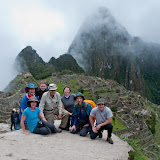
We made it through the Inca Trail trek to Machu Picchu. We had Shelley's 82 year old father (Earl Ballard) with us so we weren't the fastest group, but he did great and made it through a tough hike.For example, one day includes a 5000 foot climb up to an almost 14,000 foot pass. Another day is 16 km including long (thousands of feet) steep descents on stone stairs. And this is the rainy season so it rained a lot. Word soon spread through all the trekkers and many people congratulated Earl and told him what an inspiration he was.


Machu Picchu itself is very impressive. Too many tourists of course, but not as many as in peak season. And it's a big place so it's still possible to wander parts of it almost on your own. 

We spent the night at Aguas Calientes and then took the train back to Cusco and spent the night and now we're off to the jungle and off the grid again for a while. These short (for me) trips with a lot packed in are hectic! Barely time to read our books! We'll slow down when the others leave and post more detailed information at that time.

Tuesday, December 22, 2009

Photos from Cusco

Been too busy to write much, but here are a few photos from the ones I've had time to look at. Tomorrow we're off for the hike to Machu Picchu so no internet for a few days. Then we're back in Cusco for one night before heading for the jungle.

Peru2009c

Monday, December 21, 2009

The Tale of Three Generations

- by Shelley

The first part of this trip is a bit different for Andrew and I. My whole family is joining us for a 4-day hike into Machu Picchu and then a few days in the jungle. The whole thing is very strictly planned with guides and schedules (not our usual fly-by-the-seat-of-our-pants travel style). The players are as follows:

- Andrew and I
- My dad Earl and my stepmom Elaine
- My sister Bev
- My nephew Andrew and his wife Gretchen
- My niece Nicole and her boyfriend/fiance Austen
- My niece Julie and her boyfriend Grayson

It's a widely divergent group in many ways. We range in age from 17 (Julie) to 82 (Dad); some are totally comfortable with camping, roughing it and, when necessary, going days, even weeks, without a real shower (Andrew and I), while some are lovingly referred to as "high maintenance" with makeup, hairdryers, always fashionable and perfectly put together (Elaine); most of us are fairly well traveled but some not so much away from the western world; some are happy to go along with whatever the plans are and my sister in particular wants to see every possible site she can in the time allotted (she's an accountant and we joked that if she started making spread sheets for us we were all going to run away!). I've got to give her credit for the monumental task of organizing all of us on various schedules and logistics.

It's a fun crew and Dad and Julie especially create a lot of entertainment value. As Julie said on her facebook page . . . "11 people, 3 generations, 2 weeks of bonding and 1 mountain to climb!!!" My Andrew jokingly replied "Bonding??? Are we on the same trip?"

Andrew and I left a day ahead of the second crew (Dad, Elaine, Bev, Gretchen, Julie, Grayson). They left from Edmonton and the last legs of their flights were with Taca. Apparently Taca oversells many of their flights and it's pretty much first come, first served. They got bumped to standby and were facing an overnight in San Salvador which would throw out several other flights and plans in Peru. Between them, they used every trick (aka sob story) in the book -- 82 year old father, meeting family, tight schedule, etc. etc. They made it and we ran into them in the airport in Lima enroute to Cusco. But then their flight to Cusco got delayed and they had to move to Lan airlines, arriving several hours later than originally scheduled.

The third crew of Andrew J., Nicole and Austen are coming a few days from now due to university exam schedules. They and Elaine will take the train and meet the rest of us at Machu Picchu. Gretchen and Bev have emailed Andrew J. with tips to try to make sure their travel goes smoothly.

We're gradually getting acclimatized to the altitude in Cusco and walking up the hill to our hotel gets easier each day. Machu Picchu here we come! 


Andrew, Shelley, Gretchen, Elaine, Bev, Earl, Julie, Grayson - Cusco in the background.

Saturday, December 19, 2009

Arrived in Cusco

And already drinking coca tea. (tastes like stewed leaves)

Friday, December 18, 2009

First Batch of Peru Photos

The Cow Parade -- There are a cow sculptures everywhere! Decorated quite elaborately. We took photos of a few that most caught our eye!

Huge Christmas trees in all the parks/squares! Seems strange with no snow and so much warmth!

Note the doberman police dog with the muzzle. Doesn't look quite so friendly as our German Shepherds!


Peru2009a

Not in Saskatchewan

by Shelley

We arrived in Lima at 0100 hrs. Only 1/2 hour late. But by the time we got through customs, waited an inordinate amount of time for our luggage, and got to our hotel it was just after 3 a.m. A whirring mind (still thinking about work), a too fat pillow, chirping birds, and being over tired made it difficult to get to sleep.

As we drove from the airport I was vaguely disappointed. Large, new modern buildings, casinos, big Toyota and Hyundai dealerships, Starbucks and Scotiabank made it seem like we'd hardly left home. But the rows of shops with metal garage overhead doors, the cement shell of buildings almost falling down, and the warm humid air blowing through the open windows of the taxi reassured me that "Yes Shelley, you're not in Saskatchewan anymore!" And if there was any lingering doubt, a number of things over the past two days sealed the deal: crowded streets and the overpowering smell of exhaust fumes; excessive amounts of graffiti; excessive numbers of police in riot gear with an armored tank; standard shift, very small taxis that rattle as if parts will fall off at any moment; taxis with no meters; the feeling that you're getting ripped off by drivers of said taxis with no meters; thanking God that you managed to survive a ride with said taxi drivers; roof top gardens; laundry hanging from rooftop clothes lines and balconies; big glasses of fresh fruit juices at ridiculously low prices; and . . . bougainvillea!

Our hotel is Villa Ponciana. A very small (6 rooms) and out of the way place run by a very friendly Peruvian man named Harry who has been extremely helpful with suggestions on where to go, places to eat, what to do and see. Yesterday we wandered in the older Central part of Lima and just happened to arrive for the changing of the guards at the palace. Also a quiet lunch at an out of the way museum and tour of the museum. Today we went to the zoo which was quite large, had some interesting animals, but was not the greatest in terms of making animal habitats that were the best for the animals. We also went for a walk along the ocean front; lots of parks and walkways on the clifftops overlooking the water. Beautiful!

Tomorrow to Cusco...

Small Coffees

We're back in the lands of small (but good) coffees. Actually, that's
pretty much everywhere but North America where we've all been super-
sized.

Thursday, December 17, 2009

First Morning in Lima

Breakfast at Hotel Villa Poinciata. Nice litlle (8 rooms?) place in
Miraflores neighborhood. What did we do before we had the Internet?

Got here late/early at 3am, slept in, and feeling ok now. The owner
has suggested a plan for the day, including a museum with a nice
restaurant with vegetarian options.

It's a beautiful day mid 20's - a far cry from -40!

Wednesday, December 16, 2009

On the Road Again

Actually, not literally the road. We're in the Toronto airport waiting for our flight to Lima.

Had the usual "alpine" start - up at 3:30, taxi at 4:15, drop off our bags (checked in online yesterday), breakfast at Tim Hortons, then through security. Flight at 6:30.

Annoyingly, this time the coffee place inside security wouldn't put my tea in my travel mug and insisted on giving it to me in a disposable cup. If I'd been more awake I would just have said no thanks. I hate disposable cups (and bottled water).

I used to really enjoy airports, not so much for the airports themselves but for the association with adventures and new places. Nowadays I'm too conscious that this kind of travel is not sustainable. But at the same time I'm here and I'm doing it so I might as well enjoy it (and I will). Every generation has its own kinds of guilt.

The terminal for our Lima flight seems new. Not much in the way of shops or restaurants. But we found somewhere for lunch with a vegie burger and Pad Thai. And there's a Starbucks for a coffee later. And a bookstore to browse :-)

I've started reading The Global Soul by Pico Iyer - good so far. (thanks Penny!)

I'm typing this on my iPhone - not bad for typing but awkward for editing.

Saturday, December 05, 2009

Seashore Scavenger

These are from our kayaking trip from Gabriola Island a few months ago.


Sunday, November 22, 2009

Sunrise

I was working at the computer and I happened to glance up and see a red tinge to the sky. I stood up to check out the sunrise and it looked pretty good so I grabbed my camera, threw on shoes and a jacket and ran down the back alley to the top of the hill overlooking the river.


The power line tower is a little annoying, but it was still a spectacular sunrise. And yes, the color was really like that, I didn't mess with it in the computer. We've had some good sunrise's and sunset's lately.

The annoying thing was that after the light show was over I looked at the display on the back of the camera and saw that the anti-shake / image stabilization was turned off!  I've been caught multiple times by not putting settings back to normal and I'd carefully checked the focus and iso and exposure adjustment etc. But I had forgotten to turn off the remote release after the previous bird pictures. And when you have the remote release turned on, it assumes you're using a tripod and turns off the anti-shake. I wish there was an easier way to reset all the settings. (There is a "green" mode that does that, but it only shoots JPEG not RAW so I don't use it.) Of course, some of the settings are actually physical knobs and levers (how quaint!) which a reset button couldn't handle. But it could still beep and flash and make it obvious so you'd know to manually reset those ones.

I hadn't thought to grab the tripod, even though it was right there. I guess I'm not a serious photographer yet! Luckily, I did sit down and brace my elbows on my knees so I was reasonably steady even without the anti-shake.

Red-breasted Nuthatch

There were a dozen of these little guys around the feeder so I got out the camera and tripod and remote.


They were pretty skittish, even using the remote they could obviously hear the shutter through the window and would fly away.

Saturday, November 21, 2009

Bird Book

There's a new coffee table book called "Bird" of amazing bird photographs by Andrew Zuckerman.

You can get see many of the photographs on his website: birdbook.org Don't miss the videos under Films, I really liked the Aviary and Behind the Scenes as well as the first Bird Film.

I see he had a previous book called Creatures that looks pretty cool too.

His main web site is andrewzuckerman.com I liked the video under Work > Films > Wisdom.

I also see some of his bird photos are in the latest issue of Audubon magazine.

Wednesday, November 18, 2009

Killing Things

Saskatchewan has put a bounty on coyotes.

Trevor Herriot comments on this.


Basically, people complain that coyotes (or gophers or wolves or buffalo or ...) are a nuisance so we should kill them. Of course, because our god, money, is involved it's regarded as much more serious. But every business accepts restrictions (that cost money) for the good of everyone.

The logical conclusion of this attitude of our culture is to kill everything except our beloved, precious human beings and the things they eat.

Don't other living things have a right to the planet as well? And even if you don't believe that, do you really want to live on a planet with just us and our food? (If that's even possible, since we rely on the ecosystem a lot more than we realize.)

And for some extra craziness, if we did succeed in wiping out most of the coyotes, we would then list them as endangered and spend large amounts of time and effort trying to "save" them.

Thursday, October 22, 2009

Politicians

Bill C311, the Climate Change Accountability Act, has been stalled again.

NetNewsledger via Nature Canada

As a result of of an email I sent, I recently received an email from Justin Trudeau (a canned response) that made it sound like the Liberals, unlike the Conservative, are 100% behind this bill. They must have a different definition of "support" since the Liberals joined forces with the Conservatives to stall the bill.

Wednesday, October 21, 2009

Photo of the Day

I was going through my Australia photos getting ready for a slideshow (2pm Fri. Oct. 23 at the downtown library) and came across this one from the Sidney Taronga Zoo. Quite the display!

I've uploaded a big enough image to use for a desktop background if you're interested. (Click on this image to see the bigger version. Right click on the big version and save it if you want to use it for a background.)

Saturday, October 17, 2009

A Beautiful Fall Day on the Prairies

After snow and -10c it was great to have a beautiful sunny +16c day.  Too nice to stay inside.

2009-10-17 Prairies
It was very calm, hardly a breath of wind. Not much stirring. Even most of the bugs were gone after the frost and snow. As I was walking back to the car I could hear some birds calling. It turned out to be a huge flock of Sandhill Cranes (scroll down and listen to their distinctive call)

Some friends were lucky enough to see some rare Whooping Cranes today.

Friday, October 09, 2009

Fees and More Damned Fees

The Forest, The Trees and the Bag Fees - The Brancatelli File at JoeSentMe.com

I love it - the airlines that tacked on the most fees lost the most money. There's payback!

I suspect you could make the same case against banks and their never ending attempts to gouge more fees out of you.

So are we going to be bailing out the airlines next?

Thursday, October 08, 2009

Vancouver Island Sea Life

More photos from our trip to Vancouver Island at the end of August.


2009-08 Vancouver Island sea life

We went scuba diving with Ocean Planet Adventures. They're a small outfit but they seem like a good bunch of people. The water was cold for wet suits, around 13c. Remember to bring your thermos of hot water to pour in your wet suit between dives! You can see why everyone switches to dry suits if they're going to be diving much. Despite the cold, it was definitely worth it. I love poking around in tide pools as well, but underwater is a whole other world.

The sea life is very different from tropical coral reefs, but it's just as rich in its own way. It was pretty murky and dark so all the underwater shots are with the flash. It's amazing how much more color stuff has when lit up by the flash. It looks much more drab in the low light.

Tuesday, October 06, 2009

Fine Feathered Friends

We have a bird feeder in the tree outside the dining room window and I love to see the birds that visit it.

Red-breasted Nuthatches like the one on the right are pretty cute. We had a Downy Woodpecker last evening. I thought it was a Black-capped Chickadee at first because of the black and white head. They're another favorite.


Of course, I picked a dark, cloudy day so it's not the greatest photo. I'll have to try to remember to take some pictures on a sunny day!

Driving Mentality

I was walking home yesterday after work, through residential streets. I approached an intersection. There was a car coming from the side street, but it was a ways back and not going too fast so I continued walking across the intersection.

The car slowed down for me (it didn't even need to stop) but at the same time it blasted its horn repeatedly at me. I assume for having the nerve to impede its progress. The driver raised her hands at me as if to say "what do you think you're doing". Uhhh ... I'm crossing the road, legally and properly, at an intersection. I didn't step out into traffic or anything silly. It was broad daylight.

What happened to pedestrians having right of way? It's obviously a thing of the past. Interestingly, a woman with two small children was waiting on the other side of the intersection to cross. She obviously knew that pedestrians no longer had rights and didn't even attempt to cross when there was a car anywhere in the vicinity.

I realize this is not the normal case. That's when you stand by the side of the road and watch the cars zoom by without them even considering slowing or stopping to let you cross. After all, we're walking, and therefore second class citizens, and must have all the time in the world to wait. Whereas they are driving, and all drivers are on urgent missions and have to get wherever they're going as fast as possible. Heaven forbid you should get in their way.

Saturday, October 03, 2009

Tuesday, September 29, 2009

Thanks for Not Driving

Once more, I give thanks that I get to walk or bicycle to work this way instead of sitting in a car in traffic.


This is the river end of the connecting path to Innovation Place. It wasn't that many years ago that it was a dirt track between a field and the railway tracks. The trees on the right between the field and the path are growing up nicely. And I have to admit that when it's wet the paved path is nicer than the mud used to be.

And here's a shot of a solitary end of season flower taken with my iPhone on the way to work.


The Smaller Majority

If you like nature and don't mind "creepy crawlies" have a look at The Smaller Majority by Piotr Naskrecki. Your local library probably has it (the Saskatoon library did).

The photographs are amazing and the text is great too.

Sunday, September 27, 2009

Only in Saskatchewan

Shelley and I had planned to go kayaking this weekend but the weather didn't cooperate (rain and 50 km/hr winds) so we went down to Regina so Shelley could take part in the police memorial parade. Looking for somewhere to stay, I googled for "regina boutique hotels" and this was one of the top results:


Pretty sad when a Holiday Inn Express is the "premier boutique hotel"!

We ended up staying at the Hotel Saskatchewan - the price wasn't much different (via Expedia) and it's a little classier :-)

Sunday, September 20, 2009

Weather Ups and Downs

I just got back from an overnight kayak trip on the Hanging Heart Lakes and Crean Lake near Waskesiu. (Shelley was on call so I was on my own.)

The two days of weather couldn't have been much different. Saturday was 30c, sunny, very little wind. I started at the dock at Heart Lakes. (satellite view is best) There were all kinds of people out enjoying the day. The paddling was easy and relaxing. I kept going until the sun was getting ready to set.

It was too hot for the bugs on Saturday. ( I wonder why they don't operate in hot weather?) I sat outside and ate my supper and watched the sunset and wasn't bothered by a single mosquito. But as soon as the sun went down and the temperature dropped a few degrees swarms of them appeared like magic and I quickly retreated to the tent. Of course every time I went out and came back in it took several minutes to eradicate all the mosquitoes that snuck in with me.

This morning (Sunday) was much cooler at 7c, windy, and raining. I camped in a relatively sheltered spot but once I got out in the open water it was ... interesting. The waves bounced me up and down, spun me around, and slapped me in the face. It was a bit like a Disneyland ride, only I didn't have to pay, there were no lineups, and it lasted two hours. Crean is a pretty big lake (over 10 km across) and the growing whitecaps made me a little nervous. But the kayak is pretty stable and the spray skirt kept most of the water out, and I was close to shore if I did get tipped. Despite going mostly against the wind I made steady progress.

In the middle of this, two bald eagles appeared and flew around me for a while. I had to be careful not to get too distracted watching them and get creamed by one of the bigger waves. 

Once I got off Crean and into the Heart Lakes it was a lot calmer and I could relax, although I started to get cold once I wasn't exerting myself as much. Despite the rain gear and the spray skirt I was still pretty wet and sitting in a puddle of water. I can see why paddlers wear rain gear that seals around your wrists - getting a wave pouring water down your sleeve is a tad unpleasant!

Nevertheless, I still enjoyed the paddle back through the rain. Out of the wind it was quite peaceful. I had to stop a few times and listen to the sound of the raindrops hitting the lake. It was an almost musical pitter patter. The loons were also adding their own accompaniment. (When I searched I also found this video of a poem about loons.)

One advantage of the bad weather was that there were no other people anywhere to be seen. I was especially happy to be rid of the power boats. If you ask me, they should ban powerboats on at least some of the lakes. But that would no doubt be so unpopular as to be impossible.

I'm pretty lucky to be within relatively easy reach of more or less unspoiled countryside. The moss on the forest floor and the lichens on the trees, the ducks and loons and eagles - it's all pretty magical. I should get out here more often.

(sorry, no photos this time)

Thursday, September 17, 2009

Summer's Final Fling

The weather lately has been gorgeous, warm and sunny and not even too windy. I've been trying to make the most of it - running, cycling, having coffee where I can sit outside. It's supposed to get up to 30c today!

Of course, it is the middle of September and the days are getting shorter, the leaves are starting to fall, and the Canada geese are congregating.

Although our winters are harsh, I still love the cycle of seasons we have here. If you compared winter to summer you'd think it was two different places entirely.

Tuesday, September 15, 2009

No Fly Zone

It's becoming increasingly obvious (to me) that flying isn't sustainable due to it's impact on climate change. Depending on whose numbers you believe, it's about 10 times worse than buses or trains. And unfortunately, there are no obvious (or even obscure) ways to make flying sustainable. You can have cars and buses and trains powered by electricity generated in sustainable ways. But airplanes require a concentrated fuel. Even hydrogen isn't a good fit.

The trip to Peru we've got planned this winter will contribute somewhere in the neighborhood of 4 tons of CO2 per person - more than what we should be producing in an entire year. I can buy carbon offsets but that doesn't change my impact, it just means I expect someone else to cut back.

So after Peru I'm going to quit flying for a while. For someone that loves to travel that's a hard pill to swallow. But if I'm not willing to sacrifice, how can I expect other, less motivated people to do anything?

People are willing to do things that don't require much sacrifice - changing light bulbs, recycling, insulating their house. But that will only go so far. The changes we really need require a lot more sacrifice and that's a show stopper for most people.

It's not all bad. In a way I'm excited about the possibilities. Constraints often end up encouraging enough creativity to more than compensate for the limitations they impose. I don't intend give up traveling entirely - there's lots of places I'd like to visit in North America that I can reach by bus, train, bicycle, etc. Even our Prius with two people in it is a lot better than flying. (And I'm less likely to travel as far by these means so that helps too.) Saskatoon is a Via Rail stop so I can get east or west that way. I could even get to Churchill Manitoba to see the polar bears before they're gone. The Amtrak rail network in the USA goes lots of places and connects to Canada in Vancouver and Quebec. Unfortunately, it's not easy to go south from Saskatoon - neither the trains or the buses go across the border except in Vancouver and out east. And once you're in the US the trains primarily go east/west except on the coasts.

Traveling by bicycle would be even better, but distances in North America are large. One option might be to travel by train or bus with my bike. For example, I could take the bus to close to the Saskatchewan border, bike across and then use buses or trains in the US. Of course, that might be a little tougher in the winter! Maybe I need a Montague folding bike (there I go again falling into the trap of needing more "stuff")

Shelley thinks I'm a little crazy, and she's not the only one. Of course, they're right, but not necessarily because of this :-)

Too many people are keeping their heads in the sand, even people that are supposedly committed to solving the problems. For example, I recently ran across the International League of Conservation Photographers. It sounded great so I went to see what they do and found they're organizing a conference in Merida, Mexico. So a whole bunch of people are going to fly long distances to go and talk about how they can save the planet. Maybe they'll talk about not flying?

The standard defense is the old "the end justifies the means" - that the good they're doing makes up for the damage. Come on, can you really get people to stop doing something by doing exactly what you want them to stop doing? Bah!
The campaign against climate change is an odd one. Unlike almost all the public protests which have preceded it, it is a campaign not for abundance but for austerity. It is a campaign not for more freedom but for less. Strangest of all, it is a campaign not just against other people, but also against ourselves. - George Monbiot, Heat

Sunday, September 13, 2009

Tofino Sunrises

I've been working my way through my photos from our recent trip to Vancouver Island. It's taking a while so I thought I'd post a first batch. When we were in Tofino I got up for the sunrise a few mornings to take pictures. I even used my tripod. Thankfully it was late enough in the summer that sunrise wasn't too too early.

2009-08 Tofino Sunrises

Leopard Frog

It was a beautiful day yesterday and I was out roaming around on my bike. This Leopard Frog (probably a Northern Leopard Frog) jumped out of a puddle on a trail close to the river. It's nice to see it around because they're not doing so well these days. I'm not sure where it came from, as far as I know the only permanent water around is the river and I don't think they can breed in moving water like that. Maybe it came down the river from somewhere else. Or maybe it they are breeding in people's backyard ponds.


I took the photo with my iPhone since it was all I had at the time. It does a surprisingly good job for a phone. The fairly wide angle lens means you have to get quite close but I moved slowly and the frog cooperated for a few shots before leaping off into the undergrowth.

A couple of years ago I did a series of blog posts on some Leopard frog eggs that I brought home and raised:

Tadpole Progression
Tadpoles Grow Legs
Tadpoles to Frogs
Formerly Known as Tadpoles

Saturday, September 12, 2009

Saskatoon Bicycling Paths

At Jan Gehl's talk in Saskatoon recently the city was handing out a brochure on "Spaces and Places to Ride in Saskatoon".

It's nice to see the city thinking about bicyclists. Saskatoon does have some good paths, along the river and a few other places.

Saskatoon has two "Exclusive-Use On-Road Cycling Lanes" - along part of Preston and part of Spadina. I use both regularly and it is really nice to have a separate lane for cyclists. Of course, because the lanes are "just" for cyclists, and because they're at the edge of busy roads they tend to get full of gravel, which doesn't make the nicest (or safest) cycling.

On the map in the brochure the most prominent network, outlined in red, is "Shared Use On-Road Cycling Lanes". It also has the most "Proposed" sections. This is the one type of "path" that is not explained in the brochure. As far as I can tell, it simply means a road that bicycles are allowed to use. In other words, a regular road. Having cycled on many of the outlined streets, I don't recall anything special about them - no signs or markings.

In other words, the big red network is hype. Bicyclists will realize this. The problem is that non-bicyclists (most people) will see it and think "what are these bicyclists whining about, look at all the cycling paths they have".

And that's not the only part of the brochure that's hype. The map in the brochure shows the Spadina section extending from 33rd to College Drive. This is pure fabrication. Spadina on this part is barely wide enough for one lane in each direction plus parked cars on one side. And on top of that, it's full of potholes. As far as I'm concerned the only time it's safe to bicycle on this section is when there's no traffic (e.g. when Shelley goes to work at 5am). There's certainly no "exclusive use cycling lane". They are currently resurfacing this section (which should at least fix the pothole issue) and maybe they plan to add a cycling lane, although I doubt it because there's no room for it.

I don't think this hype is conspiracy or malicious or even deliberate. I just think most of the people involved are out of touch. I bet they haven't even looked at most of the paths in person, let alone cycled on them. The other symptom of this is discontinuous paths - bike lanes that suddenly end and sections of path that don't connect. They look ok on paper and add to the stats, but they're not so good for actual use. (Check out the path along Whiteswan, it's a crazy collection of discontinuous pieces.)

I think, at least unconsciously, there's this image of cycling as being something you go out and do on a sunny Sunday afternoon along the riverbank. Not something as mundane as trying to do your shopping or commute to work. That's pretty obvious when you look at where the good trails are - along the river. Where the shopping is it's almost impossible to cycle. This is true even in areas that are supposedly more "enlightened" like Broadway. Try maneuvering between stores on 8th Street on your bicycle.

It's also obvious when there is absolutely no provision for pedestrians or cyclists, only cars. For example it's almost impossible to get from my house in Richmond Heights to the restaurants and shops very close by on 42nd Street. You have to play Frogger and dodge traffic across 6 lanes of busy Warmen Road, then get across the train tracks (ignoring the no trespassing signs) scramble up and down the embankments, and then cut across a car sales lot. And it's even more fun in the winter with the snow and ice.

Studies show that traffic expands to fill the available space. Enlarging roads or parking to reduce congestion almost always has the opposite effect - it just increases traffic. The best way to reduce traffic is actually to shrink roads and parking. So on Broadway, for example, where people would say there's no room for a bike lane, we could just convert the parking lanes into bike lanes, at least for the summer. Of course, the drivers would complain and they have a bigger lobby so it's unlikely to happen.

It would also be nice if the city demonstrated a little more interest in input from people. Deliberately or not, the brochure did not give any way to contact anyone. No phone number, no email address. Only the web site for the city as a whole (saskatoon.ca) There is an advisory committee for cycling in Saskatoon, but from what I hear, the city primarily uses it to announce what they plan to do, not to actually get input.

Oh well, I shouldn't complain, it's nice to see some attention to cycling.

Monday, September 07, 2009

Where Are We Headed?

I'm in the middle of reading Heat by George Monbiot.  It's a few years old but still an excellent read.

Check out a couple of his recent blog posts.

Not Even Wrong

Should We Seek to Save Industrial Civilisation?

I find it very hard to know what to think of our current situation. Should I retreat to a cabin in the woods and attempt to live a pre-industrial life? But a few people doing that won't save us. Or do I give up and live it up while I can?

The middle ground of making some feeble personal attempts to "reduce, reuse, and recycle" seem almost pointless when the people around me are buying SUV's and McMansions. And when I, myself, hypocritically continue to travel by air, eclipsing any savings I might have made other ways.