Sunday, October 12, 2008

Back from Down Under

We got back from Australia yesterday. 12 hours of sleep and I'm almost feeling normal.

I apologize for not blogging during the trip. I prefer to write about things at the time rather than after the fact but it obviously didn't this time. We were camping (tenting) for most of the time which isn't conducive to blogging or sorting photos. And there weren't a lot of internet places, partly because we were (deliberately) off the "beaten path". But even to me, those seem more like excuses. The big reason (problem?) was that we were too busy. Writing and sorting through photos takes me a fair bit of time.

There's such a drive to "fill up" your time, to not miss anything, to see as many things as possible. It's good but it leaves me feeling uncomfortable. It doesn't seem right that you're so busy that you look forward to coming home so you can relax. That's where my last trip to Mexico was nice. Apart from the diving I did, I didn't have any agenda, no sights to see, no places to go, no things to do. Just hanging out in a different place, soaking up the different place.

A recent post by Timothy Ferris interviewing Rolf Potts echoes this:

Travel isn’t about efficiency. It’s about leaving yourself open to new experiences. You can’t do this when you’re racing around on a strict itinerary. If you examine the truly life-affecting experiences I describe in my new book, you’ll find that they most all happened by accident. If you aren’t open to the unexpected — if you aren’t willing to get lost from time to time — you’ll be selling your travels short.

[Suggestion from Tim: reread the previous paragraph substituting "travel" and "travels" with "life".]

[I enjoyed Rolf's book Vagabonding and I'm looking forward to reading his new book, Marco Polo Didn’t Go There.]

In any case, it was a great trip and I'm hoping to write it up "real soon". And post some pictures, as soon as I get a chance to pick out some good ones (out of the roughly 4500 I took - about 150 per day!)

Wednesday, September 10, 2008

2008 Prairie Pitch

I always breath a sigh of relief when the last racer crosses the finish line and I'm no longer "responsible" for them. And a final sigh of relief when the course is all taken down and I'm home again.

This year's race was a bit of a roller coaster, with Murphy doing his best to mess us up, and lady luck doing her best to rescue us. Maybe it was payback for everything going so smoothly last year. (Of course, I thought last year was payback for the problems the year before!) For example:

Several weeks before the race there's no water in the creek we're supposed to canoe on. Luckily it was only because they diverted water for irrigation and it came back again.

One land owner didsn't want us on his land, so I re-routed the course around it. Then, two weeks before the race, we found out his land actually juts out on one corner so I had to re-route the course again. In the process our proposed rappel location no longer worked and we had to hurriedly scout out another one. Luckily, we found a good spot nearby.

The people I'm counting on to lend us orienteering flags end up having an event the same weekend. Yikes! I arrange to borrow some from Alberta but they have an event the weekend before. Luckily, the flags arrive an hour before I leave for the race. Nothing like cutting it close!

Although statistically this area should have had little to no rain, the week before the race there's over 2 inches of rain. Two days before the race because of the mud we can't get our vehicle to the rappel and have to carry 4 big metal tripods and all the ropes and anchors a kilometer from the highway. Five trips later and I've completed the first 10 km of my race. (Of course, if I didn't keep forgetting things I could have cut out a couple of trips!) Things had just barely dried out enough to make the dirt roads passable and then it rained most of the night before the race. Even then, we might still have squeaked by but it rained again in the first few hours of the race.

The day before the race the water system at the camp burst and we had no water for toilets, let alone showers! Luckily it was easy to fix.

Because of all the changes I ended up printing the maps at the last minute. Of course, the printer has major problems - actually melting one of the rollers! Luckily we have a spare, even though it's not something we normally keep a spare of.

Anyway, you get the idea. It definitely added to the stress of organizing the race.

On top of the stress, there's just a lot of work involved in organizing this kind of event. I made 5 trips down to the area, totaling 14 days. (No wonder I didn't get out climbing much this summer!) Even just the driving time added up to 40 or 50 hours - a full work week! And then there's the countless hours preparing the maps and other materials, handling registration, and organizing volunteers, and all the hassles associated with each of those. Thank goodness Don Hernberg looked after dealing with the land owners - that was another big job all by itself.

Don and his son Michael have been wanting to organize their own race in the area. After the race I asked Don if he still wanted to do his own race. I had to smile at his response: "Well, I don't know, it's a huge amount of work."

Don't get me wrong - I enjoy it, especially the scouting and the planning. But still sometimes I wonder why I get myself into these things!

Race day just continued the roller coaster. I lay awake most of the short night before the race (the start is at 4 am) listening to the rain and wishing it would stop. It actually did stop about 3:30 am but then we had to decide what to do. Would the roads be passable for the volunteers and support vehicles? We decided they wouldn't be, so I quickly shuffled parts of the course to try to piece something together. But then the volunteers who had gone to the first location said that conditions weren't that bad, so we decided we'd go back to the original plan. Then, after we'd committed to that, it started raining again. And the vehicles that had gone ahead further reported that the roads were no good and we'd never get the support vehicles down them safely. So I had to re-shuffle the course yet again. As the saying goes, "No plan survives contact with the enemy."

I thought I'd designed the first foot stage in the dark to be fairly easy. You could follow a fence line from one road to another, and then follow the road to the transition. Even in the dark, you wouldn't think that should be too hard. And it wasn't for some teams. But others had more problems. Teams arrived up to 45 minutes late. One team arrived at the transition from the opposite direction, having somehow missed the road and done a big circle. One team quit and went home after this stage.

We'd carefully instructed teams not to cross the fence into the out of bounds area. Somehow, between racers and volunteers some teams heard "don't cross any fences". So when they came to the first fence they had to cross, they retreated. Even though the fence was fallen down, and we'd gone to the trouble to mark the route with a glow stick, and the map was pretty clear. Of course, after they retreated they found out they had been in the right place after all and they had to go back again (up a big hill). Ouch! I do have to give them credit for following instructions though!

Meanwhile, the racers were all on their way to a transition area where we couldn't get to and they were going to arrive to find no one there. I jumped on the quad with another volunteer and we got there as fast as we could. (I'm not a big fan of things like quads, but it's hard to argue in this kind of situation.) Surprisingly, despite the mud plastered biking, the racers were in good spirits and were understanding about the problems. We sent them on their way to bike another 10 km of mud to meet up with their support vehicles.

I stayed to wait for the last few teams. At this point I realized that there I was, alone, in the middle of nowhere with no water, no food, no pack, no first aid kit, no nothing. But hey, I had my clipboard! On the positive side, by this time the sun had come out and it turned into a reasonable day.

Once we'd regrouped all the racers and support in one location (the Jensen's farm) I let the racers vote on whether to continue biking, which they'd have to do if they wanted to do the bulk of the original course. As I expected, there were some teams that had had enough of biking in the mud, but most wanted to continue. In the end only one team decided not to get back on their bikes. At least everyone had a bit of a break and a chance to clean the worst of the mud off their bikes.

We took all the support people back to the camp, and at this point the volunteers and I could relax a little. We had 4 hours or so till we'd see the racers again.

The race finished up with the climbing wall and zip line and a foot section around the camp. Everyone crossed the finish line within about a 40 minute period - one of the nice things about the score format with timed stages. (Previous point-to-point Prairie Pitches had people crossing the finish line over as much as a six hour period.)

In hindsight, I could have planned the canoe stage near the camp. Not so nice, but we could have done it regardless of conditions. And I probably shouldn't have planned a transition in a spot we knew we wouldn't be able to get to if it rained a lot. (Regardless of whether a lot of rain should have been about as likely as winning the lottery.) But hindsight is always 20:20.

Even without the bad conditions, I also suspect I made the course a little too tough for the beginner teams. It's so hard to judge. When I raced in the Prairie Pitch I usually came in somewhere near the middle. So I figure I can regard myself as somewhat "average". However, when it comes to the hills, all my climbing experience probably makes me not so average. And after scouting the course multiple times it all starts to seem pretty easy!

An even bigger problem is the huge variation. Fast teams are twice as fast (or more) as slow teams. And bad conditions can easily be twice as slow as good conditions. So a fast team on a good day could be 4 times as fast as a slow team on a bad day. So do you allow an hour for a stage, or four hours? (Then add another factor of two for navigation skill!) In theory, the score format and its optional points accommodate for this. And it did for the most part. But because conditions were slow (at least on the biking) it meant that people got very few (if any) optional points, which makes the race less interesting.

Of course, you're not dealing with a blank slate when you're designing the course. There are all kinds of constraints that make it tough to adjust things the way you'd ideally like to. There are only roads and trails in certain spots. The interesting terrain is only in certain spots. Canoeing is only possible in certain spots. Support and volunteer vehicles can only reach certain spots. And, of course, you want to include as much good stuff as possible.

Oh well, it was definitely an adventure, for the organizers as well as racers. For the most part I think everyone had a good time despite the hiccups. All I can do is try to learn from the experience when I'm planning next year's race. Not that I want to think about that just yet!

I have to admit I'm looking forward to leaving tomorrow for a month in Australia where the most stressful decision will be which beach to lie on! (Ok, slight exaggeration, anyone who knows me knows that lying on the beach isn't exactly my style. But you get the idea.)

Links:
ACC Sask race web site
Photos
Map and Point List

Tuesday, September 02, 2008

2008 Prairie Pitch Adventure Race

The Shaunavon Standard has run a couple of stories on this year's race - Race trek and Gearing up for adventure.

I enjoy planning and organizing these races, but it's a lot of work, and can be a little stressful. I'm just crossing my fingers the weather isn't too evil!

Thursday, August 28, 2008

Elephants in Bangkok

Check out the story and photos. Amazing!

I love the angles and light in the photos.

Bangkok is such a huge busy city full of cars and people. It's bizarre to think of elephants there. It makes me want to go visit. If I ever get back to Bangkok I'll have to look for them.

Tiger, Tiger, Burning Bright

I was riding my bicycle to work yesterday and encountered a tiger salamander. Of course, I jammed on the brakes, hopped off my bike, and pulled out my camera.

The question, of course, is why did the tiger salamander cross the road? I'm not sure. It rained a lot yesterday which may have something to do with it. It surprises me that they're active when it's cold - the overnight low must have been around 5 c and it had only warmed up to about 8 by this time. I wonder if they move to different places to spend the winter? Or if they're out looking for mates? A couple of years ago I saw another one near here at a similar time of the year in even colder temperatures.

When I moved close to photograph him (her?), he'd curl up his tail. But after I squatted in front of him for a few minutes without moving he approached my feet and appeared to be looking for a hiding spot under my shoes.

They almost look like they're smiling. After taking pictures I backed off and watched to see where he'd go, assuming he'd cross the trail and head off into the grass. But no, he seemed intent on heading straight down the middle of the path. This is a busy trail with bicycles and walkers and dogs and I didn't think the trail was the best place for him so I carefully picked him up and moved him onto the grass where he soon disappeared.

I'm not sure what the attraction of the trail was. Maybe to a salamander it resembled some kind of drainage that it was programmed (by evolution) to follow to the next pool of water.

I put my camera away and got back on my bike, only to encounter a second salamander a few hundred meters away.

This one was slightly larger and appeared to still have remnants of the gills they have in their aquatic larval stage.

I know to a lot of people it'd just be another ugly critter and a slimy, crawly one at that. But I love 'em all.

* The title is from a line from a William Blake poem.

Saturday, August 16, 2008

A Letter to Arc'teryx

I recently sent this to Arc'teryx:

I love your products. I have used your clothes, packs, and harnesses for many years. I love the attention you pay to design and details

However, I was recently shopping for a new harness at MEC and I was quite disappointed to see the metal box packaging.

In a time when we should be placing more and more emphasis on sustainability and the environment I think it's awful that you would choose such wasteful packaging.

Sure, the metal boxes look nice, but they aren't even very good packaging. Once you pull a harness out to look at it or check sizing it's just about impossible to fit it back in the box, with the result that the sales rack is full of lids and boxes with harnesses hanging out. Not the elegant look that I assume you were aiming for.

Please consider changing your packaging. A simple mesh bag or cardboard box would be more than enough.

If you agree, consider sending your own letter to Arc'teryx.

Friday, August 15, 2008

Ouch!

Shelley and I were out climbing a few days ago.

The first day we had planned to do a climb called Joy in Kananaskis but we woke up to rain and low clouds - not the kind of conditions we wanted to start a 10 or 12 pitch climb, even if it was easy.

So we drove out to Yamnuska where the weather was at least a bit better. The clouds were higher and it only sprinkled on us a couple of times. We did an easy route called Kings Chimneys which we'd done before but not for many years.

The next day we met up with a couple of friends (Mark and Jackie) and set out to do a route called Gooseberry on the side of Tunnel Mountain just outside Banff. Again, we'd done the route before, but not for a few years.

One of the nice things about Gooseberry is the short approach - it only takes 15 minutes of easy walking from car to base. We arrived early and set off. The plan was for Mark to practice leading on some of the easy pitches and for Shelley and I to lead the harder pitches. Shelley and Mark would climb on one rope, Jackie and I on another.

Shelley led the first pitch, Mark the second. I was belaying Jackie up the second pitch as Mark belayed Shelley on the third pitch. The third pitch is the crux of the route. Not hard by modern standards, but a bit awkward and slippery. Both Shelley and I had led it previously without any problems.

Shelley was around the corner out of sight, but we heard a yell and the rope went tight to Mark. Holy shit! Shelley had fallen! There was no warning, she hadn't been in trouble or off route. It was a scary minute or two. At first all we could hear was some groaning. We yelled to try to find out if she was ok. I thought she didn't sound too bad but Mark had never heard Shelley make those kind of noises and he thought she might be hurt badly.

Eventually (probably less than a minute but it felt much longer) Shelley yelled down that she was "ok".

There was a guided party on a nearby route and the guide had seen Shelley fall. He talked her out of immediately climbing back up and trying again. (Shelley can be quite determined!)

Luckily (?) the last piece of protection had been a bolt. Mark was able to lower her back down to the belay. Between the rope going around the corner, Shelley being above the anchor, and then the rope stretch, she'd fallen almost 20 feet, luckily stopping just before a broken ledge.

Considering the fall she'd just taken, she looked remarkably unscathed. No blood or even visible scrapes. Her harness had dug into her ribs on one side and she'd hit her tail bone on something but neither seemed serious. Apparently she had been climbing along just fine when her foot had slipped off with no warning.

At first she was still talking about going back up to finish the pitch. When we talked her out of leading she still wanted to follow on the rest of the climb. But as time passed her bumps and bruises became more painful and she finally started to talk about going down.

Next, she wanted to go down on her own, so the rest of us could continue the climb. We refused to let her go down alone. She argued but I told her the victim doesn't get to make the decisions! We lowered Jackie down and then Shelley rappelled so she could control her descent (with Jackie controlling the bottom of the rope to stop her if necessary). Luckily we were less than 60 meters off the ground and we could do this with a single rope.

Predictably, when we dropped the rope to them it got caught and Jackie couldn't pull it down. So Mark and I had to pull the rope off the next pitch so he could lower me to where I could unsnag it.

Shelley insisted that Mark and I should finish the climb and we agreed, partly because I knew Shelley would be pissed off if she "ruined" our day.

We had started early, to avoid other people on the route, but by the time we finished all this two other parties had passed us, with the very slow guided group in front. We waited almost an hour more on the ledge before they'd all gone by and we could continue. We ended up having to wait at every belay and twice I had to wait 10 or 15 minutes halfway up a pitch because the belay was too crowded.

I was a little nervous leading the pitch Shelley had just fallen off, but it went fine. As did the rest of the route (albeit slowly). Despite the rather unnerving events, Mark led three of the seven pitches and did very well.

Not being in shape for climbing (having only been out a few days this year) I relied on my experience and finesse more than strength. Thankfully that's possible on a relatively moderate route like this. (Speaking of experience, when we were on Kings Chimneys the day before I'd been having trouble remembering the route from the first time I climbed it. Shelley pointed out that it wasn't surprising since it was 30 years ago!)

While we finished the climb I was concerned about Shelley but she'd seemed ok. The worst part was that every time I shared a belay with the guide he kept telling me how bad the fall looked and how he sure hoped she was ok. Still, I was grateful he had talked her into going down instead of trying to finish leading the pitch.

We met up with Shelley and Jackie after the climb. They'd gone to the hospital for x-rays and everything looked ok. A bad bruise on her tail bone, and maybe some torn cartilage around her ribs, but no broken bones.

Shelley and I have had a remarkably "uneventful" climbing career. This was the first lead fall either of us have had (other than on single pitch bolted sport climbs). We hadn't even been around when anyone else had taken a bad fall. That's partly due to our conservative style, but it's also pretty lucky considering all the years of climbing we've done.

If I was religious I'd be thanking God. A fall like this could have been so much worse - broken bones, compound fractures, hitting your head. I don't even like to think about it. To come out with only a few bruises was incredibly good fortune.

Shelley's ribs are still quite painful, but I came home yesterday to find her mowing the lawn! So I guess she's not going to let it slow her down too much. And, of course, she's insistent that we have to go back so she can finish leading that pitch!

Nudibranches

Check out these photos. Calling them "sea slugs" hardly does them justice. There's also a video.
I've seen a few of these diving but they're quite small and hard to spot.

Our planet is an amazing place. Let's hope we can save some of it.

Friday, July 18, 2008

Where the Buffalo Roam

To me, the buffalo seem like the perfect symbol of our (humans) destructive tendencies. When I'm out on the prairie (or at least, the farm and ranch land that used to be prairie) I imagine what it must have been like when millions of buffalo roamed here.

So it's sad to see in an article in Harpers that, even now, we haven't finished with our efforts to control and destroy the buffalo.

It wouldn't bother me to get rid of the cattle. And people who want to eat meat can eat buffalo just as well as cow.

But then again, I'm one of those wacko's who thinks the environment and nature are just as (or more) important than people.

If you want to help, check out the Global Response campaign.


One of my pictures from Yellowstone on my way back from Colorado last fall.

Wednesday, July 09, 2008

Unusual Moth

Walking by some bushes, something caught my eye, but when I turned it looked like a dead leaf on a bush. I almost kept going, but it didn't really look like a dead leaf so I looked closer.

I'm glad I did - it was a beautiful large moth. I've never seen one like it before. Luckily I had my little camera with me and it stayed still for me to photograph.


Click on the picture to see them larger.

Creatures of Habit

A week or so ago I was riding my bike to work and as I came around a corner I heard something that sounded like a snake. You might not think that snakes make much noise, let alone a distinctive noise. I can't put my finger on it, but it is recognizably different from other animals, presumably related to the way they move.

I stopped and put down my bike and walked back to see if I could see anything. I was actually a bit surprised to see a snake on the edge of the path. I figured even if I had heard correctly that it would have disappeared into the bushes.

It had obviously been sunning on the warm ashphalt path. Cool mornings with warm sun are a good time to see snakes around here.

I slowly moved closer, expecting it to take off. Usually they're pretty nervous and wary of people. It was alert but allowed me to get to where I was crouching down beside it. It had started to move away but its tail was still on the path.

Out of curiosity I reached out and stroked it's tail. Surprisingly, it still didn't take off. I wondered if there was something wrong with it, but when I stood up it disappeared rapidly into the bushes. It was maybe just a little sluggish from the cold night.

Today, when I rode by the same spot, on another cool but sunny morning, I heard something again. Sure enough, there was a snake again, in the same spot.

I'm pretty sure it's the same individual since it's one of the largest, fattest garter snakes I've seen. If it was spring I'd assume it was a pregnant female, but I don't think that's the case this time of year.

I hadn't thought of snakes as creatures of habit, but it makes sense that they would remember good spots and reuse them. I'll have to keep my eye out for it.

Tuesday, June 24, 2008

Oregon Coast

This is overdue, but if I don't post right away, then I get waylaid by too many things waiting to do at home.

After a conference in Portland at the beginning of June, Shelley and I rented a car and spent a few days driving down the coast of Oregon. We've been to the Oregon coast a few times and it's very nice. Here's the route we took:


View Larger Map

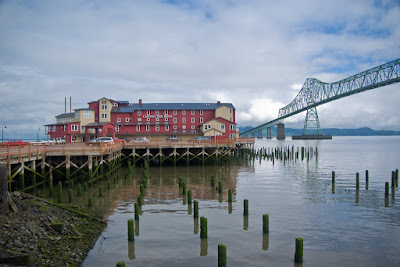
We left Portland in the afternoon and reached Astoria at supper time. There were various chain hotels which would have been fine but we were keeping an eye out for something different. We spotted the Cannery Pier Hotel and decided to check it out.


Their regular rates are pretty steep, but it was off-season and later in the day and they gave us a good deal. And we got a glass of local wine as a welcome drink :-) The room was very nice with a great view of the bay. The "window" from the bedroom into the bathroom overlooking the tub and glass walled shower was a first for me!

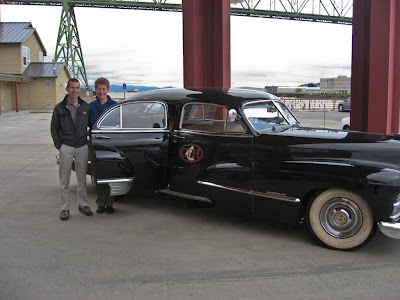
We asked for recommendations for supper. There was a place next door but then we wouldn't have gotten driven to supper in the 1946 Cadillac. So we went to Clemente's downtown. We had a great meal. When we ordered tiramisu (one of my favorites) for dessert they were all out :-( But the waiter came back and said the chef would make something for us and whipped up a tiramisu-like dessert and it was complimentary :-) After supper the chauffeur came back in the Cadillac and took us back to the hotel. Can't beat that!


The next day we drove down the coast, stopping at Cannon Beach (for a walk on the beach), and at Tillamook for a visit to the cheese factory.

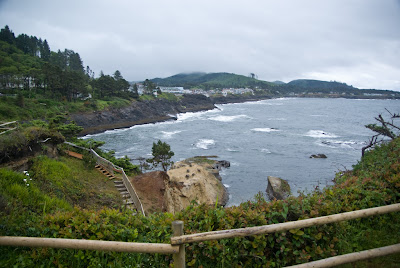
We had asked at the Cannery Pier Hotel for recommendations for places to stay further down the coast and they had suggested the Inn at Arch Rock. It turned out to be an older place but with a great site overlooking the ocean. We stayed here the next two nights.


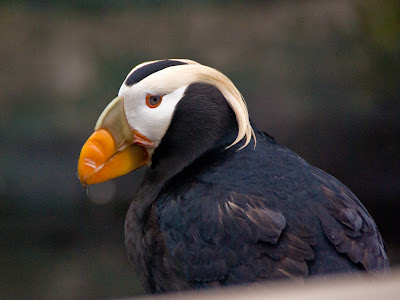
The next day we drove down to Newport and visited the Oregon Coast Aquarium. I think my favorites were the tufted puffins.


In one of the local newspapers we'd seen a review of a restaurant called 44 Degrees not far from where we were staying. On the way by we stopped in to check it out. It's in the Whale Cove Inn a new (very fancy) hotel. We decided to splurge and try it out for our last supper. They serve a fixed seven course dinner. The only choice was the entre. Wine, of course, was extra. Each course was quite small but we were just pleasantly full when we were done. Everything was great. We were glad we went.

However nice fancy hotels and restaurants are, they're also a sign of "development". People talk about the "wild Oregon coast" and maybe parts of it still are, but the majority of it consists of towns, restaurants, hotels, condos, and vacation homes. Every beach we visited was overlooked by buildings. And, depressingly, me being a tourist there just adds to it. Too many people, too much money, not enough concern about the environment. I can't help think we're doomed, or at least the world I'd like to see is. Sorry, that's my lament for today.

The next day we drove back to Portland and flew back to Saskatoon.

I did have one complaint flying back. I've been carrying my travel mug with me on trips to avoid the waste of paper cups. But when we went to the Starbucks in the Portland airport, they refused to use my mug. (It was even a Starbucks mug!) It was some kind of regulation but I'm not sure what the reason was. Maybe it's not sanitary for the staff to handle? (It wasn't a Starbucks regulation, it was something to do with the airport.) In any case it was mildly annoying!

Wednesday, May 28, 2008

Portland

It was a cool, cloudy, rainy day here. I spent the morning at the zoo but didn't take many pictures (and the ones I did take were unusable). Pretty hard to take pictures of moving animals at 1/20 of a second!

I did a little better at the Japanese Garden and the Rose Garden.

Sunday, May 25, 2008

2008 Thrashers Rock Climbing Weekend

Every year the Saskatchewan Section of the Alpine Club of Canada has a beginners rock climbing weekend. This year Shelley and I helped lead the climbing. As usual, we spent our time at Wasootch slabs in Kananaskis. Unusually, the weather was great!

The photos are at: http://picasaweb.google.com/apmckinlay/200805Thrashers

I left in more than usual because everyone likes to see pictures of themselves. (And their kids!)

Thursday, May 08, 2008

Aggressive!

When I was out running today I came across a garter snake on the trail. By itself that's not too unusual. The first unusual thing about this one was that it didn't immediately flee. Instead it formed a rough coil in the middle of the trail and stared at me. I froze to get a good look at it before it took off. It was quite thick, a lot fatter than the other garter snakes I'd seen this spring. My guess is that it's a pregnant female.

When it didn't move I started to edge closer. It continued to stare at me, it's pink tongue with it's black forked tip flicking in and out.

When my shadow crossed over it, it lunged with its mouth open as if to bite. I was still several feet away and it only lunged about 6 inches, so I wasn't in any danger of getting bitten. But it still took me aback. I've seen and handled lots of garter snakes and I've never seen one aggressive like this. Even picking them up I've never had one try to bite me. (Note: they aren't poisonous and they don't have very big teeth so they couldn't hurt much even if they wanted to.)

I didn't want to leave her sitting on the path - too many dogs and people who are scared of snakes. So I edged closer again, hoping she'd head into the bush. But she refused, instead lunging at me again. I picked up a stick and tried to gently encourage her to leave. She lunged at the stick a few times but eventually gave up and slithered away.

I wonder if her aggression was because she was pregnant? (If she was actually pregnant.) But when I was a kid I took home a "fat" garter snake that gave birth a short time later, and it was never aggressive like this. (I returned mother and children to the wild.) Maybe this was just an aggressive individual. In a mammal you might wonder about rabies but I don't think that's a possibility for snakes.

[Sorry, no pictures, I haven't gotten as far as carrying a camera running yet.]

Sunday, April 27, 2008

Flowers at the Mendel

A few days ago when I stopped at Museo for coffee I wandered through the conservatory and I couldn't resist taking a few flower shots. In the past I'd wish I had a camera. Now that I carry the little one pretty much everywhere, I find myself wishing I had the big one!


A Morning at Beaver Creek

This morning looked so nice and sunny that I decided I had to get outside. I grabbed my camera and headed out of town, stopping to pick up a latte and a muffin. It was cool at first, just above freezing, but it warmed up as the morning progressed.

After reading photography books lately, I dug out Shelley's old tripod from the basement. I also figured out how to turn on the exposure warning on the camera display (so areas that are too under or over-exposed blink red).

At first, I didn't find anything to take pictures of. There are no leaves on the trees yet so everything is pretty drab. I was keeping an eye out for spring flowers, but there didn't seem to be any out. There weren't even any buds on the trees to photograph.

I did experiment with exposures a little - the white ice and dark bushes made a good challenge. It took up to three stops of exposure override to get a decent histogram with no blinking exposure warnings. It seems odd that the automatic exposure doesn't handle this better. Occasionally you might want to let part of the picture go black or white, but I would think that would be the exception. Wouldn't the norm be to keep the exposure within range? (like I did with the override) But I'm no expert. As long as I get a feel for when I need to override I'll be ok.

I got the tripod out to take some pictures of the ice. I was quite proud of myself for using the tripod. But at the end of the morning I remembered that you're supposed to turn off the image stabilization when you use a tripod. (I hadn't.) Oh well, can't win 'em all!

I was quite surprised to disturb a garter snake sunning in the grass. It would be warmer in the sun, but considering the air was only a few degrees above freezing, and the ground was still frozen, it's pretty amazing a cold blooded animal could be active. I'm not sure how it would get warm enough in its hole in the ground to move to get out into the sun.

After seeing the one snake I looked for more, but didn't find any. After a while I quit looking. Of course, then I just about stepped on one. This one didn't take off quite so quickly and I managed to get some decent pictures of it. No chance to use a tripod on these shots and with shooting through the bushes and grass I had to manually focus. But a few of them came out ok.

I found the crocuses nearer the river. I did use the tripod for these shots, although it was hard to get low enough with it. I had to override the exposure on most of these as well. Adjusting the exposure when taking the shot definitely made my Lightroom work easier, and ended up with a better result. (I think)

Baja Birds

I finally got around to going through all my bird photos from Baja.


One of the "tricks" to getting good photos is to take lots and pick out the best. The first part is pretty easy with digital - I took almost 1000 bird photos in Baja. But I'm still having trouble with the second part.

I'm reminded of the quote "I have only made this letter rather long because I have not had time to make it shorter." -- Pascal.

I would show you less photos if I had time to narrow them down more. And as well as taking time to narrow them down, it also takes a certain ruthlessness that I still have to work on. Once you've thrown out 90%, there's usually something you like about each of the ones left. And also probably something "wrong" with all of them.

There are still a lot of these that aren't as sharp as I'd like - hand holding a 400mm lens in low light will do that :-( And there's still a lot that aren't properly exposed. Shooting raw and adjusting with Lightroom (or equivalent) helps a lot (thankfully) but it still isn't a replacement for a good exposure originally.

I'm linking to the full size slideshow because I didn't think the smaller embedded slideshow did them justice.

Sunday, April 06, 2008

Baja Pelicans Video

I managed to capture a few video clips of the pelicans dive bombing for fish in the marina in Loreto: QuickTime version

If you have trouble playing this version, try the Flash version (lower quality).

Sunday, March 30, 2008

Beach Time

My continuing annoyance with the noise pollution and the realization that my sojourn here was almost over combined to lead me out of town to camp on the beach. (Plus, I'd feel better if I used the camping gear I'd brought.)

I planned to avoid being out in the heat of the day and to not have to carry a lot of water. I left about 4 pm, still hot but late enough not to have to worry about getting sunburnt. I headed down the beach out of town. Without a car it's hard to really get away from people entirely - there are houses scattered all along the coast around Loreto. And there are spots where vehicles can get to the beach and then drive up and down it.

But still, it was a relief to get away to where the loudest noise was the sound of the waves on the beach. The beach is a mixture of sand and rocks. Huge numbers of shells and shell fragments were mixed in. Dried starfish collected in some spots. There's some garbage, but given all the people, I would have expected to see more.

For some reason there are large numbers of sea slugs washed up on the beach - some still with signs of life, some dead. They varied in size from an inch or two up to seven or eight inches. They were a mottled brown and I couldn't find them in my book of local marine life. I wonder what caused them to be here? I read so much about environmental problems that I wonder if there is some kind of pollution that is killing them. Then again, maybe they die after they have bred as some creatures do.

Other creatures or portions thereof were more or less explicable. Fish heads, tails, and bones were obviously the castoffs from fishermen. A pelican with half a wing missing, the white bones sticking out, was she the victim of a shark? She paddled away. I wondered how long she'd survive like that. A pelican with one wing hung around our hotel in Galapagos, but I suspect it was fed by the staff.

A bat faced ray with a wingspan of 5 or 6 feet had washed up. The skin from the top of it's wings had been removed with straight cuts, the work of someone's knife. A baby shark about 2 feet long lay at the edge of the water intact although missing it's eyes. The victim of fishermen or natural causes? The "hammerhead" from a hammerhead shark lay further up the beach. On one of the islands I'd seen part of a sea turtle shell. Hard to understand why people are still killing these creatures.

I still find the concept of the "marine reserve" here a little strange. Everything is still allowed - sport and commercial fishing. You just have to buy a license. (As you also have to do to snorkel or dive.) I guess the license cost reduces the fishing, especially commercial, but it still seems contrary to my idea of a "reserve". I guess it's a bit like our provincial parks that the hunters would say exist so they have somewhere to hunt.

I took no book to read, no journal to write in, no ipod to listen to. It's been four weeks since I've watched TV. I walked till sunset, made camp, ate a cold snack. I retired with the sun and rose with the sun. Beach time. I woke several times and gazed at the stars. Something yipped off in the distance. It didn't sound like a dog, maybe a fox. There were a few hoots that might have been an owl. It was very peaceful among the cactus. I could hear the quiet murmur of the surf.

I stopped in a hollow enclosed by bush and cactus just back from the beach. It was unlikely anyone would stumble on me here. A few minutes later, in quick succession, three different kinds of birds stopped by to observe me. Seemingly satisfied with my presence they continued on with their business.

I woke just before 6 am. The sky was starting to lighten and I threw on my clothes, grabbed my camera, and headed to the beach to catch the sunrise. There was a bank of fog offshore, hiding most of the islands. The sky gradually turned pink and brightened and finally the disk of the sun appeared through the fog and finally rose above it to start warming the day.

I returned to my hollow to pack up my few things and eat another a meager cold breakfast. My pack was light - I had my smallest tent, sleeping bag, and thermorest, waterbag, and little more. I wandered back along the beach enjoying the quiet early morning. It wasn't quite the end of my trip but it seemed like a fitting finale to my time here.

Saturday, March 29, 2008

Travel Reading

Who are you that wanted only a book to join you in your nonsense?
- Walt Whitman, By Blue Ontario's Shore


I started this trip with Enough: Staying Human in an Engineered Age by Bill McKibben. It seemed like a suitable counterpoint to an emerging technology conference. It's a good read, he's a good author, but as much as I agreed with many of his arguments, I just can't quite swallow his conclusion - that we should "stop" here and not pursue certain technology (e.g. nanotech and human gene manipulation) any further. Part of the problem is that I'm a techie geek - I live for the next great thing. Saying "no more" is about as popular as it would be to a kid in a candy store.

He claims things are "good enough" now. But couldn't/wouldn't people have said that at any time in the past? And likewise would most people want to go back? If not, then presumably they should have been in favor of going forward. Sure, we've cured many diseases, but what if you get one of the diseases we haven't found a cure for. Where that cure may require nanotech or gene manipulation?

There's no question that the future may bring changes that take us so far from what we now are as to be unrecognizable. But is that necessarily bad? Going from stone age jungle villages to a modern city is a huge jump too. And some might argue, not a step forward. But the fact that it's a big jump doesn't necessarily make it "bad".

I read a lot of science fiction and it explores all kinds of possible futures, many of them strange and inhuman. But "bad"? I don't know. Is it possible to say in an absolute sense that one culture is better or worse than another? In a way this theme is also explored in Theroux's book below.

For a change of pace, next I read The Escapement, the third and final book in the Engineer series by K. J. Parker. Although the descriptions talk more about power, politics, ware, and economics, what I liked best were the engineering - pre-computer geekdom. In that sense it reminded me of Neal Stephenson's Baroque Cycle. Although it's classified as "science fiction" it's actually more like "alternate past". There's no magic and no technology that doesn't actually exist. The details of medieval technology are fascinating. I can't vouch for their accuracy but they seem well researched. I also enjoyed K. J. Parker's other Fencer and Scavenger trilogies, but this one is definitely my favorite. It also has an immensely dry sense of humor that I love - enough to make me snort out loud on occasion.

Next up was The Log from the Sea of Cortez by John Steinbeck. This is a non-fiction account of a trip he and Ed Ricketts, a marine biology, made from San Francisco to Baja collecting marine biological specimens. It's a good mix of nature, travel, adventure, and philosophy. I really enjoyed this book and it was great to read it while I was in the area. Here's a sample quote:
A squadron of pelicans crossed our bow, flying low to the waves and acting like a train of pelicans tied together, activated by one nervous system. For they flapped their powerful wings in unison, coasted in unison. It seemed that they tipped a wavetop with their wings now and then, and certainly they flew in the troughs of the waves to save themselves from the wind. They did not look around or change direction. Pelicans seem always to know exactly where they are going. A curious sea-lion came out to look us over, a tawny, crusty old fellow with rakish mustaches and the scars of battle on his shoulders. He crossed our bow too and turned and paralleled our course, trod water, and looked at us. Then, satisfied, he snorted and cut for shore and some sea-lion appointment. They always have them, it's just a matter of getting around to keeping them.
Currently I'm in the middle of three books:

Vagabonding by Rolf Potts was recommended by Timothy Ferriss of The 4-Hour Workweek. It's aimed more at beginning travelers, or at least beginners to off the beaten path, extended travel, but I still enjoyed it. I really liked the quotes at the start of each chapter, many from Walt Whitman, like the one starting this post.

The Happy Isles of Oceania by Paul Theroux. I'm enjoying this, but it's a bit depressing to read about the problems of an area (tropical islands in the Pacific) that we like to think of as paradise. It fits this trip as he's traveling on his own near and on the ocean - as I've been doing.


The Phenomenon of Life Book One by Christoper Alexander. The sub-title is "An Essay on the Art of Building and the Nature of the Universe". Alexander is known to software people as the inspiration for "design patterns" from A Pattern Language and other books on architectural design. He has an interesting thesis and lots of interesting examples, but "the nature of the universe" might be pushing it a little far. It's thought provoking and I like to find parallels with software design. I wonder what I'll think after all four volumes! Here's a quote:
I have come to believe that architecture is so agonizingly disturbed because we - the architects of our time - are struggling with a conception of the world, a world-picture, that essentially makes it impossible to make buildings well. I believe this problem goes so deep that it even makes it extremely difficult to build the most modest, useful building in an ordinary way.

Many of us are not especially aware that our conception of things - our picture of the universe - could have any concrete or immediate effect on activity as architects. We go about our business trying our best to make good buildings - in whatever fashion we understand "good". The task is difficult. We struggle with it. But we are not aware, perhaps, that we have any special picture of the world.
...
How could it possibly be true that this conception might interfere so deeply with our efforts as builders, that it makes it all but impossible to make a building well?
Oops, actually I'm reading a fourth as well The Tenderness of Wolves by Stef Penney (fiction). It's good, but it hasn't really captured my attention so it's going slower than usual.

In case you're wondering how/why I keep that many books going at once - it's my normal procedure. Generally I only read one fiction book at a time, usually reserved for the hour or so before going to sleep. Then I like to have a couple of non-fiction books of different types so I can suit my reading to my mood. I've mostly been reading Alexander over breakfast, Theroux and Potts during the day, and Penney before sleep.

Thursday, March 27, 2008

Around Loreto

Here are some photos of Loreto and area:


click to enlarge / go to the album

Wednesday, March 26, 2008

Life in Loreto

More on life in Loreto.

Last night I had a little trouble finding a place to eat supper. I was a little later than usual and so several places had already filled up. And several of the restaurants (Mandiles, Islas, 1697, Panchmama) are closed on Tuesday's (which probably contributes to the others being busier). I thought I'd try El Taste, which is a chain. It doesn't get great reviews but Shelley and I had eaten lunch at one last year and it was ok. It was quite a pleasant evening outside, but inside El Taste it was stifling and stuffy. I was the only customer. I couldn't imagine sitting in there for any length of time regardless of the food so I walked back out.

I ended up back at Canipoli. I really like this little family run place. The tables are in a quiet shady courtyard with a fountain in the middle. There's even a view of the church tower from some of the tables. One night when it was cool they brought me a blanket. The kitchen is open and you can watch them prepare the meals. So far, a delightful place. But the service really sucks. Two young girls, maybe 12 years old, presumably daughters, wait on the tables. But they also tend bar and since virtually every tourist has to order margarita's they tend to get tied up with making them. You seat yourself, and then wait 15 minutes to get a menu. Then you wait another 20 minutes to order. I watched several groups of tourists get impatient and walk out. One night Shelley and I had ordered a bottle of wine (just the house wine - no choices) and it took about 45 minutes to arrive. It looked like one of the kids eventually ran to the grocery store to get it. Last night the food also took forever. I suspect it sat somewhere forgotten, since it arrived cold. I know what to expect and I take it in stride, but even for Mexico it seems pretty bad. It's worth going, but don't be in a hurry!

On the days that I haven't been diving I've been getting out for a run first thing in the morning while it's still cool. Last time I went for about an hour, north out of town on the road and then back on the beach. The beach is mostly good firm sand, but the soft or rocky parts give you an extra workout. It's great to watch all the birds - gulls, egrets, herons, pelicans, etc. And running along the beach you get to watch for interesting things washed up - puffer fish, sea slugs, shells. Although there are crabs here, even Sally Lightfoot's like in Galapagos, there don't seem to be many along the beach. Eventually I found a few tiny ones under rocks.

After my run I was sitting on the deck on the roof of the hotel cooling off, looking at the ocean and half a dozen dolphins went by in the bay. They were fairly far away but it was still neat to see them.

I went diving again today. Rafael, who runs the dive shop, is determined to reduce the weight I'm using. I started with 24 lbs, then went to 22 lbs, and today 20 lbs. Rafael keeps saying he only needs 16 lbs. (You need so much weight because of the buoyancy of the thick wet suits, but it's ok once you get down because the pressure compresses the wetsuit. Less weight is better once you get down because you don't need as much air in your BCD.) But with 20 lbs I had a heck of a time getting down, even swimming down headfirst. I could feel Rafael pushing me down from above! The problem was at the end of the dive when we did our safety stop at 5m I couldn't stay down. I had to be head down kicking constantly. Rafael ended up giving me his weight belt. He can't understand why I need so much weight. Beats me. I wouldn't be surprised if I was doing something wrong, but I'm not sure what. I was being careful to get all the air out of my BCD which is the usual cause of the problem.

It was a beautiful calm day on the water. Most days even when it starts calm it gets windy and rough by noon, but today it stayed nice and calm.

Ramon, our boat drive driver, always brings his fishing rod and in between dives he fishes. But Rafael says he never catches anything, so we were surprised today when he hooked one. It was a decent size white fish (maybe 2 ft long) but as he was lifting it out of the water the hook came out and the fish swam away. Personally, I was just as happy. Although I eat fish occasionally, I'd much prefer to see them swimming around under water. I think Ramon was pretty annoyed though!

He was also asking me about where I was from and what I did, especially considering I was here for so long. I told him I had a computer software company. He wanted to know if I was the "hefe" (boss), miming this by saluting. I said yes, and his next question was how many employees. He was quite surprised when I said about 50. "You pay them every month? How much?" I gave him a rough figure and I could see his eyes get wider as he calculated the monthly payroll. I don't blame him. I don't like to think about it myself. He wanted to know if they were all working while I was here. I said, of course, they don't need me. He laughed and agreed, of course they don't need you, you're just the hefe. He figured it was a good arrangement for my staff to work and me to travel. I agree :-)

After diving I figure I deserve ice cream. My primary ice cream place was all out after the long weekend, but luckily I have a backup. They're not as generous, but maybe because of that, they had lots of ice cream left. They also sell home made popsicles. I tried a strawberry one the other day - delicious, made with real strawberries, not artificial flavoring.

Tuesday, March 25, 2008

Thoughts from Loreto

I've spent quite a lot of time lately posting photos but I realize I haven't really written much. Pictures are marvelous, but they can only go so far to explain what it's like to be somewhere. And they say very little about what's it's like inside my head.

It seems like a long time since the conference in San Diego. And it seems very different here from there.

The first week here, with Shelley, was a lot like our usual travels. We were keen to fill up our days, to see and do as much as possible in the short week we had. Not that we were rushing around, just that we wanted to take advantage of the time.

After Shelley left, things have slowed down. Other than the diving I've done, I haven't tried to fill up my days. First thing, when it's cool and quiet, a run or a walk on the beach. Then breakfast and a good book. A few hours on the laptop over a latte at the coffee shop. A stop at the bakery and the supermarket. Some quiet time in my cool hotel room during the hottest hours of the day. The wireless doesn't reach my room, which is perhaps a blessing. But I can still download from the cameras and review the photos I've taken. Then back out into the sun, which is the perfect excuse for an ice cream :-) Another couple of hours on the laptop over another latte at the coffee shop. (Luckily it's a different girl in the afternoon so I'm not quite so self-conscious about spending so much time there!) And then it's time to look for somewhere to have supper. Some days it's a Pacifico beer and fish tacos at the Giggling Dolphin, other days it's a classier dinner at 1697 or Panchomama over a glass of wine. Then back to the hotel to read for a while before turning in for the night.

I could be trying to get out of town for a hike in the dessert, which would require some kind of transportation. I could be trying to arrange some sea kayaking. I even brought camping gear so I could go out overnight. But I'm not sure I'll get to any of that. Perhaps it's laziness. But the reason I wanted to stay here for a longer period was to just be here, without trying to do so much. To see what it was like just to live somewhere different. I've traveled lots, but I've never just lived anywhere other than Saskatoon.

Doing some work is part of that. It's not that I have to work. There's nothing that couldn't wait. But my work is part of who I am. No one would find it strange that a painter would want to paint. So why should it be any different for a programmer to want to program? It is different, programming is not as artistically creative. But it's still creating and it still gives me pleasure to accomplish things, as mundane as they might be. So far I haven't accomplished a lot of work - one of the drawbacks of a slower pace! But I've managed a few things.

Loreto is a mixed up place. On one hand it's a 300 year old Mexican town. On the other hand it's a booming area for Americans to buy real estate. It's also somewhat of a tourist destination. The cruise ships even stop here. And the locals aren't examples of some quaint old Mexican culture. They're teenagers with monster trucks with monster sound systems driving up and down the malecon honking their horns and talking on their cell phones. And yet, there is still some old culture around. Still people going to church.

Like everywhere, cars rule. Even the "pedestrian" shopping street allows cars. I'm not sure what qualifies it as a "pedestrian" street. I guess because it's narrow with no sidewalks. Which actually makes it more dangerous for pedestrians than the regular streets.

The street where they should ban cars is the malecon, running along the waterfront. This could be such a peaceful enjoyable place with the boardwalk along the water and the restaurants with views of the ocean. Instead it's a constant stream of cars with their stereos cranked to the maximum level of distortion. Having supper and watching the sunset over the ocean sounds great, but the horrendous racket spoils the scene. And in case you think this is just the teenagers, it's not. Whole families from parents to young kids drive up and down or park to watch their friends drive up and down. But these people aren't looking at the view, they don't need to be on the water front. Give them a street somewhere else, that I don't need to be near. Leave the ocean in peace for those of us who want to walk quietly and watch the sun set.

Nor do they seem to realize that the town square could be much more than it is. There are a couple of restaurants and the Posada de las Flores hotel beside the square, but there's room for shops, more restaurants, a bar, a bakery, ice cream, another coffee shop. Instead there are several buildings that have appeared abandoned since I was here a year ago. The result is that the square languishes somewhat sadly forgotten.

Still, there's lots to enjoy here. The sunshine, the birds singing, the bougainvillea, the ocean, the goofy pelicans, the restaurants and the coffee shop (which wouldn't be here without all the gringos).

Monday, March 24, 2008

Baja Dolphins

I shot some video of a school of dolphins we saw on the way to a dive, using the Canon SD700 IS. (I didn't embed the video here because it's too wide to fit into the blog format.)

There must have been a school of fish they were feeding on since the pelicans were diving for fish as well.

Note: You probably want high speed internet to watch it.

If you're interested you can read about the hassles I had trying to post this video.

Thursday, March 20, 2008

Michael Clark - Adventure Sports Photographer

Check out his web site and his newsletters. Awesome photos, even climbing and adventure racing ones. And a review of the new Nikon D300 that makes me drool (sorry, I can't help being a geek).

Following links from there I found a great video promoting Joe McNally's new book - The Moment it Clicks.

I love the amazing photographs these guys take.

Baja Snorkeling

Shelley and I got out snorkeling three times, to Coronado, Carmen, and Danzante islands. Coronado is the closest and most common snorkeling spot; it's where we snorkeled last year. We were pretty lucky with calm, sunny weather. But there's no avoiding the cold water this time of the year, 16c (60f). It's not too bad with a 7mm wetsuit, hood, boots, and gloves.

It's always hard taking underwater photos. At least snorkeling on a sunny day you have a decent amount of light. Scuba diving, especially in poor visibility leaves little light for photos. My Canon SD700 IS isn't the ideal underwater camera but it's nice to have some photos. Good underwater cameras get pretty expensive.

Adobe Lightroom (or similar software) is almost essential to make the most of the photos you do get. You can improve some photos quite dramatically. Ideally, the shot would be perfect out of the camera, but until I can achieve that, Lightroom is a big help.

I omitted the worst of the fuzzy ones but they're still not all that sharp. But hopefully they give you an idea of the fantastic sea life that abounds here. There's lots more that I didn't get pictures of, often because they move too fast!

Baja only has one coral reef, at Cabo Pulmo. But there are lots of individual soft and hard corals on the rocks.

We used Dolphin Dive Center for snorkeling and diving. Raphael, the manager and dive master, is a great guy. And Ramone, the boat driver, is great too.


As usual, click to enlarge (and then click on "Slideshow" if you want)

Tuesday, March 18, 2008

Baja Whale Watching

Gray whales migrate up and down the west coast from Alaska to Baja. Last time we were here in Baja we didn't get a chance to see them so this time we made a point of it. Loreto, where we stayed, is on the inland side of the Baja peninsula but the gray whales are on the outer Pacific side. We booked through Arturo's for a day trip to Adolfo Lopez Mateos. It's about a 2 hour drive each way. We went out in a small boat for two hours to see the whales. It was a little expensive with just the two of us but it was nice not to have a crowded boat like some we saw.

We had a beautiful sunny, calm day and the whales were fantastic. We were lucky and saw lots of them and took a ton of pictures. Most of them weren't that great but a few were presentable. One problem I had was that the automatic focus had trouble with the water and if it couldn't focus it would refuse to shoot. So half the time I turned off the automatic focus but then I had to guess where they whales would surface to preset the focus. Needless to say, I didn't always guess correctly. You'll notice a number of the pictures aren't very sharp.

The last two pictures are from one of our snorkeling trips. I'm not sure what kind of whale it is. Someone said humpback but I have no idea if that's correct. There are also blue and fin whales in the area. We were lucky to see a blue whale on another snorkeling trip (but no pictures). Pretty cool to see the largest animal ever to live.

Monday, March 17, 2008

San Diego Zoo

The San Diego zoo is one of my favorites. It covers a big area and gives lots of room to the animals. I have never been a big fan of birds in cages but I really like the big aviaries that you walk through. They seem much nicer for the birds. And it's a lot better to take pictures of the birds without a cage in between. The baby panda has only been out for a week or two - it was very cute.


As usual, click to enlarge (and then click on "Slideshow" if you want)

Sunday, March 16, 2008

Last Morning in San Diego

I had one day in San Diego after the end of the conference. I started it by taking the big camera for a walk along the waterfront. I was hoping to find the baby ducks but they were hiding.

There are some interesting sculptures along the waterfront:


As you may have gathered by now, I really like the patterns of reflections in the water:


Another facet of the waterfront are the homeless people. They don't seem to bother anyone and in turn the police don't seem to bother them.

Thursday, March 06, 2008

More San Diego

A few photos walking back to the hotel after a day at the conference.

Tuesday, March 04, 2008

Sunshine on San Diego

This is the view I woke up to, out of my hotel window. What's not to like - sunshine, clear blue sky, water, boats, palm trees. This is from the Holiday Inn on the Bay where I've stayed each time. It's not as fancy (or expensive) as the bigger hotels where ETech is held, but it's nice enough and right on the water. It's about a 20 minute walk to the conference hotel but along the waterfront that's a bonus, not a drawback!


Every time I've been here (this time of year), I can't resist photographing the baby ducks at the pond in Seaport Village. Such cute little balls of fuzz. Sadly, the numbers of ducklings always seems to decline as the days go by. It might be something to do with the cats roaming around.


I stopped for my morning coffee at the Brickyard coffee shop. I discovered this place last time I was here. They have great coffee and snacks and it's quiet.

ETech this year is at the Marriott, pretty fancy. It even has a Starbucks inside for the breaks when they don't provide refreshments.


Of course, at conferences like ETech, you have to be on-line non-stop, even when you're enjoying the sunshine.

Monday, March 03, 2008

Heading to San Diego

I hadn't paid much attention to the times of my flights to San Diego. I assumed it would be the same early morning flights out of Saskatoon that we usually get. Instead I found that I left at 2:30pm and arrived at 11:30pm. I would have preferred to get there earlier, especially since the ETech conference started first thing Monday morning. Oh well, my own fault for not paying more attention.

On Saturday it had been amazingly warm in Saskatoon - melting temperatures. So I figured I'd be fine wearing sandals to travel, my preference instead of confining my feet to shoes for such a long time. But Sunday it was -17c with nasty winds bringing the wind chill to -30c or more. Too late, I'd already packed my shoes in the bottom of my bag. It's a quick trip to the airport.

For some reason they could only check me in as far as Calgary. That seemed a little odd but not unheard of so I didn't think too much of it. I also had aisle seats on all the flights. Shelley would have been happy but I like to sit by the window so I can look out and take pictures. Luckily they could switch my seat.

Of course, I had arrived at the airport early. I'm a belt and suspenders kind of guy. Maybe working with software development has made me more of a believer in Murphy. Not a problem, I'm already switching to "patience is my middle name" travel mode. To avoid leaving a trail of disposable cups I'd brought my travel cup with me and I filled it with a cup of tea to keep me company while I waited for the flight.

When we eventually boarded the walkway to the plane was freezing - I'd left my winter jacket at home. And then the plane was roasting hot, presumably a result of trying to fight the cold air coming in the open door. I sat down in my window seat and was a little horrified to see a large, wide woman drop into the seat beside me. The middle armrest was up and she overflowed into my space. One of the risks of traveling solo. Just as I was resigning myself to a somewhat "cozy" flight I happened to glance up at the row numbers and realized I was, hallelujah, in the wrong row! I apologized and moved ahead one row to sit beside a thankfully more normal sized person.

It was a clear afternoon, blue sky overhead shading to almost white at the horizon with a little haze. The fields were all white with snow in Saskatchewan but as we got closer to Calgary the snow disappeared. I think we flew over Eagle Creek that I kayaked down last spring. I'll have to compare the pictures I took with the map (or Google Earth).


There was enough haze in Calgary that you could just see the tops of the mountains peeking out. We had to walk down the steps of the plane to the ground and then immediately up a set of stairs to the walkway. All we need was a plank and we could have gone straight across. Luckily it was warmer in Calgary.


I got to practice my calm, relaxed, zen travel attitude early in this trip. I went to the United counter to check in and get my boarding passes for the rest of the trip. Although there was no lineup, no one seemed to want to talk to me so I tried the automated check in. But it refused to recognize me. Eventually I got someone to help me. But they couldn't check me in! I was on the passenger list and I had a seat, but for some reason I didn't have a ticket. Huh? How could I have a seat without a ticket? Because of my flights to Mexico next week my ticket had been booked through Aeromexico, although it was Air Canada and United Airlines flights to and from San Diego. Could I contact my travel agent? Not on a Sunday. They phoned Aeromexico but they just said they had nothing to do with the flights in Canada and the United States. Next they phoned Air Canada who told United not to worry about it, just check me in. But the computer wouldn't allow that. Damn computers :-) Eventually Air Canada issued a paper ticket and somehow that allowed United to check me in. I even managed to change to window seats :-)

Unfortunately, Shelley is flying on a similar itinerary next week to meet me in Mexico. Hopefully the travel agent can straighten things out so she doesn't have the same hassles.

By now my bag had been tirelessly circling the conveyer for some time. Customs was pleasantly uncrowded so I was through in no time. There's not a lot of choices for restaurants in the C terminal but there is a Starbucks so I picked up a latte and even managed to snag one of the few big comfy chairs to sit in while I drank it. The sun was shining through the window and I was on my way - life is good.


It was midnight (2am Saskatoon time) when I finally got to the hotel so I pretty much crashed right away.